Last Updated on April 7, 2025
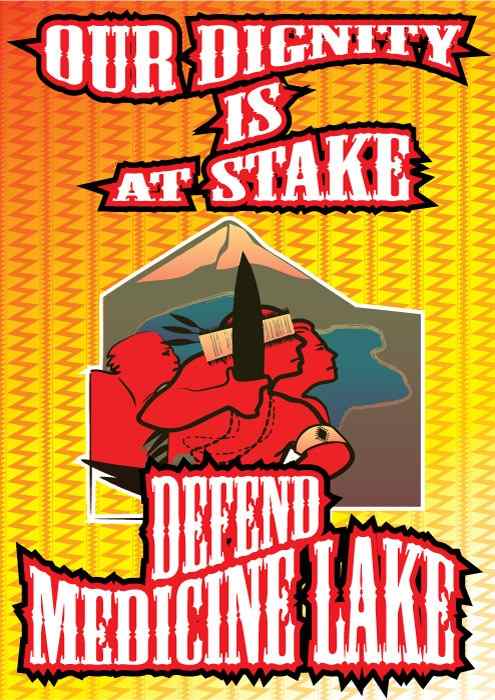
Several weeks ago, members of the Pit River Nation and supporters, planned to deliver an eviction notice to Calpine Energy Corporation, to demand that the company drops its “decades-long attempt to build polluting power plants in the Medicine Lake Highlands tion notice, indigenous, Medicine Lake, protests, Sacred Grounds, Traditions, videonear Mount Shasta…”
Here is the video of Calpine being publicly served:
On 2/21/07 the US Department of Justice (DOJ), acting on behalf of the Bureau of Land Management (BLM) and the Forest Service (FS), requested that the 9th Circuit Court review the issues involving the proposed plans to build geothermal power plants in the Medicine Lake Highlands, a mountainous region held sacred to many Native Nations. In November 2006, a panel of the 9th Circuit unanimously ruled that the agencies not only violated the cultural rights of the Pit River Nation but also failed to uphold provisions of the National Environmental Protection and National Historic Preservation Acts. In their ruling the Court of Appeals found that the above Federal Agencies had never adequately considered whether the Highlands should be developed for energy at all. As a result, the Court rejected the leases that would have allowed Calpine Energy Company to build geothermal plants. (source)tion notice, indigenous, Medicine Lake, protests, Sacred Grounds, Traditions, video
There was another protest on April 6 — see the above link for more info.
Across the world right now, Indigenous peoples are facing a renewed assault on their lands, rights, and ways of life.
From extractive industries pushing deeper into ancestral territories, to governments rolling back hard-won protections,
the threat is global—and it is growing.
What makes this moment especially dangerous is how little attention it receives.
Stories like this are disappearing in real time. Mainstream media
barely covers it and the coverage is fragmented. The public is left without the context
needed to understand what is truly at stake.
That is exactly why IC Magazine exists..
For more than 20 years, IC has reported on Indigenous struggles worldwide — consistently, independently, and without compromise.
We don’t follow news cycles; we trace patterns. We don’t sensationalize; we provide context.
And when the world looks away, we stay focused.
But this work is increasingly difficult to sustain.
We refuse to lock our reporting behind a paywall. We don’t sell access through subscriptions.
And we don’t answer to advertisers. IC Magazine survives solely because readers like you choose to
support independent Indigenous journalism.
Please donate today if you can. Every contribution helps us to continue this crucial work.
Thank you,
John Ahni Schertow
Founder and Editor in Chief