

Last Updated on April 10, 2025
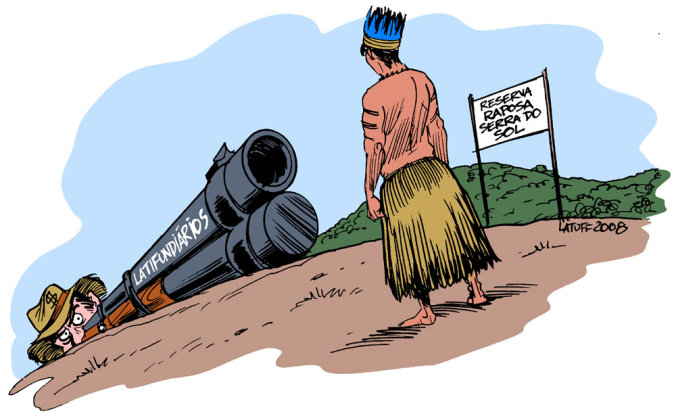
The Supreme Court of Brazil is set to announce it’s decision on the indigenous territory of Raposa Serra do Sol, a legally-recognized Indigenous Territory in the Brazilian state of Roraima.
Home to the Ingarikó, Makuxi, Taurepang, Patamona and Wapixana Peoples, Raposa Serra do Sol has been a site of great controversy due a small group of vigilante rice farmers that have refused to leave the territory, despite being ordered to do so by the government in 2005.
In May of this year, a group of armed guards working for one of the farmers opened fire on a group of Macuxi, injuring At least 10. One month earlier, the farmers barricaded themselves into the indigenous territory, setting up roadblocks and burning at least three bridges to block Brazil’s Federal Police forces from evicting them,. The farmers also threw a home-made bomb into a local Indigenous Leaders home. Fortunately, no one was injured.
The Brazilian Supreme Court was originally scheduled to hand down its rule on August 27, however only on judge, Magistrate Carlos Ayres de Britto, handed down his decision before the court adjourned ‘to gather more information’.
Hopefully Magistrate Britto’s descision is an indication of what we can expect today. A key judge in the case, Britto stated that the reservation must remain intact in order for Brazil to uphold the constitutional rights of the the Makuxi, Wapixana, Ingariko, Taukepang, and Patamona.
Using the Portuguese word ‘esbulho’ (dispossession or unlawful possession) to describe the occupation of the reservation by the non-indigenous farmers, Britto further emphasized that the Indigenous People are in fact the region’s original occupants, and that “territories like Raposa-Serra do Sol which border other countries are not incompatible with national security, as the military have claimed,” notes a press release by Survival International.
Before the Judge handed down his ruling — an indigenous lawyer, Joênia Batista de Carvalho, rose in front of the Judges to defend her people, the first time in the history of Brazil’s that such an event occurred.
Recorded on video, she stated:
“We are accused of being thieves in our own land, of being invaders. We are slandered, we are discriminated against. This must come to an end.
“It falls upon the Federal Supreme Court, this Court, to enforce what we’ve been hearing said for a long time: that traditional indigenous lands go well beyond mere houses.
“Many people do not know that indigenous lands cannot be characterized only by dwellings. They also include areas where people fish, hunt, walk, maintain sacred places, where we maintain spirituality, where our culture is maintained. This is fundamental so that we can guarantee the importance of our land not [only] for today, but for tomorrow also. We want this.”
“Today we are living a truly historic moment in Brazil. The indigenous lands [of] Raposa Serra do Sol are an emblematic case for the whole national territory, and they represent the voice of indigenous peoples.
“This is about enforcing in practice what was promised 20 years ago: our rights of origin, our right to inviolable land rights, our right to live in accordance with our customs and traditions. And so those who define indigenous land are the very indigenous people themselves. I want to remind [you] here, Justices, that what is at play here is the 500 years of colonization. This is what is at play.”
For updates on the case, keep an eye on icmagazine.org, or head over to the facebook group, In Defense of Indigenous Brazil – Raposa Serra do Sol.
Photo: www.sisejuferj.org.br c/o brasil.indymedia.org
Across the world right now, Indigenous peoples are facing a renewed assault on their lands, rights, and ways of life.
From extractive industries pushing deeper into ancestral territories, to governments rolling back hard-won protections,
the threat is global—and it is growing.
What makes this moment especially dangerous is how little attention it receives.
Stories like this are disappearing in real time. Mainstream media
barely covers it and the coverage is fragmented. The public is left without the context
needed to understand what is truly at stake.
That is exactly why IC Magazine exists..
For more than 20 years, IC has reported on Indigenous struggles worldwide — consistently, independently, and without compromise.
We don’t follow news cycles; we trace patterns. We don’t sensationalize; we provide context.
And when the world looks away, we stay focused.
But this work is increasingly difficult to sustain.
We refuse to lock our reporting behind a paywall. We don’t sell access through subscriptions.
And we don’t answer to advertisers. IC Magazine survives solely because readers like you choose to
support independent Indigenous journalism.
Please donate today if you can. Every contribution helps us to continue this crucial work.
Thank you,
John Ahni Schertow
Founder and Editor in Chief


