
Last Updated on August 9, 2016
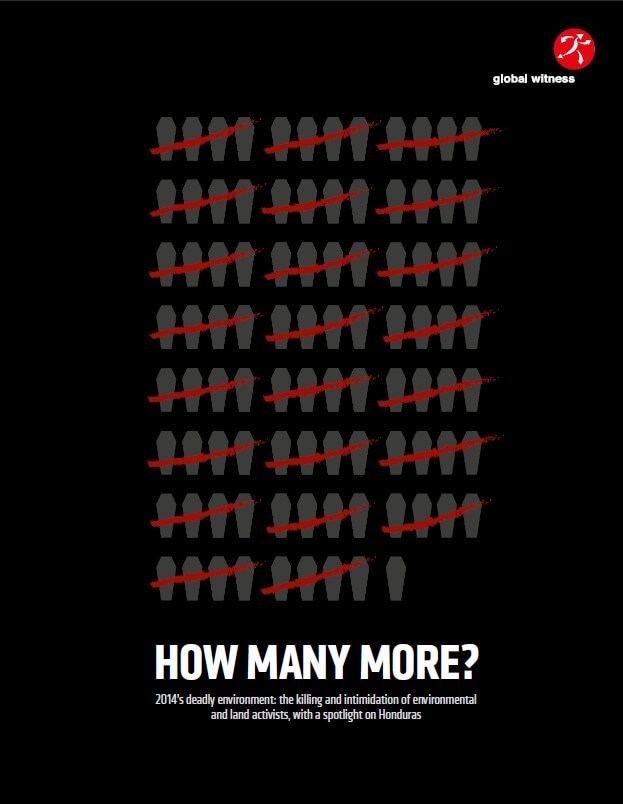
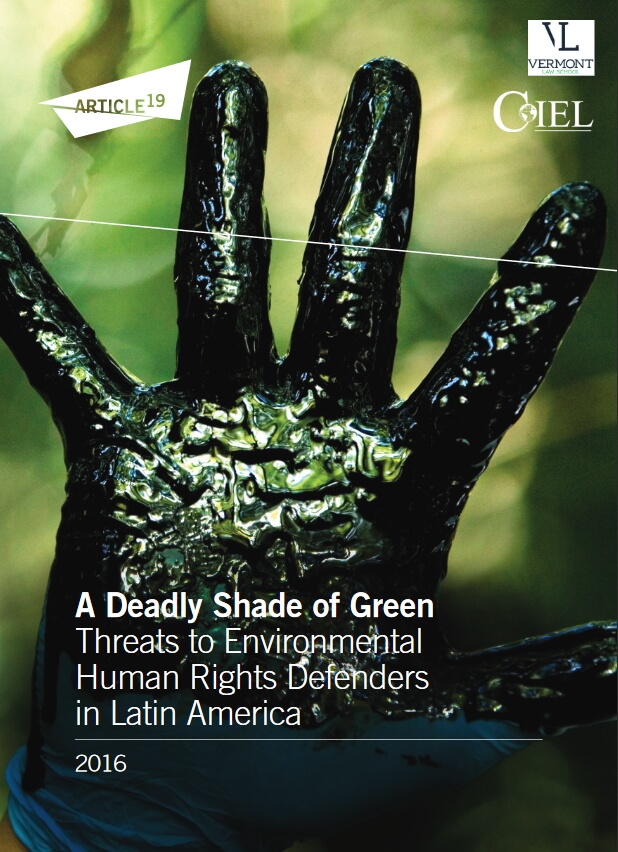
Latin America is, by far, the most dangerous region in the world for environmental human rights defenders (EHRDs). The murder of campaigner Berta Cáceres in March reverberated worldwide, but a new report by ARTICLE 19, CIEL, and Vermont Law School, A Deadly Shade of Green, reveals this to be only the tip of the iceberg, documenting an atmosphere of violence and physical threats, as well as surveillance, spurious charges, and arbitrary detention, across the region.
Key findings include:
“Those with vested interests in the exploitation of land in Latin America employ an armoury of threats to silence dissenting voices, who speak out against business and state interests,” stated Thomas Hughes, Executive Director at ARTICLE 19. “Those who violate the rights of EHRDs often do so with impunity, with state apathy or even complicity, creating a climate of fear and self-censorship. The situation is dire: urgent action is needed to protect defenders, and the environment they fight to protect,” Hughes added.
The report calls for immediate action to end the harassment and murder of human rights defenders, and for accountability for those perpetrating attacks across the region. Resource extraction and development projects must begin only with meaningful, inclusive and participatory consent processes. EHRDs must be empowered with the means to defend their rights. The Regional Agreement on environmental democracy under negotiation in Latin America and the Caribbean must provide effective mechanisms to safeguard the rights of EHRDs.
“The persistent escalation of violent attacks against environmental defenders can and must end,” says Marcos Orellana, Director of the Human Rights & Environment Program at the Center for International Environmental Law (CIEL). “Across Latin America, the systematic persecution of environmental human rights defenders is so pervasive that defending the environment has become synonymous with risking your safety and well-being. Both governments and corporations must be held accountable for their role in attacks against environmental defenders.”
The report is available in English and Spanish.
Media contact:
Amanda Kistler – CIEL: akistler@ciel.org, +1 202-742-5832
Across the world right now, Indigenous peoples are facing a renewed assault on their lands, rights, and ways of life.
From extractive industries pushing deeper into ancestral territories, to governments rolling back hard-won protections,
the threat is global—and it is growing.
What makes this moment especially dangerous is how little attention it receives.
Stories like this are disappearing in real time. Mainstream media
barely covers it and the coverage is fragmented. The public is left without the context
needed to understand what is truly at stake.
That is exactly why IC Magazine exists..
For more than 20 years, IC has reported on Indigenous struggles worldwide — consistently, independently, and without compromise.
We don’t follow news cycles; we trace patterns. We don’t sensationalize; we provide context.
And when the world looks away, we stay focused.
But this work is increasingly difficult to sustain.
We refuse to lock our reporting behind a paywall. We don’t sell access through subscriptions.
And we don’t answer to advertisers. IC Magazine survives solely because readers like you choose to
support independent Indigenous journalism.
Please donate today if you can. Every contribution helps us to continue this crucial work.
Thank you,
John Ahni Schertow
Founder and Editor in Chief