Last Updated on August 3, 2018
Pedro Jiménez Gómez and Juan Jiménez, Adherents of the Zapatista Other Campaign, Are the Latest Political Prisoners in Mexico
By Al Giordano
The Other Journalism with the Other Campaign in Chiapas
September 9, 2006
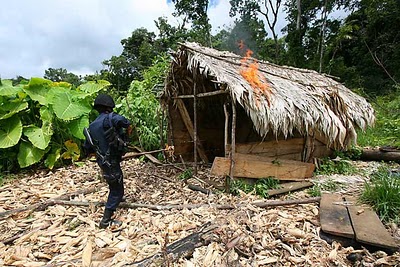
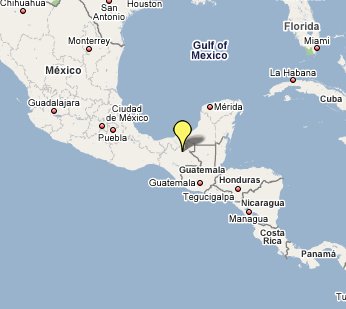
On Friday, Juan Jiménez, 33, and Pedro Jiménez Gómez, 18, armed with gardening rakes, walked out to work the field where they cultivate radishes, cucumbers, carrots and flowers to sell in the markets of San Cristóbal, Chiapas. Agents of the federal attorney general’s office (PGR, in its Spanish initials) seized their rakes and placed the two men under arrest. As of Saturday morning they were still imprisoned in the PGR offices of San Cristóbal de Las Casas.
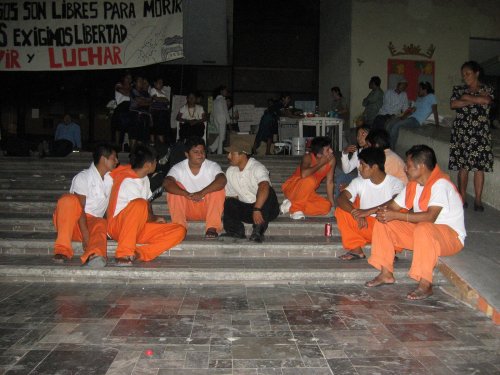
About 80 neighbors and family members from their community, Huitepec Sección 2, kept vigil overnight outside of the PGR building near the entrance to the new federal highway that connects San Cristóbal with the state capital of Tuxtla Gutiérrez. The highway was built through an ecological reserve. Overlooking the highway and the PGR office is the tallest mountain surrounding San Cristóbal, known as Tzontehuitz. Atop the mountain are various telecommunications and media company antennas, also in the Huitepec “ecological reserve.” The reserve includes private property, homes, and government land. According to yesterday’s police action, it is perfectly fine to ram a highway through or keep a microwave tower atop an ecological reserve, but not to plant radishes. Prosecutors demand 20,000 pesos (about $2,000 dollars) bail for the release of the two prisoners, an amount that surpasses their average annual income. They are charged with the crime of “change of land use.”
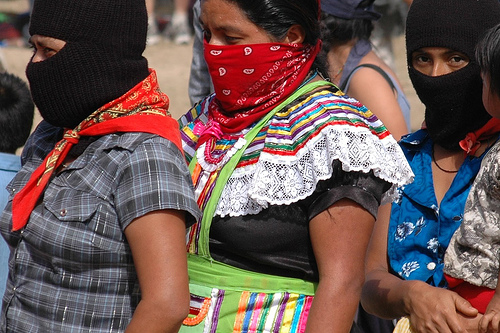
The community that Pedro and Juan belong to is one that counts itself as a civilian “base of support” for the Zapatista Army of National Liberation (EZLN, in its Spanish initials). “This land is ours, from the times of our tata-abuelo,” said one neighbor, using an indigenous Tzotzil-and-Spanish word for great grandfather. “We have always cared for it, cleaned it, and guarded it. Here, we have restored our ancient uses and customs.”
The federal government’s agrarian prosecutor has, as in other communities in Chiapas and elsewhere, fueled land disputes between neighboring towns. In this case, it signed agreements with neighbors from another section of Huitepec, who are not Zapatistas. “We don’t agree with the government’s agrarian policies,” said another of the neighbors, most of whom declined to offer names for fear that what happened to Pedro and Juan could yet happen to them. “They don’t take the indigenous people into account.”
One man did step forward and offered his name: “Pedro Jiménez Gómez is my son, we share the same name.” Speaking in Tzotzil through a translator he said “We would like there to be movement to win their release.”
Also outside the gates of the PGR offices were various adherents of the Zapatista Other Campaign, including a San Cristóbal neighborhood organizer Dámaso Villanueva who had been arrested and imprisoned last February and released on March 3 after an international outcry. Villanueva had been charged, falsely, with toppling the very kind of cell phone company tower that sits atop Tzontehuitz mountain and the ecological reserve. (If federal officials truly were interested in protecting the environment, they would have given Dámaso an environmental award instead of a prison cell.) Villanueva told Narco News that pressure should be brought to bear on the PGR, specifically functionaries Artemio Cruz Cruz and Rodolfo Hernández Limón, to insist on the immediate liberation of Pedro Jiménez Gómez and Juan Jiménez. (The web page of the agency has no staff directory or contact information, although it does have online forms that can be filled out to send messages to unnamed bureaucrats. However, President Vicente Fox’s email address is vicente.fox.quesada@presidencia.gob.mx).
The arrest of the two radish farmers came at an hour when social tumult rocks various regions of Mexico and as hardliners of the Fox regime call for a “tough hand” against protests. Specifically in Chiapas, the arrests signal an escalation in the constant “low intensity warfare” waged against civilian Zapatista supporters. On the very same Friday, 20 hours away, in Morelia, Michoacán, the alleged president-elect of Mexico, Felipe Calderón, was chased from a city square by egg and tomato throwing protestors against the electoral fraud that institutions conducted to hand him a government that millions of Mexicans believe is not his to take. He had to cancel his public act and return to his bunker in Mexico City. By attacking two indigenous Zapatista civilians from Chiapas’ highlands, the state risks awakening action from a region where hundreds of thousands like them also farm their lands.
Meanwhile, even farther north, from San Luis Potosí, a national gathering to free all of Mexico’s political prisoners began on Saturday morning. From there, former political prisoner Italia Méndez (one of 217 arrested May 3 and 4 in and near Atenco) contacted Narco News to inquire on the status of the two new Chiapas political prisoners. “We’re going to take action on it from here,” she said.
source
Across the world right now, Indigenous peoples are facing a renewed assault on their lands, rights, and ways of life.
From extractive industries pushing deeper into ancestral territories, to governments rolling back hard-won protections,
the threat is global—and it is growing.
What makes this moment especially dangerous is how little attention it receives.
Stories like this are disappearing in real time. Mainstream media
barely covers it and the coverage is fragmented. The public is left without the context
needed to understand what is truly at stake.
That is exactly why IC Magazine exists..
For more than 20 years, IC has reported on Indigenous struggles worldwide — consistently, independently, and without compromise.
We don’t follow news cycles; we trace patterns. We don’t sensationalize; we provide context.
And when the world looks away, we stay focused.
But this work is increasingly difficult to sustain.
We refuse to lock our reporting behind a paywall. We don’t sell access through subscriptions.
And we don’t answer to advertisers. IC Magazine survives solely because readers like you choose to
support independent Indigenous journalism.
Please donate today if you can. Every contribution helps us to continue this crucial work.
Thank you,
John Ahni Schertow
Founder and Editor in Chief