
Last Updated on April 10, 2025
Communities and organizations around the Great Lakes received heartening news over the weekend. A plan to ship radioactive waste across the Lakes was officially cancelled after years of community opposition.
Swedish company Studsvik announced that the plan was annulled in its interim report for the first half of 2013.
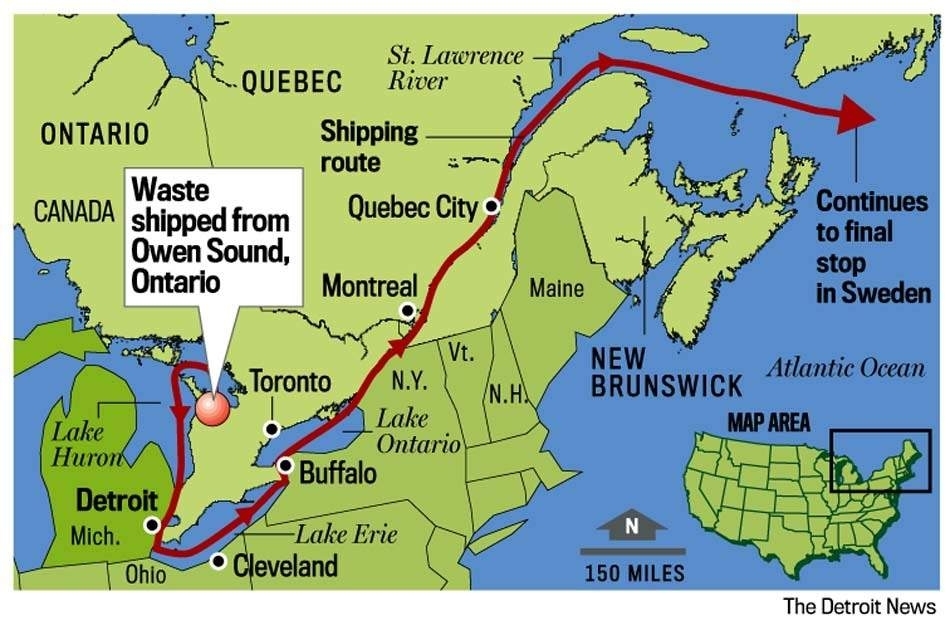
As you may remember, Bruce Power had proposed shipping 16 bus-size radioactive steam generators across the Great Lakes and Atlantic Ocean to Sweden for the nuke waste to be decontaminated.
City mayors, U.S. Senators, environmental and nuclear groups, indigenous communities and other civil society groups raised many important concerns about this shipment including the potential for water contamination and the lack of adequate community consultation. The shipment would have passed through British, Danish and Swedish waters and many European organizations and communities spoke out against the shipments.
This is a huge victory for communities around the Great Lakes and shows what can be achieved when people come together with passion and purpose.
However, the need to protect the Great Lakes from nuclear waste is not over. We need to use this victory as fuel for stopping plans to bury nuclear waste in the Great Lakes Basin. Ontario Power Generation has proposed a plan to bury low and intermediate level waste on the shores of Lake Huron. And there are further plans to find a willing community in Ontario or Saskatchewan that would bear the brunt of a high-level nuke waste site.
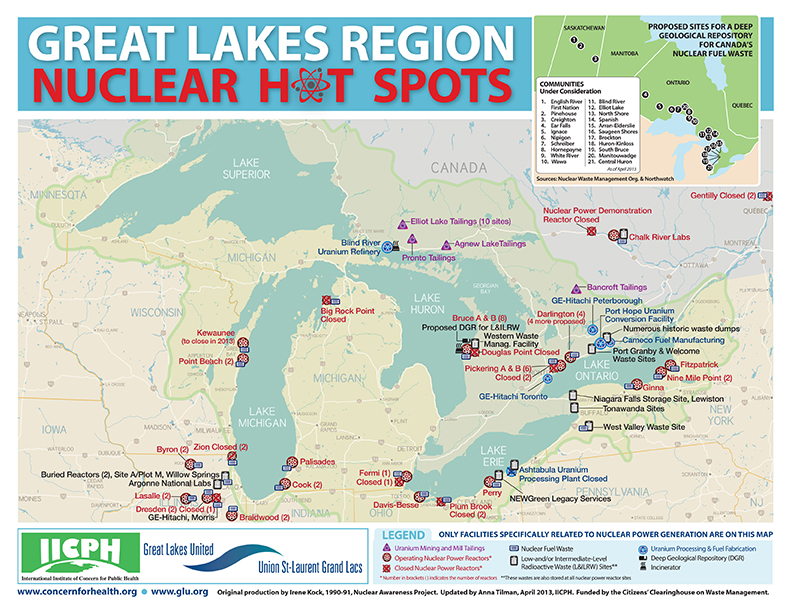
Great Lakes Nuclear Hot Spots Map (Credit: Great Lakes United and the International Institute of Concern for Public Health)
Article Adapted for Intercontinental Cry under a Creative Commons (BY-NC-SA 3.0) license. Originally published at Canadians.org
Across the world right now, Indigenous peoples are facing a renewed assault on their lands, rights, and ways of life.
From extractive industries pushing deeper into ancestral territories, to governments rolling back hard-won protections,
the threat is global—and it is growing.
What makes this moment especially dangerous is how little attention it receives.
Stories like this are disappearing in real time. Mainstream media
barely covers it and the coverage is fragmented. The public is left without the context
needed to understand what is truly at stake.
That is exactly why IC Magazine exists..
For more than 20 years, IC has reported on Indigenous struggles worldwide — consistently, independently, and without compromise.
We don’t follow news cycles; we trace patterns. We don’t sensationalize; we provide context.
And when the world looks away, we stay focused.
But this work is increasingly difficult to sustain.
We refuse to lock our reporting behind a paywall. We don’t sell access through subscriptions.
And we don’t answer to advertisers. IC Magazine survives solely because readers like you choose to
support independent Indigenous journalism.
Please donate today if you can. Every contribution helps us to continue this crucial work.
Thank you,
John Ahni Schertow
Founder and Editor in Chief