Last Updated on January 7, 2026
I grew up hearing stories about the land as a living being, one who remembers the humans who are part of it. But today, my people’s lifeways are threatened by extraction. State-led mining interests clash with Akan land guardianship, revealing the unequal power dynamics behind the language of “development.” But the struggle over Atewa involves more than trees or minerals. It is about the vision of Indigenous governance to guide the future of humanity.
“Atiwa yε abusua dan mu” —the forest is home. Among the Akan peoples, this ancestral saying reminds us that land is not owned but inherited, protected, and passed on.
For generations, the Atewa forest has been deeply intertwined in Akan history, serving as a source of healing, memory, and belonging. Elders tell of the ancestral spirits who inhabit its trees, rivers, and mountains. Yet the Atewa forest now faces mining destruction, with state-backed “development” encroaching on its spirits and its peoples.
For conservationists, the Atewa Forest Reserve is a treasure. Located in eastern Ghana and covering approximately 263 square kilometers, it is recognized as a Globally Significant Biodiversity Area by the Government of Ghana, as well as an Important Bird Area by BirdLife International. It is home to rare and threatened wildlife and plants, and its rivers supply water to Accra. Atewa also supports the lifeways of over fifty forest-edge communities that rely on its water systems, microclimate, and fertile forests for survival. It is, as a Pulitzer report points out, irreplaceable.
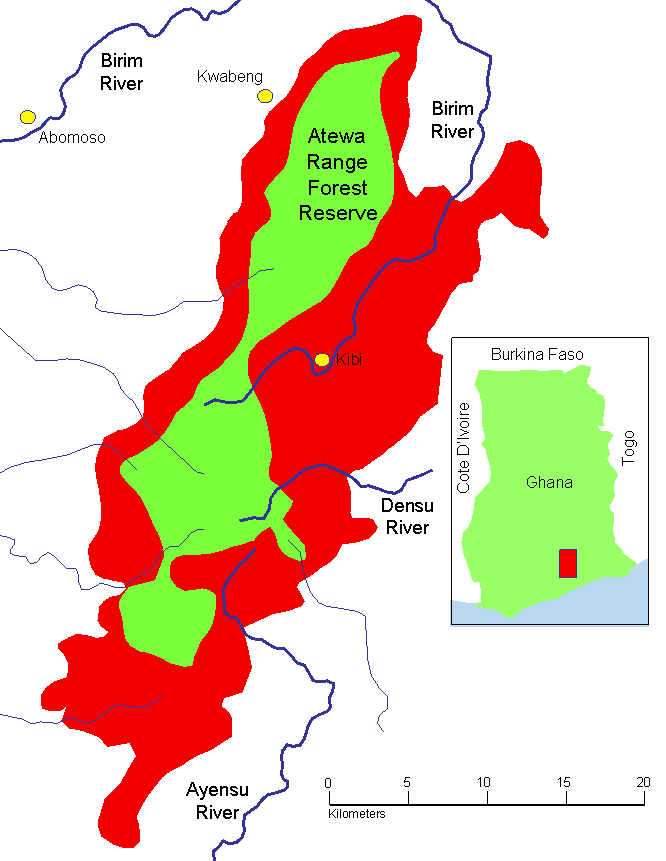
Atewa Range (dark red area) with Forest Reserve (lighter green area)
In Akan cosmology, one cannot think of forests as empty; they exist through the presence of ancestors. The forest is deeply rooted in Akan cosmology and forms part of Akan governance, in which people personify the land as a living being with memory and responsibility. To understand what is at stake in Atewa, one needs to move beyond conservation to listen to Indigenous ways of knowing that frame the forest as an ancestral, spiritual, and community space rather than as resource to generate profit.
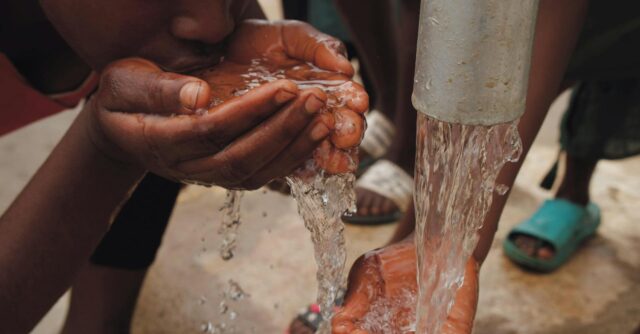
Atewa is where the Birim, Ayensu, and Densu Rivers are born. The three rivers are essential to both biodiversity and traditional practices, providing drinking water for millions of Ghanaians, and holding stories, rituals, and culture.
The forests that feed these rivers are home to over 1,100 plant species, many of which are used in local medicine and crafts, such as mahogany and Baphia pubescens, whose bark and sap have traditional uses in treating ailments and producing natural dyes and woodworking materials, including craft pestles, mortars, and woven baskets. There are endemic species such as the Atewa Dotted Border butterfly and the white-naped mangabey primates.
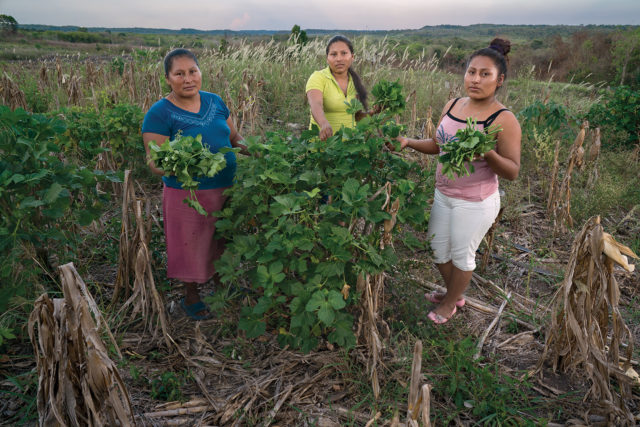
Locals gather forest plants, honey, snails, mushrooms, rattan, and forest fruits. These interwoven ecological and cultural resources show why protecting Atewa’s forests and rivers is critical.
Beyond sustaining life, the rivers also hold deep spiritual significance. The Birim River is believed to be inhabited by the goddess Birim Abena, whose presence is said to govern taboos, rituals, and water protection practices. Atewa has clan totems, sacred groves, and ancestral burial grounds.
Grace Sogbey, the Communications Officer for A Rocha Ghana, describes the forest as “the home of ancestral spirits,” which includes the memory of clans, spiritual places, and the relationship between people and nature, all passed down through generations.
However, as extractivism unfolds in Atewa, the Akan peoples resist by holding their ground day by day. It is a place of community. The Akan, like Amazonian Indigenous peoples, are deeply connected to the forest.
Ghana’s national discourse is framed around economic gains. Governments have repeatedly identified bauxite mining of the Atewa Range as a national priority and a means to achieve so-called development through mineral infrastructure agreements with China.
Mongabay reported that the Ghanaian government hoped to secure multi-billion-dollar infrastructure funding from bauxite extraction. Indeed, the 2018 Master Project Support Agreement (MPSA) deal signed between the Ghanaian government and the Chinese state-owned Sinohydro Corp Limited provides for $2 billion to be repaid in return for 5 percent of the country’s bauxite.
Yet it overlooks the real long-term environmental and cultural costs.
Bauxite mining would permanently deforest the Atewa Forest canopy and topsoil near the headwaters of the Birim, Ayensu, and Densu rivers. The ecological consequences of bauxite extraction directly threaten local and indigenous lifeways.
Emmanuel Tabi, who grew up in the Atewa Forest area and serves as coordinator of the Concerned Citizens of Atewa Landscape, a community-based organization representing approximately 500 members from the 53 surrounding communities of Atewa, emphasizes the urgency of forest protection. According to Tabi, nearly 80 percent of people living in the area depend on agriculture for their survival. The forest plays a critical role in regulating rainfall patterns, and its destruction would severely disrupt farming systems across the region.
Akan resistance to mining in Atewa is sustained political organizing. One prominent example occurred in 2018, when community members and activists undertook a six-day walk from Atewa to Accra to petition the government for a permanent ban on the mining in the forest and demand stronger protection for Atewa.
Ancestral Akan governance has historically guarded trees and rivers, long before colonial rule or modern state governments. Akan law on land ownership is regulated by the Akan Law of Property. The SOAS Repository documents that in Akan states, land, lineage, and politics were inextricably intertwined. Atewa is no mere forest, but a community shaped by inter-species governance.
Akan communities have also formed legal alliances and advocacy with environmental organizations such as A Rocha Ghana, using public campaigns, environmental assessments, and policy engagement to challenge mining proposals and assess land rights.
Resistance to mining of the Atewa has extended beyond Ghana through transnational advocacy, with environmental groups warning that multinational companies like BMW, Tetra Pak, and Schüco should cease purchasing aluminum linked to bauxite extracted from the Atewa forest.
When national media cover Atewa’s story, it often emphasizes the government’s economic interests, highlighting the perspectives of bureaucrats who promise infrastructure and jobs, while downplaying the authority of Indigenous communities. However, local reporting and public accounts describe ongoing public resistance; for example, Ghana Business News notes that residents, environmental groups, and farmers continue to condemn plans to mine in Atewa, framing the issues in terms of threats to water, biodiversity, and community survival. In contrast, The Ghanaian Chronicle described the residents protesting the granting of mining licenses for Atewa, highlighting local fear about water security and environmental degradation.
Meanwhile, Indigenous and local peoples, including A Rocha Ghana, view Atewa as a living heritage, an ancestral and spiritual site to be protected from destruction to prevent irreversible cultural loss.
Sogbey points to the importance of international coverage. “They have focused on issues such as biodiversity, water security, climate change, and global supply chains. Whereas our local media would rather focus on water supply (for over 5 million people), loss of livelihoods, and social-economic justice.”
Many Ghanaians support the venture, expecting it to create jobs, without realizing that an open pit mine would destroy the upper ridges of the forest and have irreversible environmental impacts.
The struggle over Atewa mirrors Indigenous resistance movements worldwide, where Indigenous and local communities resist extraction against national governments despite biased media. When they support anti-extractive struggles, media narratives tend to portray Indigenous peoples as environmental activists rather than autonomous political nations in their own right with a history of self-governance.
The Akan struggle to protect the Atewa Forest against extractivism is not just about stopping a mine. It is about self-determination and remembering who we are in relation to the land and environment. As our elders tell us, “Asaase yɛ duru sen sika”—the land is heavier, and more valuable than gold. The forest has always taught us that real wealth is not what we take from the earth, but what we leave behind for those who will come after us. When we defend Atewa, we are reminded that the future of humanity depends on whether we choose to listen to Indigenous knowledge that knows the earth as a relative, not a resource that must be cared for so that life itself can endure.
This article is a part of Hotspots, a journalistic collaboration between IC, Professor Manuela Picq and her students at Amherst College.
Across the world right now, Indigenous peoples are facing a renewed assault on their lands, rights, and ways of life.
From extractive industries pushing deeper into ancestral territories, to governments rolling back hard-won protections,
the threat is global—and it is growing.
What makes this moment especially dangerous is how little attention it receives.
Stories like this are disappearing in real time. Mainstream media
barely covers it and the coverage is fragmented. The public is left without the context
needed to understand what is truly at stake.
That is exactly why IC Magazine exists..
For more than 20 years, IC has reported on Indigenous struggles worldwide — consistently, independently, and without compromise.
We don’t follow news cycles; we trace patterns. We don’t sensationalize; we provide context.
And when the world looks away, we stay focused.
But this work is increasingly difficult to sustain.
We refuse to lock our reporting behind a paywall. We don’t sell access through subscriptions.
And we don’t answer to advertisers. IC Magazine survives solely because readers like you choose to
support independent Indigenous journalism.
Please donate today if you can. Every contribution helps us to continue this crucial work.
Thank you,
John Ahni Schertow
Founder and Editor in Chief