Last Updated on December 30, 2025
A Naxi herb shop owner in the mountains of LiJiang in northwest China warned of the declining plant knowledge related to linguistic erasure. “They all speak mandarin now,” she lamented. China’s university system requires that all students take a nationally coordinated admission exam in Mandarin, the Gaokao test. “No one speaks our ancestral language anymore, so the names of the mountain plants are disappearing with our language.”
Scholars have documented this precipitous decline. A 2016 study in the village of Baidi documented 173 wild edible plant species that many younger Naxi could barely “identify, gather or process.”
Simultaneously, these plants’ habitats are being destroyed. A recent analysis of rare and endangered plants in Yunnan province shows that the potential habitats of many species are shrinking under climate change and habitat loss.
The two crises of knowledge and habitat loss overlap, but they are not the same.
The government treats the environmental problem of habitat loss as an issue of resource management. But underlying the disappearance of biodiversity is a deeper fracture; the knowledge that sustained it for millennia is disappearing too.
A word at a time. The problem isn’t just ecological. It’s epistemological.
Indigenous traditional knowledge is embedded in plants; except that for China’s government there are no Indigenous peoples anywhere in the country. Everyone is Chinese.
This refusal is rooted in what scholars refer to as the ‘salt-water theory.’ Asian governments argue that ‘indigeneity’ is a concept exclusively applicable to victims of Western settler colonialism: people who crossed salt-water to occupy lands. By framing indigeneity solely as a byproduct of European overseas expansion, China claims that because its citizens are all ‘Asian,’ indigeneity has no relevance within its borders.
China, while a signatory of the United Nations Declaration on the Rights of Indigenous Peoples, does not recognize Indigenous, Tribal, and Native peoples within its borders. Instead, it officially recognizes fifty-six so-called “ethnic groups”. Through this classification system called Minzu Shibie, these communities are acknowledged as minority cultures but not as nations with self-determination and autonomy over their own knowledge.
By translating political difference into cultural variation, Minzu Shibie allows China to display diversity while ensuring containment. To acknowledge indigeneity would imply recognizing territorial rights, ecological stewardship, and most importantly, self-governance outside of Party authority.
Scholar Uradyn Bulag refers to this phenomenon as the “folklorization of sovereignty,” where culture is preserved as performance. The same happens in Finland, where Indigenous peoples are treated as cultures to celebrate diversity in ways that reduces them to artifacts and relics of the past while obscuring their lived governance systems.
The result is the erasure of the political dimension of knowledge itself. Ecological practices and local ontologies cease to function as systems of governance as they are rebranded as “heritage”. Communities like the Naxi become shaoshu minzu (minority nationalities); colorful, folkloric, and depoliticized.
But plant knowledge is not folklore. It is food and health sovereignty; it is knowledge and collective stewardship. It is governance.
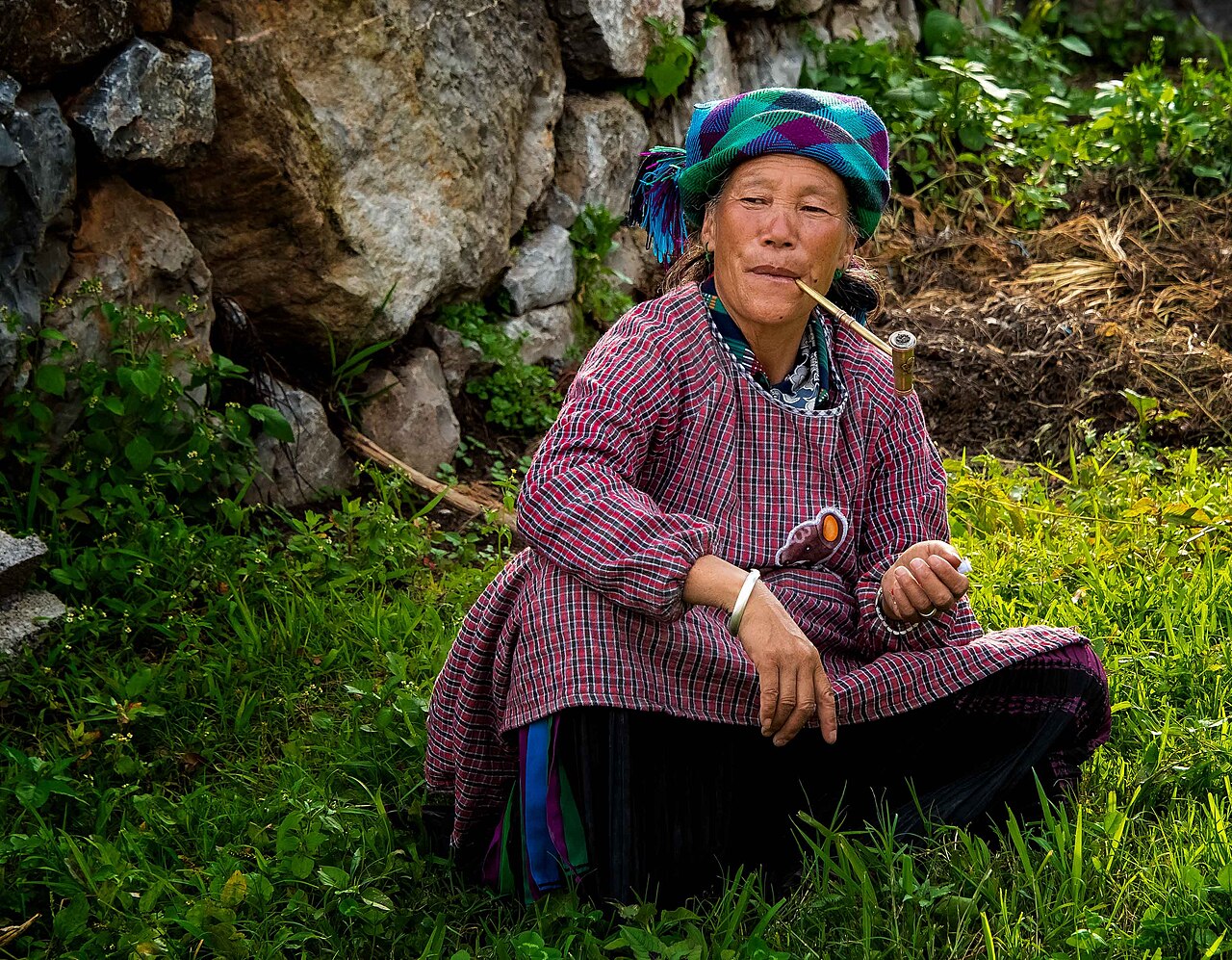
A Naxi Woman in Yunnan. Photo: Rod Waddington on Wikimedia (CC)
The irony is that while the state “celebrates” culture, they simultaneously restrict access to the commons where Dongba ecological knowledge ancestrally functioned.
In 2023, Beijing intensified its “ecological civilization” (生态文明) campaign, an expansive environmental initiative, by designating vast ecological areas as “redline zones” across Yunnan’s alpine valleys. These zones drawn through satellite mapping mark ecologically critical areas where almost all human activity is restricted.
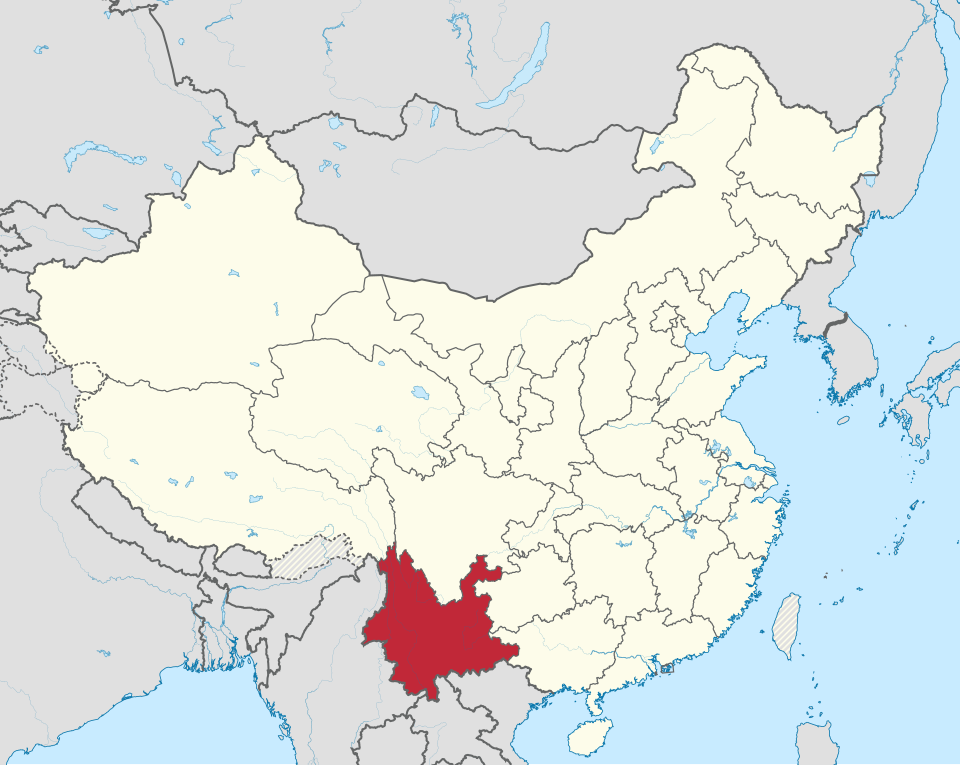
Location of Yunnan in China. Credit: TUBS on Wikimedia (CC)
These redlines overlap the very hillsides that Naxi communities have lived off for centuries. Within the boundaries, gathering herbs is prohibited. Citing the 1996 Regulations on the Protection of Wild Plants, new regulations stipulate that species listed as “national key protected wild plants” cannot be collected without a government permit blocking the Naxi from gathering herbs on communal lands that host dozens of species central to traditional medicine.
Amidst these restrictions, the state inserts its own epistemic infrastructure. Across Yunnan, labs like LiJiang station now propagate endangered herbs in tissue culture and archive plant genetic profiles in DNA banks. The state is effectively ‘mining’ the genetic code while removing the ‘inconvenient’ people who actually sustained it.
Conveniently, these artificially propagated plants are regulatorily compliant and may be sold for food and medicine under Chinese law. It is a system that preserves the material life of species by transferring them into ownership of the state.
This is not unique to Yunnan. Science has been weaponized throughout China as a weapon for displacement. Uyghur scholar activist Reyhan calls this politics, normative inversion; politics in which the state claims moral authorities to justify colonial control. In the same way that Uyghur surveillance is justified as “counter-terrorism“, the restriction of Naxi herb gathering is being framed as “ecological stewardship”.
In this transformation, language plays a critical role. The Naxi language and Dongba script encode relationships between nature and humans. Much is lost in the process of translating them into standardized Mandarin, which strips away contextual logic.
As Naxi scholar Yang Fuquan observes, the Dongba script understands “Man and Nature as two brothers with the same father and different mothers”, where the natural world (“舒”) and humankind (措) once shared a covenant of balance. Yang describes the script’s pictographic grammar as animistic epistemology: a mode of knowing in which trees, clouds, and spirits are interlocutors, and moral order depends on reciprocity with the non-human.

The Naxi written language is the only hieroglyphic language still in use. Photo: Maxdel9 on Wikimedia (CC)
The Dongba manuscripts are manuals for interacting with nature. Rituals encoded within them regulate when to sow or harvest, rest the earth, and how to repay debts (the act of “borrowing” natural resources) owed to the natural world. Yang describes prohibitions against cutting trees “beyond one’s daily demand” and ceremonies held to “repay the debt of a tree”.
A Naxi herb seller told me recently that collecting plant matter is heavily dependent on contextual conditions. Only when two whorls appear following snowfall do locals know that the Chonglou herb, used traditionally as a form of pain relief, has bloomed and is ready to harvest. This ancestral knowledge is self-regulatory, ensuring plants wouldn’t be collected before the roots have “ripened.”
This prevents the next generation of plants from being killed off, creating a practice of regenerative harvesting. A Naxi version of the Native American principle of seven generations.
This is when the “knowledge system” stops being theory and starts being governance.
As the Dongba language and its knowledge systems are phased out, what remains is an extractive framework. LiJiang’s plants are no longer ecological partners but rather resources to be harvested.
This is the real transformation underway in Yunnan. It’s the transfer of authority from communities that stewarded ecosystems across generations through knowledge passed down by language, to institutions that manage them through law and science.
Knowledge is being extracted and the people who maintained it are pushed to the margins.
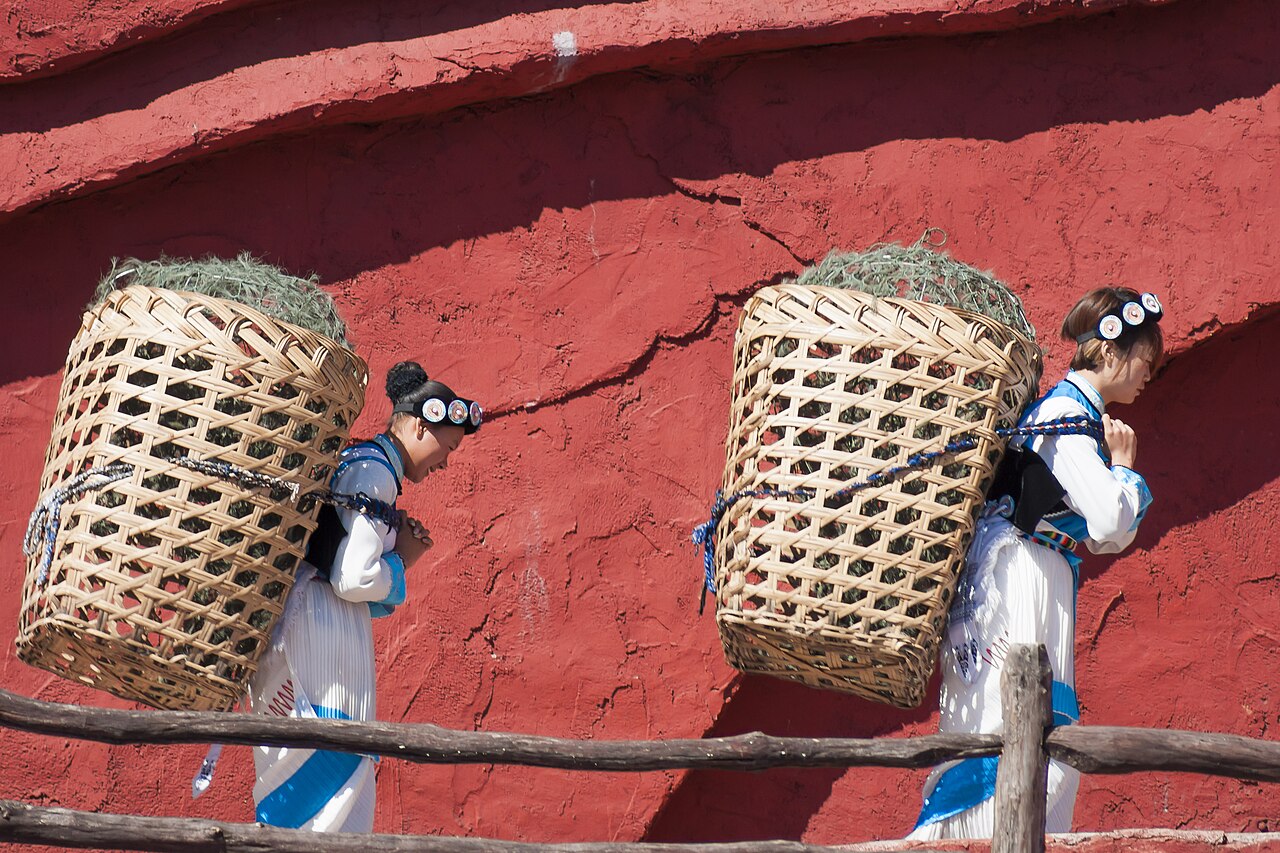
Naxi people carrying baskets during a public performance at the Jade Dragon Snow Mountain Open Air Theatre. Photo by CEphoto, Uwe Arana on Wikimedia.
For most of my life I was an accomplice to this erasure. Growing up, I watched my grandmother sprawl weeds across our kitchen table, dandelion, burdock, and wild onion. I felt a secret pity and embarrassment for her. She would brew dandelion tea, pushing into my hands to drive away the “liang qi” (to drive the cold away). When her back was turned, I would overturn the contents into the sink. To me, my grandma and her knowledge of plants was nothing more than superstition born from the backwardness of China in the 1950s. I believed that when discussing plants, one must strip it of its stories until only the “science” remained.
I didn’t realize that in trying to understand her world through science, I was practicing the same coloniality of knowledge that is currently unfolding in Yunnan’s DNA bank.
This matters far beyond Yunnan. If biodiversity is to be protected, the ancestral knowledge systems sustaining it must be protected too. To replace Indigenous governance with scientific management reenacts colonial logic under the guise of conservation. While the species are preserved, the relationships that once bound people to them and their lands are severed.
The state believes that conservation ends when the Naxi herbs are genetically cataloged, but by ignoring the Naxi peoples it breaks intergenerational knowledge rooted in reciprocity. In this rupture, the state reproduces the colonial illusion that knowledge can exist without community.
This so-called conservation is just occupation by other means.
This is the violence of the laboratory. It doesn’t understand that knowledge is alive and embodied. It wants the tea but not the grandmother. It wants the herb but not the elders. True knowledge is a collective process inseparable from the community. It cannot be preserved on a shelf because its essence lies in autonomy, the power to name oneself and to steward the earth according to a logic that no state can own, or lab replicate.
The state may succeed in cataloging the forest, but it will never understand the tea. For you cannot archive a breath nor chart a way of thinking.
This article is a part of Hotspots, a journalistic collaboration between IC, Professor Manuela Picq and her students at Amherst College.
Across the world right now, Indigenous peoples are facing a renewed assault on their lands, rights, and ways of life.
From extractive industries pushing deeper into ancestral territories, to governments rolling back hard-won protections,
the threat is global—and it is growing.
What makes this moment especially dangerous is how little attention it receives.
Stories like this are disappearing in real time. Mainstream media
barely covers it and the coverage is fragmented. The public is left without the context
needed to understand what is truly at stake.
That is exactly why IC Magazine exists..
For more than 20 years, IC has reported on Indigenous struggles worldwide — consistently, independently, and without compromise.
We don’t follow news cycles; we trace patterns. We don’t sensationalize; we provide context.
And when the world looks away, we stay focused.
But this work is increasingly difficult to sustain.
We refuse to lock our reporting behind a paywall. We don’t sell access through subscriptions.
And we don’t answer to advertisers. IC Magazine survives solely because readers like you choose to
support independent Indigenous journalism.
Please donate today if you can. Every contribution helps us to continue this crucial work.
Thank you,
John Ahni Schertow
Founder and Editor in Chief