
Last Updated on April 10, 2025
“The fires were never a threat to us. It was the state that was the threat.”
In two short sentences Chief Joe Alphonse, Tribal Chair of the Tsilhqot’in National Government, conveyed to a House of Commons committee a central insight of disaster studies. The environment does not create disasters — people do.
In 2017, British Columbia experienced the first of two successive years of record-breaking wildfires. On July 7, following 130 lightning strikes, fires (amplified by climate change) tore through the B.C. interior, consumed 760,000 hectares of Tsilhqot’in territory and engulfed three of six Tsilhqot’in communities.
The provincial wildfire response that followed revealed how people — through policies, practices and laws — leave some communities more vulnerable to disasters. It was a striking example of law’s role in disaster, which I mapped in relation to the 2016 Fort McMurray wildfire. After the 2017 wildfires, I worked with the Tsilhqot’in Nation to document its communities’ experiences with wildfire.
Decades of research has documented that social factors such as race, gender, ability and poverty contribute to the harms suffered during disasters. Laws and policies that continually marginalize people and communities during ordinary times make these same people vulnerable to disaster.
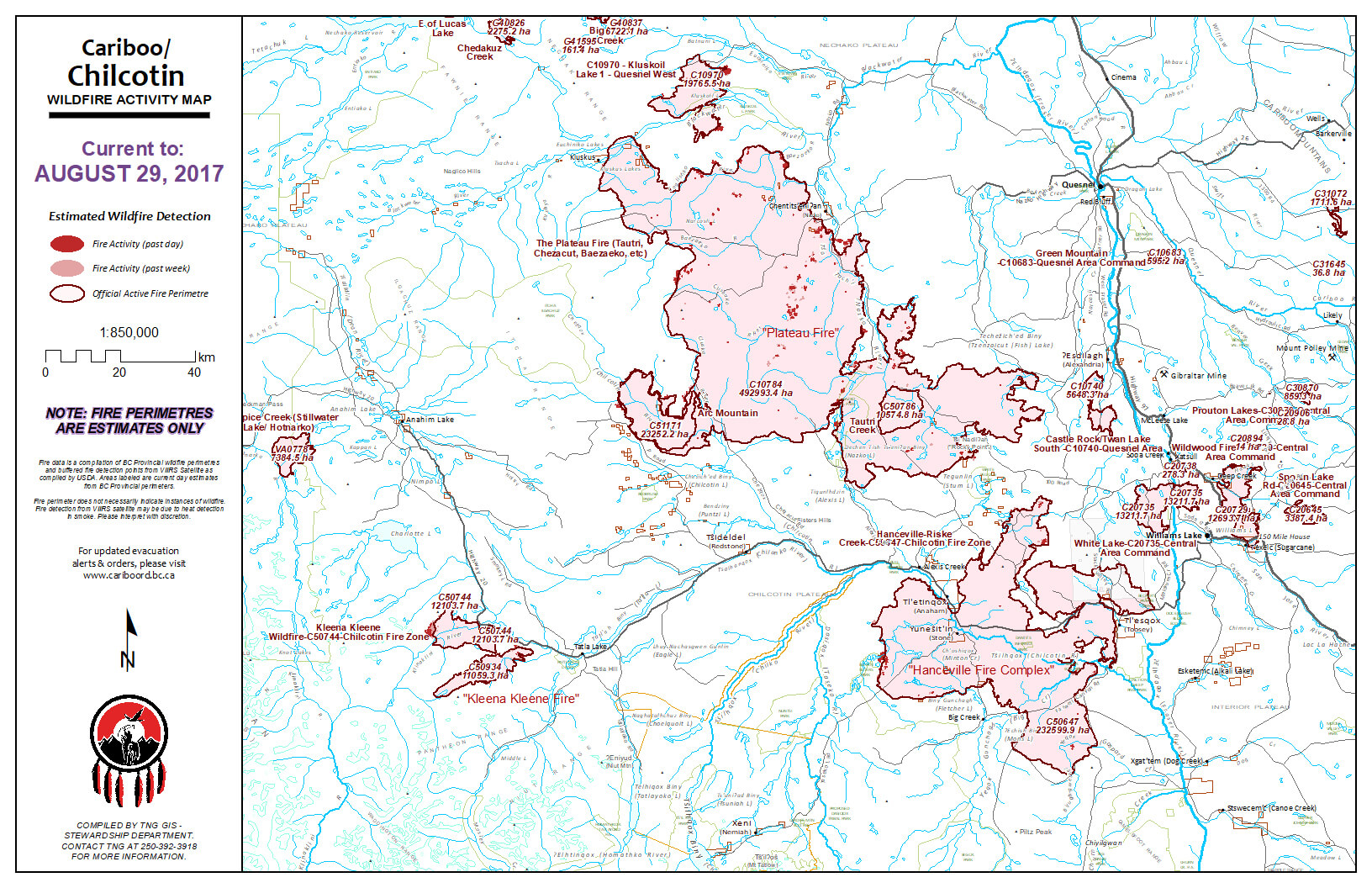
Wildfire map for the Tsilhqot’in territory during the summer of 2017. Tsilhqot’in National Government, Author provided
This theory was tested the summer of 2017 when fires raged through Tsilhqot’in territory. The wildfires revealed the inadequacy of existing laws and the ongoing legacy of colonial policies as key culprits in the vulnerability of the Tsilhqot’in during the wildfire response. Confusion and conflict over legal jurisdiction were central and enduring themes of the wildfire response.
Jurisdiction is fundamental to self-determining Indigenous peoples. It is also fundamental to understanding how multiple levels of government and agencies involved in emergency management work together to keep people safe during a crisis. Jurisdiction answers the question: Who gets to decide?
Who gets to decide when a First Nations community evacuates during an emergency? Tsilhqot’in leadership knew the answer to this vital question. Tsilhqot’in leadership gets to decide, not British Columbia.
And yet, in its recent report on the 2017 wildfires, the Tsilhqot’in Nation documents how federal and provincial officials encountered fundamental questions of jurisdiction for the first time. Lawful emergency decisions in Tsilhqot’in communities were disputed or misinterpreted.
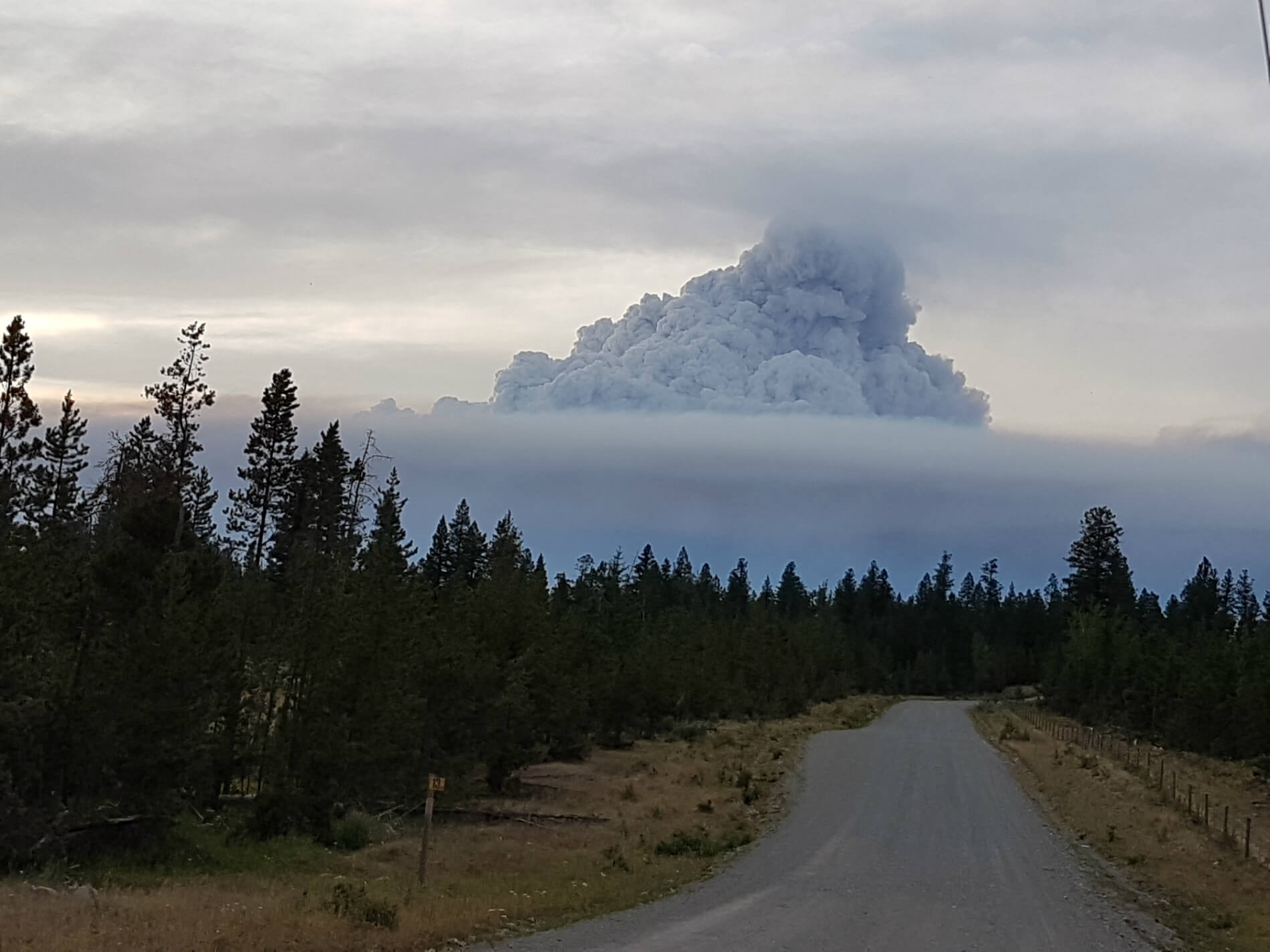
Smoke plumes from wildfires rise above the Tsilhqot’in territory in central British Columbia in 2017. Tsilhqot’in National Government, Author provided
One community, Tl’etinqox, chose not to evacuate despite a provincial evacuation order that covered the surrounding area. After experiencing previous wildfires and culturally inappropriate evacuations led by the province, Tl’etinqox leadership ensured plans were in place to effectively lead its own emergency response.
Under the Constitution, a provincial evacuation order does not apply to First Nations reserves. The community’s lawful decision led to a dramatic stand-off with the RCMP, which threatened to remove the community’s children.
In Yunesit’in, the RCMP misinterpreted the community’s evacuation order. Instead of collaborating with Yunesit’in leaders and staff on a soft evacuation that encouraged people to leave, as required, the RCMP unilaterally enforced an immediate evacuation.
As Tsilhqot’in leaders and citizens worked to contest and clarify ill-informed decisions by emergency responders — such as the enforcement of roadblocks that held up vital supplies to Tsilhqot’in communities — the wildfires burned and communities were left vulnerable.
Confusion and conflict over Indigenous jurisdiction are not limited to emergency response.
Indigenous communities in Canada lie at the intersection of multiple legal systems. Federal and provincial laws intersect with each other as well as with Indigenous laws, governance systems and traditions of the community.
The Truth and Reconciliation Commission recognized the need to reconcile Indigenous and non-Indigenous legal systems through renewed nation-to-nation relationships in its 94 Calls to Action. Like most of those 94 calls to action, this is still a work-in-progress.
The Tsilhqot’in Nation has played a central role in this project with its history-making declaration in 2014 of Aboriginal title, which recognized the Tsilhqot’in as lawful owners of the land under Canadian law, the first of its kind in Canada.
This work of unravelling the respective roles of the Tsilhqot’in Nation, B.C. and Canada in governing the land, water, wildlife and resources in Tsilhqot’in territory is ongoing. But the 2017 fires revealed that there is much, much more work to be done.
Nearly five years after the Tsilhqot’in Nation’s landmark Supreme Court of Canada judgment, the Nation has laid out a detailed path for partnership with B.C. and Canada to ensure that Indigenous jurisdiction is recognized and supported in emergency management.
This partnership would entail government-to-government protocols to ensure recognition of Tsilhqot’in emergency measures and to enable coordination across Tsilhqot’in and non-Tsilhqot’in officials. It would include financial agreements to resolve jurisdictional disputes between the federal and provincial governments over who will reimburse First Nations communities for fire-fighting expenses and other emergency measures. It would ensure Indigenous peoples with recognized legal rights and title have a prominent role in mapping out the rehabilitation work on the land to ensure land, wildlife and communities are protected moving forward.
Canadian constitutional law and Aboriginal law are not likely what comes to mind when identifying the cause of a wildfire disaster. However, they are one of the many ways in which people — not the environment — cause disaster. Reconciling multiple legal orders across a shared landscape is difficult and delicate work, and it is necessary to prevent future disaster.
Across the world right now, Indigenous peoples are facing a renewed assault on their lands, rights, and ways of life.
From extractive industries pushing deeper into ancestral territories, to governments rolling back hard-won protections,
the threat is global—and it is growing.
What makes this moment especially dangerous is how little attention it receives.
Stories like this are disappearing in real time. Mainstream media
barely covers it and the coverage is fragmented. The public is left without the context
needed to understand what is truly at stake.
That is exactly why IC Magazine exists..
For more than 20 years, IC has reported on Indigenous struggles worldwide — consistently, independently, and without compromise.
We don’t follow news cycles; we trace patterns. We don’t sensationalize; we provide context.
And when the world looks away, we stay focused.
But this work is increasingly difficult to sustain.
We refuse to lock our reporting behind a paywall. We don’t sell access through subscriptions.
And we don’t answer to advertisers. IC Magazine survives solely because readers like you choose to
support independent Indigenous journalism.
Please donate today if you can. Every contribution helps us to continue this crucial work.
Thank you,
John Ahni Schertow
Founder and Editor in Chief