Last Updated on February 5, 2014
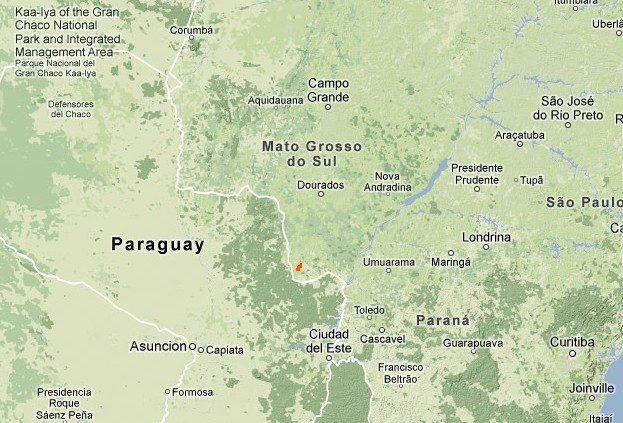
At this time–when we are mourning the loss of Nelson Mandela, a leader and an example for so many people throughout the world–I’d like to take a moment to reflect on the death of another leader across the ocean from him. His name was Ambrósio Vilhalva; he lived in the Guaraní community of Guyra Roká in the Brazilian state of Mato Grosso do Sul; he belonged to the Guaraní Kaiowá people.
Survival International reported the murder of Ambrósio Vilhalva on December 3. He had been brutally killed a couple of days earlier and his body was later found in his own hut. Survival International also reported that Vilhalva had been receiving death threats, a situation all too common for Guaraní indigenous leaders. The Brazilian police later detained Vilhalva’s father-in-law as a suspect; however, he was released without charge shortly thereafter.
The full picture of Vilhalva’s death remains unclear. But it is important to know about it, just as it is important to know about Vilhalva’s life, and what he fought for.
Ambrósio Vilhalva was a spokesman for his people and a leader in his community’s struggle to reclaim their ancestral land. In the words of another Guaraní spokesman,
Ambrósio Vilhalva was also an actor. In 2008 he took part in the Italian-Brazilian film Birdwatchers, at the same time a love story and an attempt to describe the plight of the Guaraní-Kaiowá people and their forest homeland. Produced with significant participation from the Guaraní themselves, and with several Guaraní actors in leading roles, the film drew a very diverse range of reactions, from thoughtful praise to angry criticism. This controversy, however, could be counted as a victory for the film, since one of its goals was precisely to call attention to the situation of the Guaraní.
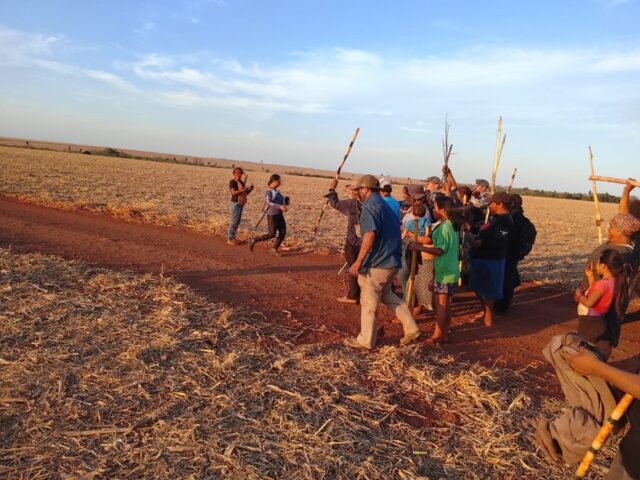
Once the traditional owners of a vast homeland in the modern states of Brazil, Paraguay, Bolivia and Argentina, the Guaraní today, in practice, live as squatters in their own land. In their own tiny reservations, they suffer from overcrowding and appalling poverty. Away from their communities, they are exploited and abused, subjected to all forms of violence, at the same time physical and spiritual. All of this has led to devastating consequences for their society and culture, including a shocking wave of suicides among their young people. These tragedies are what Ambrósio Vilhalva tried to stop, during his lifetime. They are also what led to his death–whoever is responsible for it.
We can only hope that one day, not too long from now, we’ll see Ambrósio Vilhalva’s dream come true–the dream he expressed so well when he said,
Until that day comes, we should also try to help the Guaraní in their struggle as much as we can, and all the other people in this world, indigenous or not, who have to contend with similar troubles.
Correction (12 December, 2013)
This article previously indicated that Vilhalva’s father-in-law was arrested and charged with the murder of Ambrósio; however, it has come to our attention that the Brazilian police only detained Vilhalva’s father-in-law as a suspect. He was then released without charge. The article has been updated to reflect this fact. Thanks to Stephen Corry/Survival International for bringing this to our attention.
Across the world right now, Indigenous peoples are facing a renewed assault on their lands, rights, and ways of life.
From extractive industries pushing deeper into ancestral territories, to governments rolling back hard-won protections,
the threat is global—and it is growing.
What makes this moment especially dangerous is how little attention it receives.
Stories like this are disappearing in real time. Mainstream media
barely covers it and the coverage is fragmented. The public is left without the context
needed to understand what is truly at stake.
That is exactly why IC Magazine exists..
For more than 20 years, IC has reported on Indigenous struggles worldwide — consistently, independently, and without compromise.
We don’t follow news cycles; we trace patterns. We don’t sensationalize; we provide context.
And when the world looks away, we stay focused.
But this work is increasingly difficult to sustain.
We refuse to lock our reporting behind a paywall. We don’t sell access through subscriptions.
And we don’t answer to advertisers. IC Magazine survives solely because readers like you choose to
support independent Indigenous journalism.
Please donate today if you can. Every contribution helps us to continue this crucial work.
Thank you,
John Ahni Schertow
Founder and Editor in Chief