Last Updated on October 1, 2025
A First Nation in Saskatchewan is moving forward with plans to create an Indigenous-led “customs-free trade corridor” that revives centuries-old trade routes, potentially reshaping cross-border commerce.
The Standing Buffalo Dakota Nation says the project would allow goods to move through Dakota territories in Saskatchewan, Alberta, Manitoba and into the U.S. without conventional border inspections or duties. Leaders describe it as both an economic initiative and a reclamation of Indigenous sovereignty.
“That was the wealth of our nation; historically we had that,” Standing Buffalo Chief Roger Redman he told CKOM.
For community leaders, the corridor is a way of making historical knowledge relevant today. As Solomon Cyr, spokesperson for Standing Buffalo Dakota Nation, explained to the National Observer, “We’re operationalizing our old corridors — taking ancient trade routes our elders told us about and articulating them in a modern context.”

Map of Dakota Traditional Territory, Whitecap Dakota First Nation
The idea of Indigenous cross-border trade is not without legal precedent. The Jay Treaty of 1794, signed between the United States and Great Britain, affirmed that Indigenous peoples had the right to “freely pass and repass” the border and “freely carry on trade and commerce” without duties.

The Jay Treaty of 1794 was a peace and trade agreement between the United States and Great Britain that averted war, resolving outstanding issues from the American Revolutionary War.
In the United States, courts have upheld those rights. Indigenous citizens from Canada who can show at least 50 percent Indigenous ancestry are recognized as having the right to live and work in the U.S. without immigration restrictions. This recognition has allowed Haudenosaunee, Anishinaabe, and other nations to maintain cross-border ties.
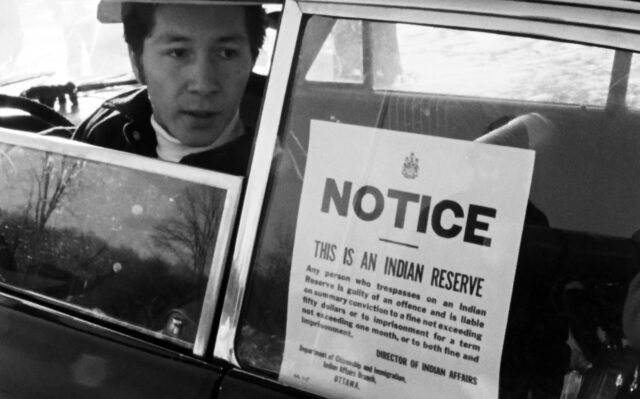
Canada, however, never incorporated the treaty into domestic law. As a result, First Nations people moving goods into Canada remain subject to customs enforcement. This uneven application has led to decades of disputes.
The Mohawk community of Akwesasne, whose territory straddles Quebec, Ontario, and New York, has long been at the center of these conflicts. Residents often face checkpoints, seizures, and legal challenges when transporting tobacco, fuel, or even groceries across the border — despite their view that such movement is protected by treaty rights. In the 1990s and 2000s, Mohawk entrepreneurs were repeatedly prosecuted for tobacco trade, sparking confrontations and reinforcing calls for recognition of Indigenous cross-border commerce.

St Regis Mohawk Tribe (Akwesasne) Territory
Similar disputes have arisen among other Haudenosaunee nations, who maintain that their sovereignty predates and supersedes federal customs regimes. For them, the Jay Treaty is not simply a historical artifact, but a living agreement that affirms Indigenous jurisdiction across borders.
The Standing Buffalo Dakota Nation envisions a trade system that allows goods to move through Indigenous territories without conventional customs checks or duties. Supporters say the corridor could create jobs, expand Indigenous businesses, and foster inter-nation partnerships across North America.
But the plan faces significant obstacles. Customs and trade are regulated by national governments, and international treaties such as NAFTA’s successor, the USMCA, set rules for cross-border commerce. It is highly probable that Ottawa and Washington will see the corridor as a challenge to state sovereignty.
Infrastructure and financing are also unresolved. Building roads, storage facilities, or checkpoints across Indigenous territories would require substantial investment. Federal officials have not yet said whether they would consider exemptions for goods moving along the proposed route.
The trade corridor proposal comes as Indigenous nations across Canada are asserting more control over resource development, infrastructure, and economic planning.
For many Indigenous nations, the trade corridor is more than an entry point into an existing economic system. It is a chance to reshape it altogether.
The Standing Buffalo Dakota Nation says feasibility studies and consultations with other Indigenous nations are planned for the coming months. Leaders hope to build alliances with communities in the U.S. and Mexico, creating a truly continental Indigenous trade network.
Observers note that the future of the project hinges on whether Indigenous leaders can attract political backing and investment while preserving control over its direction. For now, the corridor remains an early-stage vision that could transform the landscape of sovereignty and trade, or stall against the same barriers that have long constrained Indigenous economic autonomy.
Across the world right now, Indigenous peoples are facing a renewed assault on their lands, rights, and ways of life.
From extractive industries pushing deeper into ancestral territories, to governments rolling back hard-won protections,
the threat is global—and it is growing.
What makes this moment especially dangerous is how little attention it receives.
Stories like this are disappearing in real time. Mainstream media
barely covers it and the coverage is fragmented. The public is left without the context
needed to understand what is truly at stake.
That is exactly why IC Magazine exists..
For more than 20 years, IC has reported on Indigenous struggles worldwide — consistently, independently, and without compromise.
We don’t follow news cycles; we trace patterns. We don’t sensationalize; we provide context.
And when the world looks away, we stay focused.
But this work is increasingly difficult to sustain.
We refuse to lock our reporting behind a paywall. We don’t sell access through subscriptions.
And we don’t answer to advertisers. IC Magazine survives solely because readers like you choose to
support independent Indigenous journalism.
Please donate today if you can. Every contribution helps us to continue this crucial work.
Thank you,
John Ahni Schertow
Founder and Editor in Chief