Last Updated on February 24, 2026
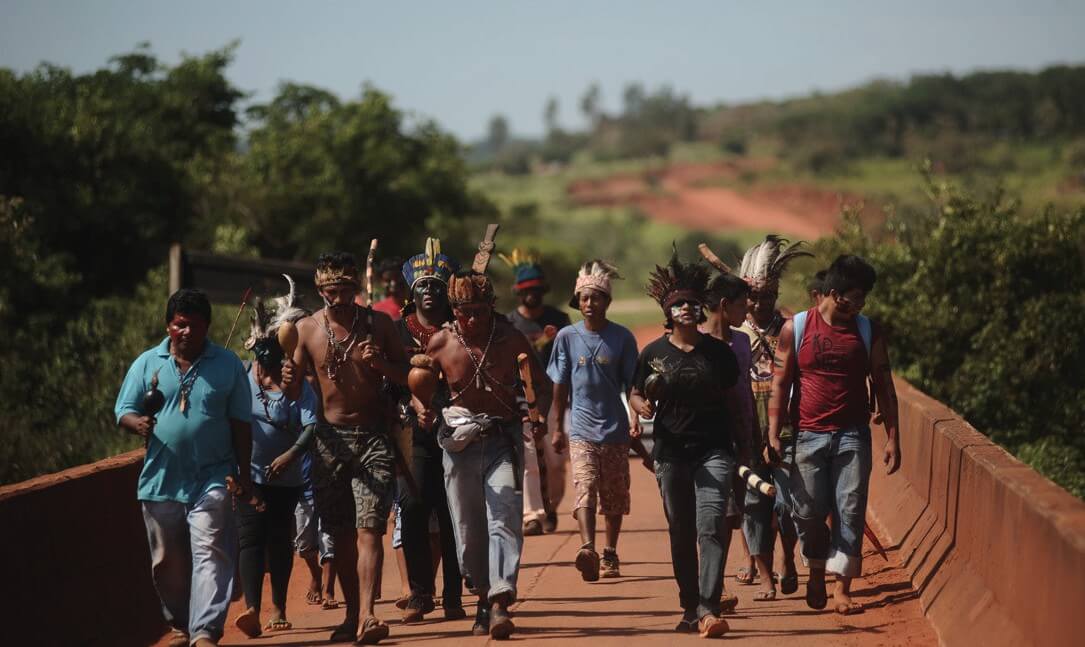
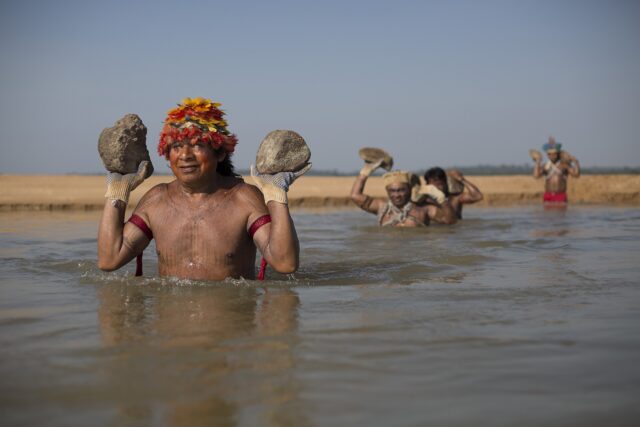
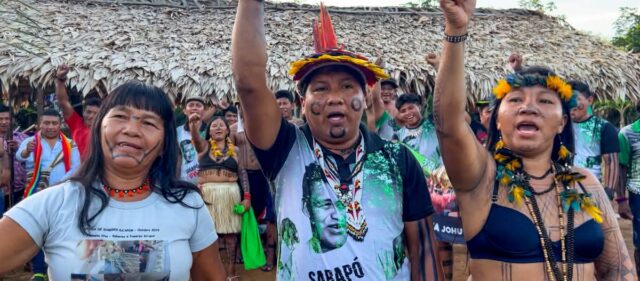
Santarém, Pará, Brazil – On the 13th day blockading Cargill’s grain terminal in Santarém, Indigenous protestors are demanding in-person dialogue with Brazil’s federal government, following its failure to send representatives to a meeting last week. The arrival of dozens of Munduruku representatives from upstream on the Tapajós River bolstered this key demand to be heard and expanded the 700-strong Indigenous blockade prior to a meeting scheduled for today.
The blockade is led by 14 Indigenous peoples from the Lower Tapajós basin and calls for the revocation of Decree 12,600/2025, which incorporates segments on the Tapajós, Madeira, and Tocantins rivers into Brazil’s National Privatization Program (PND). The decree opens the door to converting vital Amazonian rivers into industrial waterways through moves to “maintain navigability” for large barges through highly-polluting dredging operations. Protestors denounce that these measures are being carried out without free, prior, and informed consultation, as required under the International Labor Organization’s Convention 169 (ILO169).
The movement is also challenging a federal maintenance dredging tender for the stretch between Santarém and Itaituba, published on December 23, with a budget of R$ 74.8 million (US$ 14.22 million) over three years.
The arrival of the Munduruku contingent to the Cargill blockade comes amid intensified development of an export logistics complex around the city of Itaituba where traditional communities, such as the Munduruku Praia do Mangue Indigenous Reserve, are based, facing soy ports and silos across the Tapajós River. In the view of Indigenous leaders, a “concession-based waterway” policy and dredging are likely to increase heavy barge traffic, place pressure on fisheries, and pose risks to places of cultural and spiritual significance, all while grain ports continue to be built irregularly along the river.
A survey by Terra de Direitos mapped 41 ports in the planning, construction, or operating stages in Itaituba, Santarém, and Rurópolis – approximately double the number recorded in 2013 – and pointed to recurring gaps in licensing and in consultation with Indigenous peoples and traditional communities. The study also notes that the region’s first cargo port was installed in 2003 by Cargill and describes the predominance of infrastructure aimed at shipping grains and transporting hazardous cargo, increasing risks to the river and to riverine and Indigenous populations.
“This infrastructure that is coming is not meant for us, and it never will be. It is a project of death meant to kill our river and our sacred places. These are projects meant to push Indigenous people out of the way, to push riverine communities out of the way, to push fisherfolk out of the way. The whole world says it is concerned about climate change, but the ones who are truly concerned are those of us who live from the river and the forest. There must be urgent respect and consultation, but a requisite of this consultation must be the revocation of Decree 12,600. The river and the water have a mother, they have spirit, they have history, and because it is our history, many people do not want to do anything,” said Alessandra Korap Munduruku, the Indigenous leader who received the 2023 Goldman Environmental Prize.
In an official statement, Brazil’s Ministry of Indigenous Peoples said the Tapajós is “life, territory, memory,” and recognized the legitimacy of the concerns raised, emphasizing that no dredging activity, waterway maintenance, or project on the river can move forward without the “free, prior, informed, and good-faith consent of directly affected peoples,” in accordance with ILO Convention 169 and Brazil’s constitution, including in-person consultation and tangible security guarantees.
“What is happening on the Tapajós is not an isolated episode: it is the direct consequence of decisions that treat rivers as export corridors and push projects forward without real listening and without rights safeguards. During COP30, more than 500 Indigenous people warned the world about the risks of projects tied to the Ferrogrão export corridor and the dredging of the Tapajós – and still, their demands remain without an effective response. The international community, buyers, and financiers cannot keep normalizing a ‘progress’ that fuels conflict and threatens living territories,” said Vivi Borari, an Indigenous leader and activist in the Tapajós Vivo Movement, a member organization of the Enough Soy Alliance.
“While Cargill tells the press that they have no control over the reckless expansion of export-oriented infrastructure across the Amazon, the opposite is true,” said Christian Poirier, Amazon Watch Program Director. “It is the demands of powerful commodity traders like Cargill that drive the destructive privatization of Amazonian rivers and construction of mega-projects like Ferrogrão. The Indigenous mobilization chose Cargill’s grain terminal for this reason, to hold them accountable alongside sectors of the Brazilian government.”
CONTACTS
Daleth Oliveira at doliveira@amazonwatch.org or +55 91 98247-4410 (Portuguese)
Pedro Charbel at pcharbel@amazonwatch.org or +55 11 97603-5014 (English and Portuguese)
Across the world right now, Indigenous peoples are facing a renewed assault on their lands, rights, and ways of life.
From extractive industries pushing deeper into ancestral territories, to governments rolling back hard-won protections,
the threat is global—and it is growing.
What makes this moment especially dangerous is how little attention it receives.
Stories like this are disappearing in real time. Mainstream media
barely covers it and the coverage is fragmented. The public is left without the context
needed to understand what is truly at stake.
That is exactly why IC Magazine exists..
For more than 20 years, IC has reported on Indigenous struggles worldwide — consistently, independently, and without compromise.
We don’t follow news cycles; we trace patterns. We don’t sensationalize; we provide context.
And when the world looks away, we stay focused.
But this work is increasingly difficult to sustain.
We refuse to lock our reporting behind a paywall. We don’t sell access through subscriptions.
And we don’t answer to advertisers. IC Magazine survives solely because readers like you choose to
support independent Indigenous journalism.
Please donate today if you can. Every contribution helps us to continue this crucial work.
Thank you,
John Ahni Schertow
Founder and Editor in Chief