Last Updated on February 10, 2026
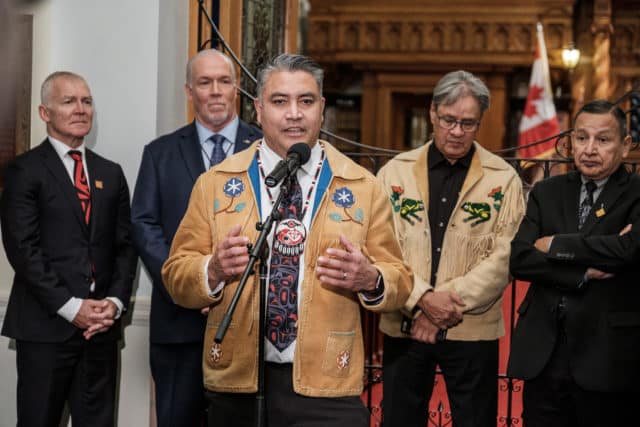
More than 100 First Nations leaders and Indigenous organizations from across British Columbia have united in vocal opposition to proposed changes to the provincial Declaration on the Rights of Indigenous Peoples Act (DRIPA), calling on Premier David Eby to uphold the law as it was originally co-developed with Indigenous communities in 2019.
In a joint statement, the alliance warned that the government’s proposed amendments could erode hard-won progress on reconciliation and lead to increased conflict and litigation. The statement urges B.C.’s political leaders to uphold the original intent of the act and maintain the shared framework of cooperation between First Nations and the government.
The Declaration Act was introduced as Bill 41 in 2019 and was it heralded at the time as landmark legislation. The province said it was the first in Canada to bring the United Nations Declaration on the Rights of Indigenous Peoples (UNDRIP) into domestic law, a move Indigenous leaders characterized as a major step toward collaborative governance and legal recognition of Indigenous rights.
Supporters of the law said it provided a principled pathway for shared decision-making, economic development and reconciliation, and helped build greater trust between Indigenous nations, government, industries and labour groups.
In December, B.C.’s government sent letters to First Nations outlining potential changes to both the Declaration Act and the Interpretation Act, signaling plans to bring the amendments forward during the upcoming spring legislative session. First Nations were invited to an expedited consultation and cooperation process, contingent on leaders signing non-disclosure agreements (NDAs) to receive detailed materials from the province.
This approach has been widely criticized among Indigenous leaders, who say it sidelines meaningful engagement and transparency. They also argue that subjecting consultation to NDAs undermines trust and the spirit of true partnership.
In their joint statement, the First Nations alliance said the provincial government’s actions risk reversing decades of progress and reigniting public contention over Indigenous rights and land stewardship. “The province’s actions risk pulling all who call B.C. home back to a time of blame, conflict, increased litigation, and threats of violence against Indigenous peoples,” the statement said.
Opposition to possible amendments to DRIPA is not isolated. In recent months Indigenous leaders and rights advocates have also publicly criticized Premier Eby’s broader plans to revise the legislation in response to a B.C. Court of Appeal ruling that found parts of the province’s mining tenure system inconsistent with the act. Critics say proposed changes aimed at limiting judicial oversight could weaken legal protections for Indigenous rights.
The debate over DRIPA amendments has also intersected with broader provincial controversies about resource development and consultation. For instance, widespread First Nations opposition greeted Bill 15, fast-track infrastructure legislation, with critics saying it circumvented consultation obligations embedded in reconciliation laws.
Premier Eby has defended his government’s intent to amend the Declaration Act, saying the changes are designed to clarify the law’s scope and ensure reconciliation remains grounded in negotiated partnerships rather than judicial interpretations. However, many Indigenous leaders and advocacy groups maintain that modifying the act under pressure from recent court decisions undermines its purpose and sets a dangerous precedent.
As the legislative session approaches, First Nations leaders are intensifying calls for Premier Eby to halt or rethink the proposed amendments and engage in genuine, transparent consultation — not just expedited processes tied to non-disclosure agreements. The leaders emphasize that strengthening, not weakening, DRIPA will foster the economic certainty and shared prosperity B.C. communities have sought through reconciliation.
Across the world right now, Indigenous peoples are facing a renewed assault on their lands, rights, and ways of life.
From extractive industries pushing deeper into ancestral territories, to governments rolling back hard-won protections,
the threat is global—and it is growing.
What makes this moment especially dangerous is how little attention it receives.
Stories like this are disappearing in real time. Mainstream media
barely covers it and the coverage is fragmented. The public is left without the context
needed to understand what is truly at stake.
That is exactly why IC Magazine exists..
For more than 20 years, IC has reported on Indigenous struggles worldwide — consistently, independently, and without compromise.
We don’t follow news cycles; we trace patterns. We don’t sensationalize; we provide context.
And when the world looks away, we stay focused.
But this work is increasingly difficult to sustain.
We refuse to lock our reporting behind a paywall. We don’t sell access through subscriptions.
And we don’t answer to advertisers. IC Magazine survives solely because readers like you choose to
support independent Indigenous journalism.
Please donate today if you can. Every contribution helps us to continue this crucial work.
Thank you,
John Ahni Schertow
Founder and Editor in Chief