Last Updated on August 4, 2018
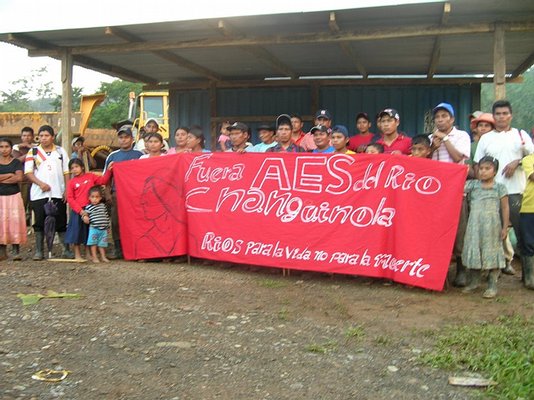
Indigenous Peoples, environmental groups and labor organizations across Panama have turned to the international community for support in their growing nation-wide campaign to defend human rights, enact Indigenous Peoples’ rights and restore environmental protections in the country.
In June, 2010, the Panamanian National Assembly pushed through Law No. 30, a controversial piece of legislation that “eliminates the requirement for environmental impact assessments for government-sponsored development projects, protects the police from prosecution for crimes and human rights abuses that they commit on the job, and limits labor unions’ right to strike,” explains a recent report from Cultural Survival (CS).
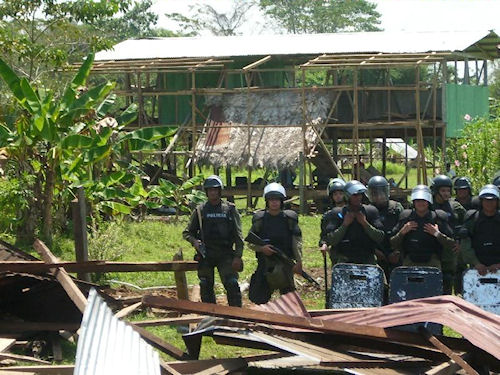
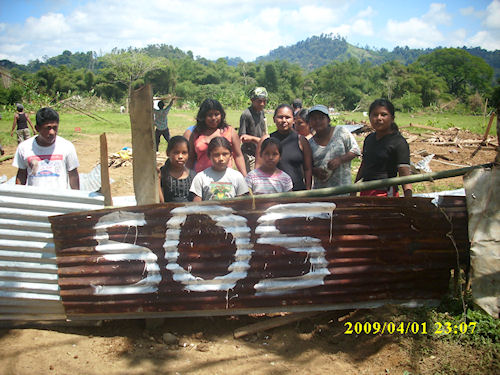
Soon after the law was passed, thousands of protesters took to the streets in Changuinola, to which the government responded “with unprecedented violence, killing at least two protesters, blinding dozens with lead bird shot, and injuring and arresting hundreds more. Indigenous leaders say more people were killed, but the government has not released complete information to human rights investigators,” CS continues.
In addition to Law 30, which has been appropriately named the “chorizo law” by critics (the “sausage law” for what they perceive to be an excess of political pork stuffed into one omnibus piece of legislation”, says a COHA Researcher) two additional laws were forced through, like the sausage law, without any public consultation or the consent of Indigenous Peoples: Law No. 14, which prohibits the act of blocking public thoroughfares during any kind of protest (the penalty for which includes a jail sentence of up to two years); and Executive Decree No. 537, which limits the right of Indigenous Peoples to elect their own leaders according to their own traditions.
Sufficed to say, “Many Panamanians were shocked by passage of these repressive laws. They were equally shocked by the violent police actions against protesters. Civil society organizations are demanding an investigation into killings, beatings, torture, false charges, kidnapping, and cover-ups by the police, and they have requested a special hearing with the Inter-American Commission on Human Rights,” says CS. Unfortunately, there’s a good chance that Panama will simply ignore any recommendations from the IACHR, just as they have consistently ignored the most basic civil and cultural rights of the Ngobe, Bugle, Kuna, Embera, Wounaan, Bribri and Naso Peoples.
And it goes without saying that a massive general strike could erupt at any time, like the one’s we have witnessed in Peru, Honduras, Ecuador, Colombia, Brazil and elsewhere around the world. And like in the cases of Peru and Honduras, it is feared that Panama’s government will respond with unrestrained violence.
To prevent this from happening–and help restore environmental protections, defend human rights and compel the government to respect the rights of indigenous Peoples–please show your support for Panama.
As a starting point, Cultural Survival has initiated a letter writing campaign to urge President Ricardo Martinelli to Revoke the Laws!
More actions and campaigns will be posted as they become available
Across the world right now, Indigenous peoples are facing a renewed assault on their lands, rights, and ways of life.
From extractive industries pushing deeper into ancestral territories, to governments rolling back hard-won protections,
the threat is global—and it is growing.
What makes this moment especially dangerous is how little attention it receives.
Stories like this are disappearing in real time. Mainstream media
barely covers it and the coverage is fragmented. The public is left without the context
needed to understand what is truly at stake.
That is exactly why IC Magazine exists..
For more than 20 years, IC has reported on Indigenous struggles worldwide — consistently, independently, and without compromise.
We don’t follow news cycles; we trace patterns. We don’t sensationalize; we provide context.
And when the world looks away, we stay focused.
But this work is increasingly difficult to sustain.
We refuse to lock our reporting behind a paywall. We don’t sell access through subscriptions.
And we don’t answer to advertisers. IC Magazine survives solely because readers like you choose to
support independent Indigenous journalism.
Please donate today if you can. Every contribution helps us to continue this crucial work.
Thank you,
John Ahni Schertow
Founder and Editor in Chief