Last Updated on June 18, 2014
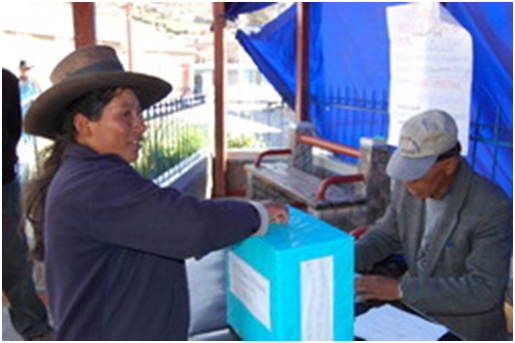
A popular consultation (referendum) was held in Peru last week, drawing out some 7500 people from the Province of Candarave to vote on whether or not they would support the initiation of new mining activities in the region—and if they would agree to the use of underground water resources for those mining activities.
Despite an effort by one mining company (Southern Copper,a subsidiary of Grupo Mexico) to illicit a YES vote, the People of Candarave made their voice abundantly clear. 90 percent of the participants voted “NO” to both questions…
While some may have bought into the propaganda, Southern Copper should have known better than to challenge what stands so vividly in everyone’s memory. For years, People in Candarave have been suffering because of the exploitation and contamination of their water supplies by mining. According to Ordonez Salazar, President of the regional government of Tacna, it has caused 80% of the social problems that exist today. “In Candarave, as in the rest of the country, the combination of water and mining just doesn’t work, it has created more and more crisis and problems.”
For instance, it was pointed out in a discussion after the referendum that water exploitation has caused the production of alfalfa per hectare to fall from 30,000 kilograms to 11,234 between 1998 and 2006. At the same time, oregano production fell from 16,071 to 4,000 kilograms per hectare.
On top of that, plummeting water levels in natural reserves such as Súchez has caused the loss of 27 thousand hectares of pastures and wetlands in Huaytire and Vizcachas.
“These figures clearly reflect how Southern Copper has been damaging the agriculture in Candarave,” said Mario Copa Conde, the Mayor of Tacna.
This is the very reason the referendum was called in the first place, though it was also to give those who continue to suffer daily water shortages a chance to speak their voice. Now that they have done so, there will be some effort to make outcome of the referendum into a formal ruling.
Across the world right now, Indigenous peoples are facing a renewed assault on their lands, rights, and ways of life.
From extractive industries pushing deeper into ancestral territories, to governments rolling back hard-won protections,
the threat is global—and it is growing.
What makes this moment especially dangerous is how little attention it receives.
Stories like this are disappearing in real time. Mainstream media
barely covers it and the coverage is fragmented. The public is left without the context
needed to understand what is truly at stake.
That is exactly why IC Magazine exists..
For more than 20 years, IC has reported on Indigenous struggles worldwide — consistently, independently, and without compromise.
We don’t follow news cycles; we trace patterns. We don’t sensationalize; we provide context.
And when the world looks away, we stay focused.
But this work is increasingly difficult to sustain.
We refuse to lock our reporting behind a paywall. We don’t sell access through subscriptions.
And we don’t answer to advertisers. IC Magazine survives solely because readers like you choose to
support independent Indigenous journalism.
Please donate today if you can. Every contribution helps us to continue this crucial work.
Thank you,
John Ahni Schertow
Founder and Editor in Chief