Last Updated on March 13, 2013
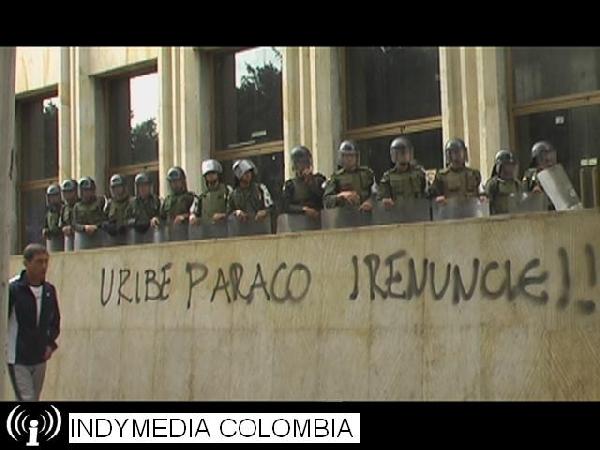
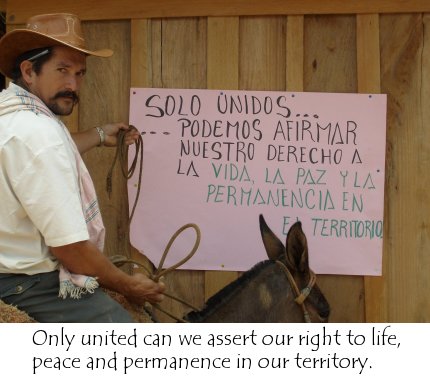
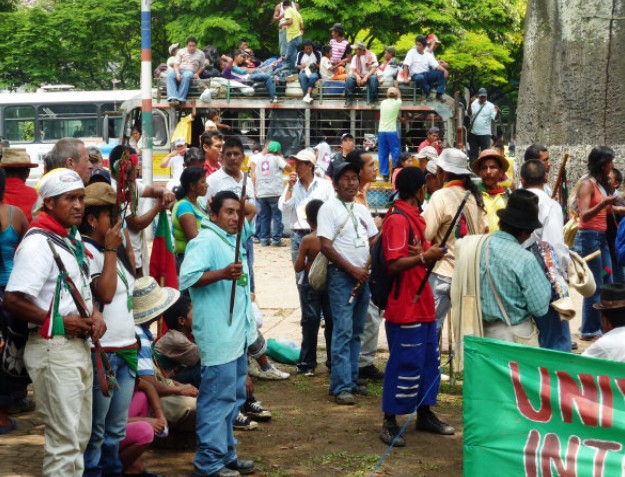
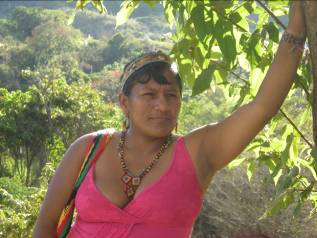
On October 10, 2007, thousands of indigenous People, farmers, unionists, teachers, students, and activists demonstrated throughout Colombia as part of the National Popular and Agrarian Mobilization, a day of action that was first called on by the Campesino Association of the Cimitarra Valley (ACVC), shortly after the Sept. 29 detention of four ACVC leaders.
Over a dozen actions were organized throughout Colombia, mobilizing upwards of 20,000 people– some getting started on October 9, and others continuing through the days ahead. Fortunately, the state didn’t intervene or try to supress many of the actions.
In Cundinamarca, 15 peasant families marched to a farm located in the village of La Victoria, as an act of reclaiming the land that was taken from them; and in Barrancabermeja, around 200 farmers gathered to participate in a workshop conducted by the corporation AVRE, during which they addressed issues about the political violence that’s occurred in the region in recent years.
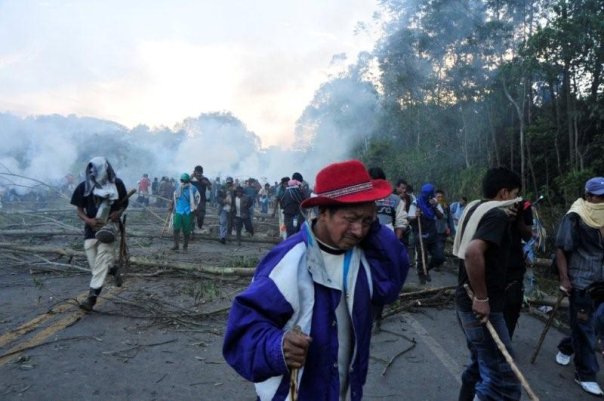
The demonstration in Cacua however, was not so calm. In the municipality of Mondomo, more than 3000 People marched, successfully blockading the Panamerican highway until Police and Security forces arrived to break it up. According to the Associated Press, they arrested eight and injured at least three other protesters.
Finally, despite considerable state effort to prevent it, over 20,000 People gathered in Ibagué, effectively putting ‘regular city life’ into a state of shock.
Consistently throughout these and other events–which includes actions in the districts of Putomayo, Narino, and Valle– and despite the considerable demobilization efforts of the government leading up to October 10, the People successfully planted a seed in Colombia–creating a public, national demand for the resignation of President Alvaro Uribe Velez, the repeal of the legislative package that threatens Colombia’s agrarian reform program, and the discarding of the pending free trade agreement with the United States
We can only hope this seed will be nurtured and protected so it may flourish in the months and years ahead. It simply must.
For more information, you can head over to prensarural.org (Spanish/English) and colombia.indymedia.org (Spanish only)
http://colombia.indymedia.org/news/2007/10/73065.php
Across the world right now, Indigenous peoples are facing a renewed assault on their lands, rights, and ways of life.
From extractive industries pushing deeper into ancestral territories, to governments rolling back hard-won protections,
the threat is global—and it is growing.
What makes this moment especially dangerous is how little attention it receives.
Stories like this are disappearing in real time. Mainstream media
barely covers it and the coverage is fragmented. The public is left without the context
needed to understand what is truly at stake.
That is exactly why IC Magazine exists..
For more than 20 years, IC has reported on Indigenous struggles worldwide — consistently, independently, and without compromise.
We don’t follow news cycles; we trace patterns. We don’t sensationalize; we provide context.
And when the world looks away, we stay focused.
But this work is increasingly difficult to sustain.
We refuse to lock our reporting behind a paywall. We don’t sell access through subscriptions.
And we don’t answer to advertisers. IC Magazine survives solely because readers like you choose to
support independent Indigenous journalism.
Please donate today if you can. Every contribution helps us to continue this crucial work.
Thank you,
John Ahni Schertow
Founder and Editor in Chief