
Last Updated on April 15, 2014
Allegany Territory, Salamanca, NY – The Seneca Nation of Indians has unanimously approved a policy ensuring that new landscape planting in public spaces on Seneca lands will be exclusively comprised of local indigenous species. This new policy also encourages private Seneca landholders to choose local North American flora in their planting decisions.
It has long been recognized that continued planting of non-native species poses a significant threat to ecosystems and causes harm to the environment. The current Seneca Nation Council is committed to restoring, preserving, and maintaining local indigenous plants that are significant to the culture of the Seneca people and that help to maintain the balance of nature.
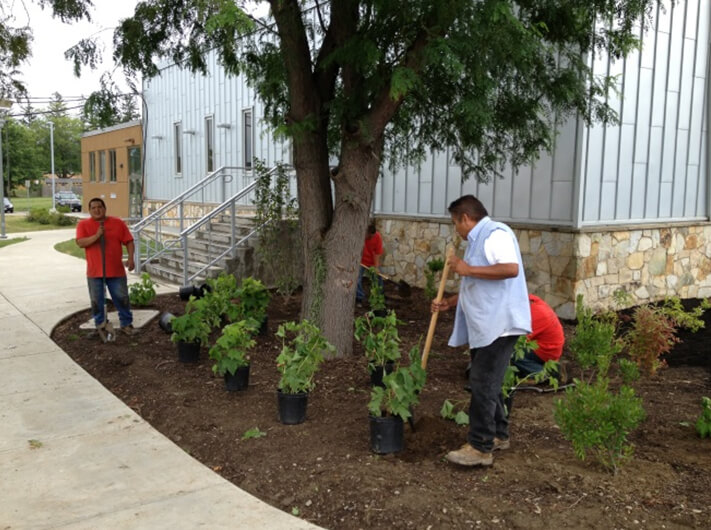
The new planting policy puts an official stamp on the Seneca Nation’s ongoing efforts to reintroduce Native species to Seneca territories. To date, over 445 native trees and shrubs have been planted and 25 different species re-introduced into the public landscape, including edible and medicinal culturally significant plants.
Although the new policy applies exclusively to plants in public spaces, owners of private property at the Seneca Nation are highly encouraged to reintroduce Native species and to remove invasive and introduced Eurasian plants.
This policy is applauded by Dr. Jeremy Pinto, Research Plant Physiologist and Tribal Nursery Specialist with the Forest Service of the US Department of Agriculture, who states: “While it should be well-ingrained in us to preserve and promote the plants that are significant to our respective cultures, a policy like this brings the issues of cultural preservation, invasive species, sustainability, and adaptability to the forefront of everyday management practices in a good way.”
With this new planting policy, the Seneca Nation has taken a substantial step forward in preserving Seneca culture and protecting and maintaining the Community’s ecological footprint. To learn more about the SNI Native Plant Policy or for a list of appropriate native plants visit FoodIsOurMedicine.org.
Across the world right now, Indigenous peoples are facing a renewed assault on their lands, rights, and ways of life.
From extractive industries pushing deeper into ancestral territories, to governments rolling back hard-won protections,
the threat is global—and it is growing.
What makes this moment especially dangerous is how little attention it receives.
Stories like this are disappearing in real time. Mainstream media
barely covers it and the coverage is fragmented. The public is left without the context
needed to understand what is truly at stake.
That is exactly why IC Magazine exists..
For more than 20 years, IC has reported on Indigenous struggles worldwide — consistently, independently, and without compromise.
We don’t follow news cycles; we trace patterns. We don’t sensationalize; we provide context.
And when the world looks away, we stay focused.
But this work is increasingly difficult to sustain.
We refuse to lock our reporting behind a paywall. We don’t sell access through subscriptions.
And we don’t answer to advertisers. IC Magazine survives solely because readers like you choose to
support independent Indigenous journalism.
Please donate today if you can. Every contribution helps us to continue this crucial work.
Thank you,
John Ahni Schertow
Founder and Editor in Chief