
Last Updated on February 29, 2016
On February 26th 2016, a Guatemalan court declared former members of the military guilty of crimes against humanity. The crimes consisted of rape, sexual slavery and murder of indigenous girls and women during the country’s armed conflict, with a sentence that amounted, in total, to 210 years. This is the first time that a domestic court has declared rape as a weapon of war and a crime against humanity, a move seen as historic by both international institutions and citizen media:
Sepur Zarco case the first time wartime sexual slavery tried in national courts: https://t.co/IXXVanQJUk #Guatemala pic.twitter.com/7FhopxIZ9M
— ICTJ (@theICTJ) February 1, 2016
#Guatemala shows us that sexual abuse in contexts of war is not "boys being boys"; it is a weapon of war and it must be punished #SepurZarco
— Dr. Jo-Marie Burt (@jomaburt) February 26, 2016
Guatemalan independent news media Plaza Publica explained the context of a legal process that took over 13 days:
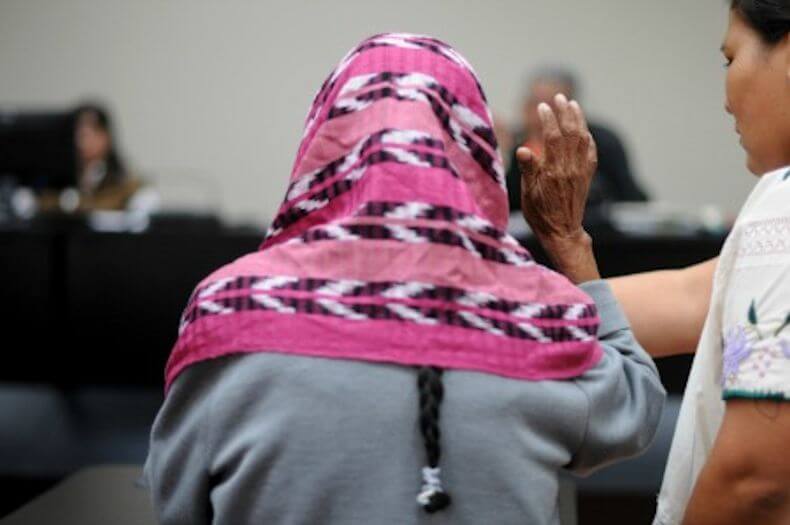
In the facilities of the Supreme Court of Justice, Q’eqchíe women have brought back to life the memories of the months they spent in the detachment of Sepur Zarco [a military outpost]. […] The testimonies of the victims […] have been reproduced and retold how the soldiers -guided by military commanders- forcefully made their husbands disappear in August 1982. ‘Widowed’ and ‘alone’, they were forced to move to the detachment in Sepur Zarco, where, according to their accounts, they were raped repeatedly and forced to cook and wash military uniforms for six months.
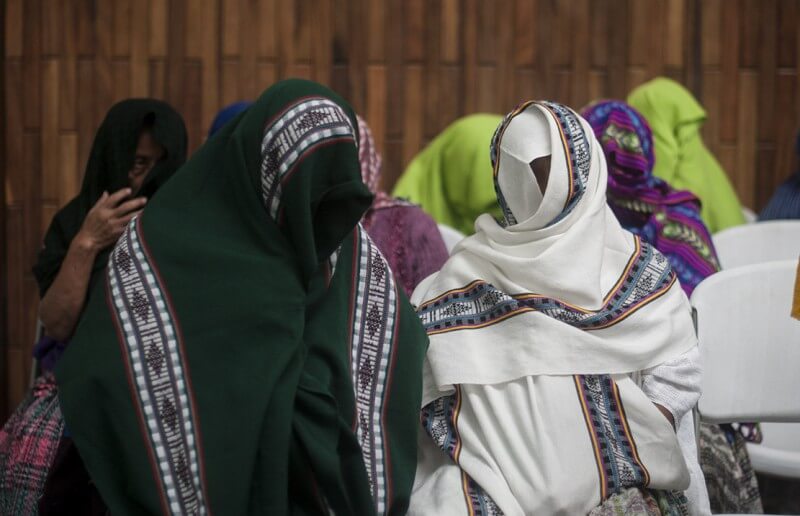
The verdict was delivered in public, while the identity of the victims was protected. Anyone interested in the case had the opportunity to watch it live online, something that prompted all kinds of reactions from the general public.
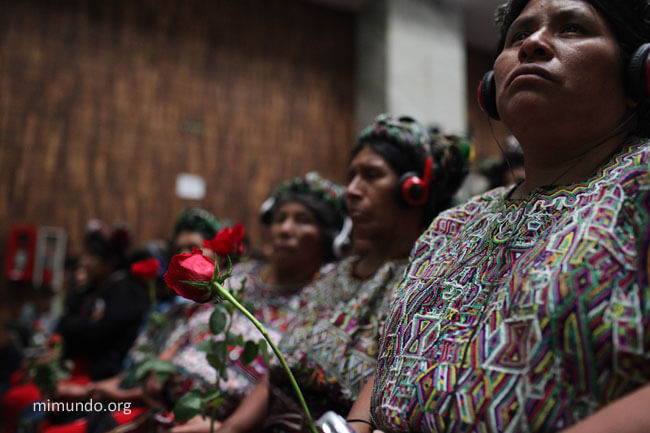
Packed courtroom @RigobertMenchu & #Guatemala activists await verdict #Sexualviolence case #SepurZarco #justice pic.twitter.com/sMfLzqyKVi
— Liz Bernstein (@lizbernstein) February 26, 2016
Prominent women like Human Rights activist Rosalina Tuyuc were in the audience, as well as Nobel Peace Prize winner Rigoberta Menchu, who was live tweeting her impressions:
Con mis hermanas de lucha, Rosalina Tuyuc y Maria Canil, fundadoras de CONAVIGUA #SepurZarco pic.twitter.com/HX5a48MZFu
— Rigoberta Menchú Tum (@RigobertMenchu) February 26, 2016
Fighting with my sisters, Maria Rosalina Tuyuc and Canil, founders of CONAVIGUA
— Rigoberta Menchú Tum (@RigobertMenchu) February 26, 2016
In her verdict, the judge described the brutal treatment that vulnerable, indigenous women suffered from soldiers during times of war:
"In #SepurZarco, the treatment women received was worse than that of animals", Judge Barrios #JuicioSepurZarco #Guatemala
— PlazaPública English (@PzPenglish) February 26, 2016
Other Twitter users underlined the importance of this verdict:
#Guatemala today is proof that justice can be served in cases of grave human rights violations by domestic courts. #SepurZarco
— Dr. Jo-Marie Burt (@jomaburt) February 26, 2016
While international observers praised the efforts of the national courts, a deep reflection came from the national organisation comprising all universities — the CEUG (in Spanish, Coordinadora Estudiantil Universitaria de Guatemala), which has played a crucial role recently in the battle against corruption, summarized in one line why the ruling is vital for the future of the nation:
As long as there is justice for the underdog, for the vulnerable, there is hope for a dignifying future for all of us #SepurZarco
— CEUG (@CEUGgt) February 26, 2016
While the sentence can be appealed in the Guatemalan courts and even declared void by the Cour de Cassation, the majority of public opinion agrees with the fact that the verdict delivered by Judge Jazmin Barrios today sets a precedent of dignity, courage and non-violent resistance for indigenous women who refused to give up the struggle for justice, and who overcame the stigma of rape, poverty, exclusion, racism, and classism to achieve justice. Even after 34 years, this judgement has opened a way to justice for women in Guatemala — and around the world — who are and have been victims of war crimes.
Across the world right now, Indigenous peoples are facing a renewed assault on their lands, rights, and ways of life.
From extractive industries pushing deeper into ancestral territories, to governments rolling back hard-won protections,
the threat is global—and it is growing.
What makes this moment especially dangerous is how little attention it receives.
Stories like this are disappearing in real time. Mainstream media
barely covers it and the coverage is fragmented. The public is left without the context
needed to understand what is truly at stake.
That is exactly why IC Magazine exists..
For more than 20 years, IC has reported on Indigenous struggles worldwide — consistently, independently, and without compromise.
We don’t follow news cycles; we trace patterns. We don’t sensationalize; we provide context.
And when the world looks away, we stay focused.
But this work is increasingly difficult to sustain.
We refuse to lock our reporting behind a paywall. We don’t sell access through subscriptions.
And we don’t answer to advertisers. IC Magazine survives solely because readers like you choose to
support independent Indigenous journalism.
Please donate today if you can. Every contribution helps us to continue this crucial work.
Thank you,
John Ahni Schertow
Founder and Editor in Chief