Last Updated on January 12, 2026
Greenland’s Indigenous leaders and residents are pushing back forcefully after U.S. President Donald Trump renewed suggestions that the United States should take control of the Arctic island, remarks that have sharpened international attention on Indigenous rights and self-determination in one of the world’s most strategically contested regions.
Trump, speaking to reporters after returning to office in January, said the United States would pursue Greenland “whether they like it or not,” describing the territory as essential to U.S. national security. The comments echoed his 2019 proposal to buy Greenland — an idea that was sternly rejected at the time by both Greenlandic and Danish officials.
Greenland is a self-governing territory of Denmark with a population of about 57,000, the vast majority of whom are Inuit. While Denmark retains control over foreign policy and defense, Greenland governs most domestic affairs and has steadily expanded its autonomy over the past several decades.
Political leaders in Nuuk responded with rare unanimity.
“We don’t want to be Americans. We don’t want to be Danes. We want to be Greenlanders,” Prime Minister Jens-Frederik Nielsen said in a statement endorsed by leaders across party lines, underscoring that Greenland’s future must be determined by its people.
Among residents, Trump’s remarks were widely viewed as dismissive of Inuit political agency and historical experience.
“We want to be independent and Inuit Nunaat belongs to Inuit, we are the people of the land – it doesn’t belong to anyone else” said Michael Bro, an Indigenous Greenlander studying Arctic policy. “I don’t want to be a Dane and I certainly don’t want to be an American.”
For many Greenlanders, the controversy extends far beyond diplomatic rhetoric. It touches on long-standing struggles for Indigenous self-determination following centuries of colonial rule under Denmark and earlier European powers.
Greenland’s autonomy is rooted in international legal principles recognizing the rights of Indigenous peoples to govern their lands, resources and political futures. Inuit leaders argue that any discussion of Greenland’s status that treats the island as a strategic asset rather than a living Indigenous homeland undermines those rights.
Under the United Nations Declaration on the Rights of Indigenous Peoples, Indigenous peoples have the right to self-determination and to give or withhold consent over decisions affecting their territories. Greenlandic officials say Trump’s remarks contradict those principles and revive colonial assumptions that powerful states can negotiate over Indigenous land without Indigenous participation.
The episode has also intensified Greenland’s internal debate over full independence from Denmark. While economic dependence remains a challenge, support for independence has grown, particularly among younger Inuit who view sovereignty as inseparable from cultural survival and political dignity.
Global interest in Greenland has increased substantially thanks to climate change. Retreating sea ice is opening new shipping routes, while the island’s mineral wealth — including rare earth elements critical to modern technologies and defense systems — has drawn attention from major powers.
The United States already operates Pituffik Space Base in northwest Greenland, a key component of missile warning and space surveillance systems. American defense officials have long described the island as strategically vital.
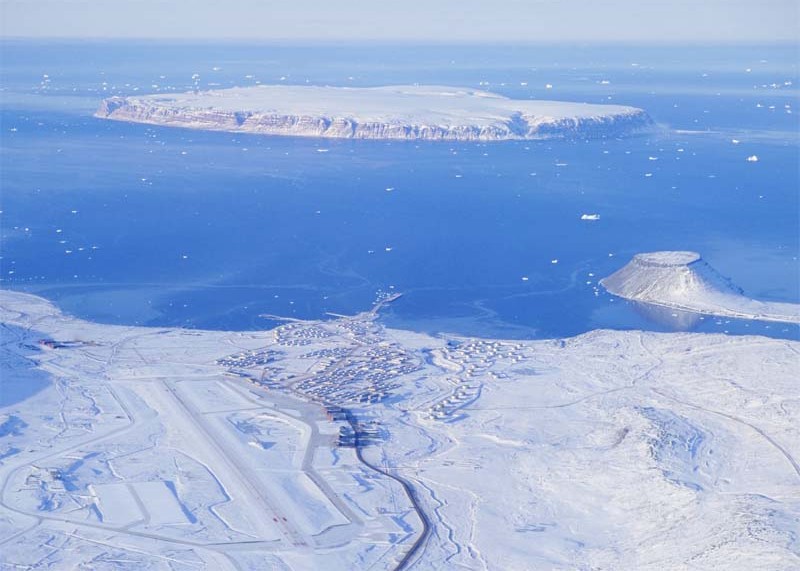
Aerial view of the base with Saunders Island in the background and Mount Dundas at right
But Greenlandic leaders and residents say global security concerns cannot override Indigenous rights — and that history shows Indigenous communities often bear the costs of decisions made far from their lands.
Legal experts are also warning that any attempt to acquire territory without the consent of its people would violate international law and set a precedent with implications far beyond the Arctic, particularly for Indigenous communities whose lands overlap with areas of strategic or economic interest worldwide.
Denmark has reiterated that Greenland is not for sale and emphasized that any security arrangements must respect Greenland’s self-government. European allies have voiced support for Denmark, warning that unilateral actions could destabilize NATO and undermine international norms.
For Greenlanders, the moment has become a reckoning — not only about Arctic power politics, but about whether Indigenous rights will be respected when global interests converge.
Across the world right now, Indigenous peoples are facing a renewed assault on their lands, rights, and ways of life.
From extractive industries pushing deeper into ancestral territories, to governments rolling back hard-won protections,
the threat is global—and it is growing.
What makes this moment especially dangerous is how little attention it receives.
Stories like this are disappearing in real time. Mainstream media
barely covers it and the coverage is fragmented. The public is left without the context
needed to understand what is truly at stake.
That is exactly why IC Magazine exists..
For more than 20 years, IC has reported on Indigenous struggles worldwide — consistently, independently, and without compromise.
We don’t follow news cycles; we trace patterns. We don’t sensationalize; we provide context.
And when the world looks away, we stay focused.
But this work is increasingly difficult to sustain.
We refuse to lock our reporting behind a paywall. We don’t sell access through subscriptions.
And we don’t answer to advertisers. IC Magazine survives solely because readers like you choose to
support independent Indigenous journalism.
Please donate today if you can. Every contribution helps us to continue this crucial work.
Thank you,
John Ahni Schertow
Founder and Editor in Chief