Last Updated on October 5, 2013
As Harsha Walia writes in rabble.ca, the Kitchenuhmaykoosib Inninuwug (KI) and Wet’suwet’en nations of Ontario and British Columbia have their own laws and traditions that conflict with those of Canada. As such, asserting their jurisdiction over their indigenous territories to enforce their natural law sometimes means running afoul of the Canadian government.
But as Walia reports, assuming their sacred responsibilities by exercising their sovereignty is not up for negotiation. While Canada may continue its policies of coercion and corruption through its Indian Act system, the indigenous activists comprising the hereditary clan system of these First Nations are taking back their inherent power of self-governance by re-establishing their presence on the land.
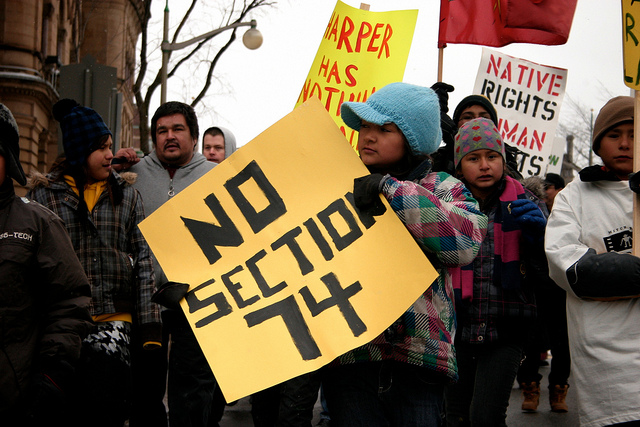
As they challenge Canada’s corporations and authorities by defending indigenous territories, the clans exercising indigenous self-determination find strength in a return to collective decision-making. While this democratic resurgence might seem threatening to those who’ve been crushed, co-opted or corrupted by Canada’s Indian Act Band Council system, it is a a reflection of a new unity in community generated by the great awakening made visible by Idle No More. As Walia notes, “Their courage and tenacity have served as an inspiration for many social movements struggling against austerity, market fundamentalism and ecological destruction.”
Across the world right now, Indigenous peoples are facing a renewed assault on their lands, rights, and ways of life.
From extractive industries pushing deeper into ancestral territories, to governments rolling back hard-won protections,
the threat is global—and it is growing.
What makes this moment especially dangerous is how little attention it receives.
Stories like this are disappearing in real time. Mainstream media
barely covers it and the coverage is fragmented. The public is left without the context
needed to understand what is truly at stake.
That is exactly why IC Magazine exists..
For more than 20 years, IC has reported on Indigenous struggles worldwide — consistently, independently, and without compromise.
We don’t follow news cycles; we trace patterns. We don’t sensationalize; we provide context.
And when the world looks away, we stay focused.
But this work is increasingly difficult to sustain.
We refuse to lock our reporting behind a paywall. We don’t sell access through subscriptions.
And we don’t answer to advertisers. IC Magazine survives solely because readers like you choose to
support independent Indigenous journalism.
Please donate today if you can. Every contribution helps us to continue this crucial work.
Thank you,
John Ahni Schertow
Founder and Editor in Chief