Last Updated on August 19, 2008
Racism is on the rise in the colonial centres of the world, and so it’s becoming increasingly important for us to develop healthy inter-cultural relationships that are founded on respect and mutual understanding. If we do not begin to develop such relationships, than the malignant ways of racism will be allowed to develop and fester without any substantial challenge (that is, challenge beyond words and argument).
First and foremost, we need space to develop such relationships; but we also need to be able to understand one another; that is, to develop a first-hand awareness of what other people mean according to their own perspectives.
If we can’t do this, then we end up internalizing their words, weighing them against our own perspectives and then just assuming we understand. This frequently leads to conflict.
Consider, for example, a discussion I observed on reclamationinfo.com last year. Two culturally-distinct people were talking–I can’t remember what about now–but they were both saying the exact same thing; only they were saying it differently. Neither realized this… Instead, they saw only the differences in their words and they got into a massive argument over it. “I’m right,” said one. “No I’m right”, said the other.
They were both right… but neither took the time to see what the other person meant, and so two prospective friends became bitter enemies.
Another example… Imagine a talk between a Cree woman and some Canadian guy. The Woman Speaks to the Man about how her people hold the land sacred, but the man has no idea what that means. Land to him is no more than real estate… he simply can’t identify with the idea that it’s sacred.
We can’t blame for that. He is Canadian, after all (sadly, that’s not meant to be a joke). And if the Woman were to repeat herself, he’s still not going to understand any better.
His lack of empathy will instead lead him to judge her words and make assumptions that re-affirm his own position. He will assume it’s nonsense and then sentence her as an opponent to his beliefs, and so his way of life. If he took a moment to stand in her shoes, as the saying goes, the outcome would have been very different.
Overcoming the barriers we’re talking about here takes time and effort, like all good things should.
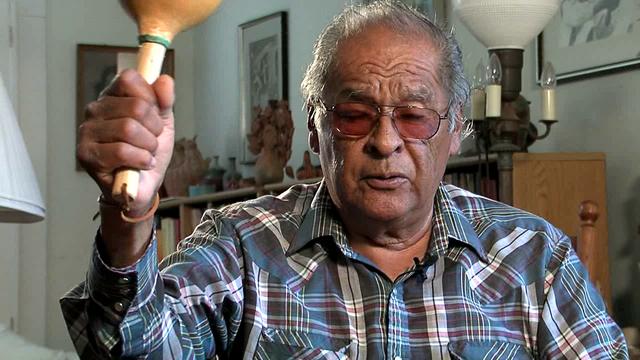
The following film, though brief, gives non-indigenous people a good starting point towards understanding where Indigenous People stand, as told by Warlpiri educator and scholar Steve Jampijinpa.
In the film, Steve explains the five pillars of Warlpiri culture, which are defined as: Walya, Kuruwarri, Jaru, Warlalja, and Juju/Manyuwana (Land, Law, Language, Family, and Ceremony).
As discussed in this briefing paper about the Warlpiri, these pillars are intimately connected to one another. They cannot be viewed, discussed, or considered in isolation of the other four “without violently corrupting the [Warlpiri] perspective.” So then, if Land was a central issue “we would also have to consider the Law that applies in the context of the Land. This would also require a consideration of the Kinship that applies in that Land, the Language that is necessary to enable proper interaction between Skin relationships and also the Language that is necessary to talk to, about and in the Land. There would also need to be a consideration of the Ceremony or Ceremonies that are tied to the specific Land being referred to.”
There is certainly alot more to be said here, but this is only meant to be a primer, of sorts. Hopefully, someone learns something by it.
Across the world right now, Indigenous peoples are facing a renewed assault on their lands, rights, and ways of life.
From extractive industries pushing deeper into ancestral territories, to governments rolling back hard-won protections,
the threat is global—and it is growing.
What makes this moment especially dangerous is how little attention it receives.
Stories like this are disappearing in real time. Mainstream media
barely covers it and the coverage is fragmented. The public is left without the context
needed to understand what is truly at stake.
That is exactly why IC Magazine exists..
For more than 20 years, IC has reported on Indigenous struggles worldwide — consistently, independently, and without compromise.
We don’t follow news cycles; we trace patterns. We don’t sensationalize; we provide context.
And when the world looks away, we stay focused.
But this work is increasingly difficult to sustain.
We refuse to lock our reporting behind a paywall. We don’t sell access through subscriptions.
And we don’t answer to advertisers. IC Magazine survives solely because readers like you choose to
support independent Indigenous journalism.
Please donate today if you can. Every contribution helps us to continue this crucial work.
Thank you,
John Ahni Schertow
Founder and Editor in Chief