
Last Updated on October 10, 2015
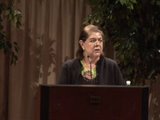
On October 2, 2008, Former Chief of the Cherokee Nation and Indigenous rights activist, Wilma Mankiller, was in Phoenix, AZ, to give a presentation on the “Challenges Facing 21st Century Indigenous People.”
A part of the Simon Ortiz and Labriola Center Lecture series on Indigenous Land, Culture, and Community, Mankiller, talked about the diversity and uniqueness of the world’s indigenous population, as well as the common, shared sense of duty to conserve and protect the natural world.
It’s a duty that we all share, not just indigenous people, states Mankiller. It’s just that many people have forgotten that duty because their culture holds no memory of their origins or of their place in the natural world.
Discussing several other issues, Mankiller also talked briefly about the common struggle of indigenous people. This shared experience, while indicating a point of unity, also shows a need for something ‘more’ than confrontation and a verbal demand that governments and corporations respect indigenous rights.
Mankiller points to that void of knowledge, and the need to show the world who we really are. Today, as i the distant past, indigenous people are often identified with “…nonsensical stereotypes [that] either vilify indigenous people as troubled descendants of savage[s]… or romanticize them as innocent children of nature – spiritual, but incapable of higher thought,” said Mankiller. Shifting this opinion to reflect our true identity — that we are not more or less, but different — will go further toward bringing the changes we need.
Another challenge Mankiller discusses, perhaps the greatest of all, is our need “to develop practical models to capture, maintain, and pass on traditional knowledge systems and values to future generations.”
If we cannot do this, then we too will one day forget.
Mankiller’s presentation follows some opening remarks by Frank Goodyear and Wayne Mitchell, and an introduction by Dr. Simon Ortiz.
Across the world right now, Indigenous peoples are facing a renewed assault on their lands, rights, and ways of life.
From extractive industries pushing deeper into ancestral territories, to governments rolling back hard-won protections,
the threat is global—and it is growing.
What makes this moment especially dangerous is how little attention it receives.
Stories like this are disappearing in real time. Mainstream media
barely covers it and the coverage is fragmented. The public is left without the context
needed to understand what is truly at stake.
That is exactly why IC Magazine exists..
For more than 20 years, IC has reported on Indigenous struggles worldwide — consistently, independently, and without compromise.
We don’t follow news cycles; we trace patterns. We don’t sensationalize; we provide context.
And when the world looks away, we stay focused.
But this work is increasingly difficult to sustain.
We refuse to lock our reporting behind a paywall. We don’t sell access through subscriptions.
And we don’t answer to advertisers. IC Magazine survives solely because readers like you choose to
support independent Indigenous journalism.
Please donate today if you can. Every contribution helps us to continue this crucial work.
Thank you,
John Ahni Schertow
Founder and Editor in Chief


