
Last Updated on November 24, 2025
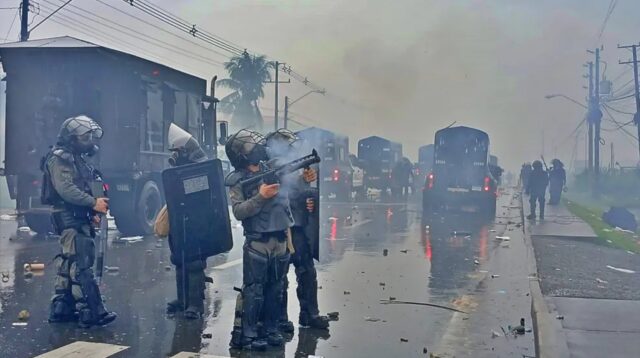
What began as a nationwide protest over privatization and inequality has escalated into a full-scale crackdown, with curfews declared, drones and helicopters deployed, and militarized police units swarming Ngäbe-Buglé territories in Panama.
Nationwide disturbances involving teachers and banana workers have also accompanied Mulino’s efforts to privatize social security, with many Panamanians believing the president has succumbed to US pressure over the Panama Canal. Protesters are equally concerned that Mulino will reopen the Cobre Panama mine and dam the Indio River.
Despite Mulino’s apparent political isolation and “gruff” manner, a resolution to some of the issues involved appears possible. On June 11, the SITRABAINA banana workers’ union reached an agreement and framework with two ministers in the National Assembly, but Mulino, for his part, ruled out any negotiations with Chiquita.
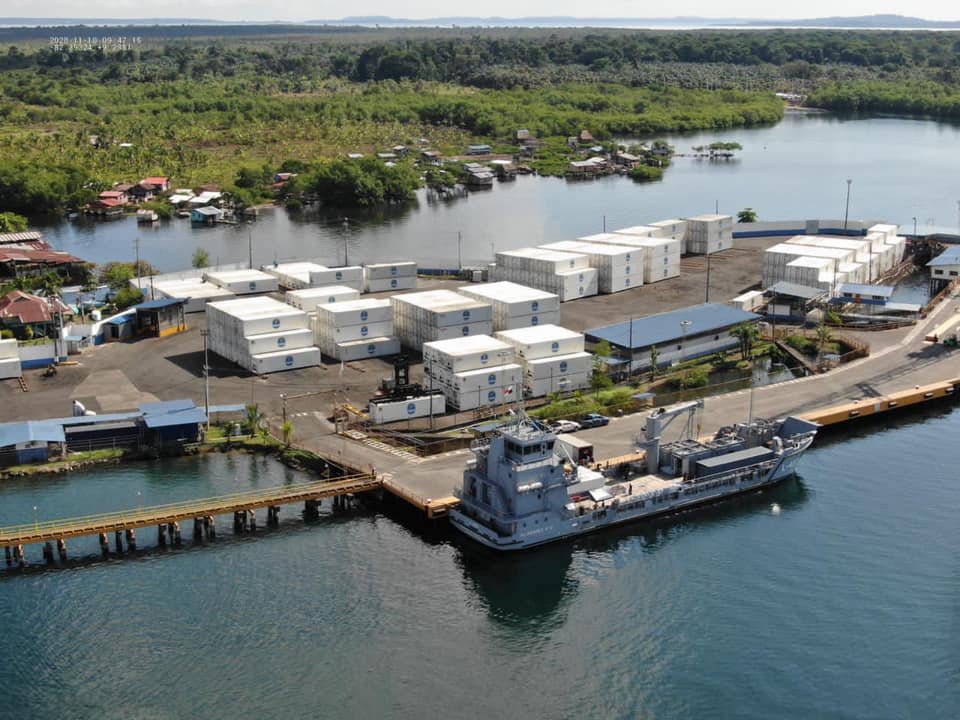
Chiquita shipping operations in Almirante (2020). Source: Chiquita
“We have no intention, nor are we making any arrangements with Chiquita to rehire the laid-off workers, much less pay them for the multi-million-dollar losses they’ve incurred over the past month or so that the streets have been blocked,” he said at his weekly press conference on June 12.
The president added, “If they were trying to destroy Bocas del Toro in the hope that the government would come and pick up the pieces, cut a check, and reappoint them, they chose the wrong government. They were asking for it.”
IC spoke to Feliciano Santos, a Ngäbe human rights activist and land defender also known by his Ngäbere name Chö Ichigo Guimanimo Kuingobo, who is the coordinator of MODETEAB – The Movement for the Defense of Ecosystems and Territories of Bocas del Toro.
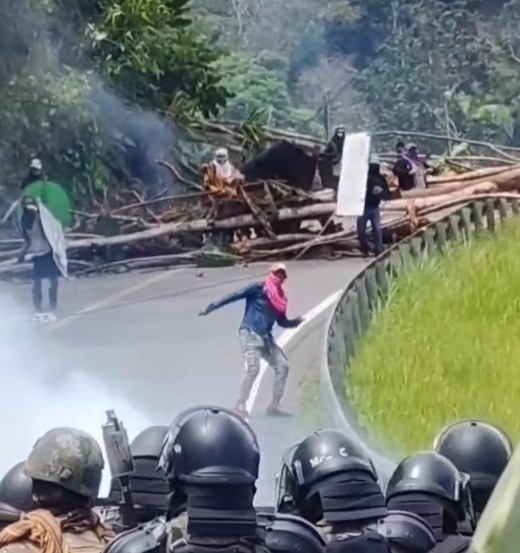
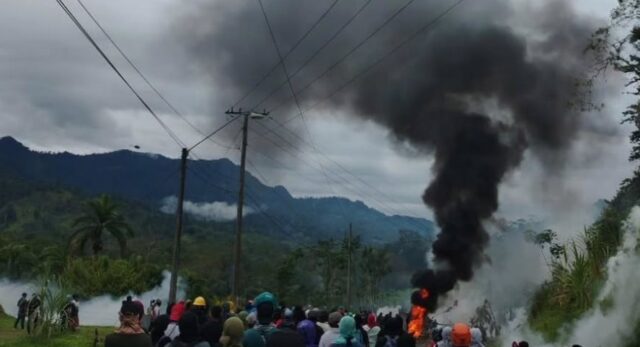
Road block in Bocas del Toro. Source: Radio Temblor
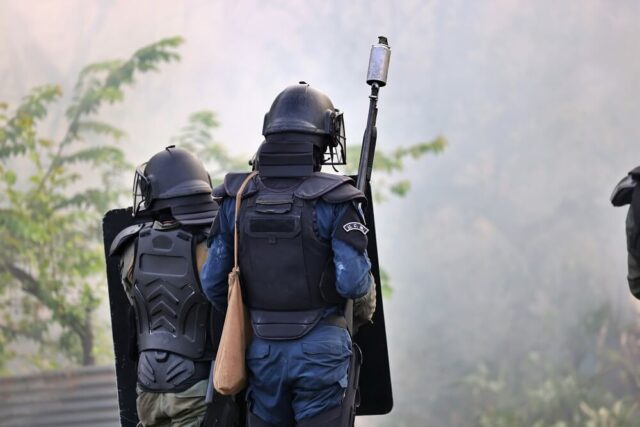
Speaking on Sunday 14 June, Santos said clashes had “continued until 4 in the morning. Today, we’re all on edge. Helicopters are flying over the area, and drones as well.” The security presence included units formed of National Police officers and military-style units comprised by SENAFRONT, the National Border Service.
“SENAFRONT planes, drones surveying the area, specialized police units, and SENAFRONT forces deployed supposedly to confront drug traffickers. They were firing weapons—it was a full-on military display. It felt like we were in a war zone, like we were armed, like we were criminals, terrorists, or drug traffickers. That’s how they came at us. But despite all of that, the communities have stood their ground.”
“Right now the protests are still going on across all the roads and communities—Changuinola, Almirante, Chiriquí Grande—everyone is in suspense, watching what will happen.”
Santos said he is observing a serious deterioration of the situation in his home province, whose roads President José Raúl Mulino has said he intends to reopen “whatever the cost”.
On Friday, June 13, the National Police announced they would be temporarily restricting the movements of cars, buses, and cargo on the highway to Bocas. Soon after, riot police were filmed descending on the province and marching towards population centres.
On Saturday June 14, the National Police started repressing communities and conducting military-style operations against citizens throughout the afternoon and evening. Disturbances continued throughout the night before a lull on Sunday morning. “At this moment,” said Santos, “we are not being actively attacked, but we know they are organizing to strike again this afternoon or tonight. The outlook is grim.”
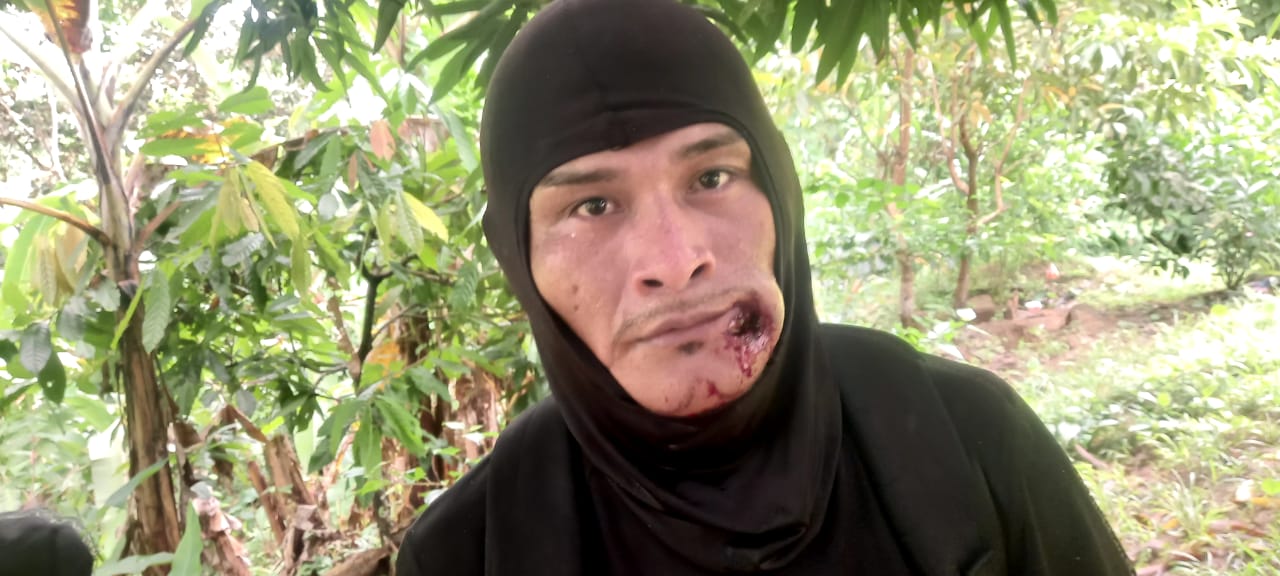
Protester with facial injury. Source: MODETEAB
Santos said 24 people, mostly Indigenous youths, had been detained in the early hours of the morning. “We’ve since learned they were transferred back to the Changuinola area by air, on a naval aviation plane… Most of them were just in underwear—as if they had been walking around naked when they were arrested. This is a clear act of violation, aggression, and psychological and physical harm. It’s humiliating. It shows the hatred and repression this government has toward Indigenous communities and Panamanian citizens in general.”
Meanwhile, it appears that various private businesses in Panama may be assisting the state in its violent repression of Indigenous communities.
“Not long ago,” said Santos, “A helicopter tried to land on an airstrip in the Almirante area, in a place called Nuevo Paraíso. What we’re observing is that there are around ten helicopters operating in the Bocas del Toro region, and they don’t seem to belong to the government. They’re owned by private companies—like AES, TESA, and others—that have made their equipment available to help repress the people. That’s what we’re seeing: these are not state helicopters, but private ones being used by the government.

Map showing Bocas del Toro province. Source: Google Earth
“The same goes for heavy machinery being used to move or intimidate protesters,” said Santos. “One in particular is called ININCO. That company has provided heavy machinery to remove barricades and similar obstacles.”
AES Panama is a subsidiary of US-based AES Energy corporation. It built the controversial Changuinola I hydroelectric dam, which displaced Ngabe communities, and is known to possess a helicopter. TESA (Transporte y Equipos, S.A) sells, rents and maintains heavy machinery. Founded in 1980, Constructora ININCO, S.A.is a Panamanian-registered construction business and part of the Grupo González. The company specializes in civil engineering, including road and bridge building.
IC reached out to AES, TESA, and ININCO for comment, but did not receive a response.
Finally, Mulino is wielding Panama’s repressive state apparatus not only to “restore order” in Bocas del Toro, but to protect the private interests of Chiquita, including its landholdings, equipment, and plants. On June 12, he claimed to have “received information, including audio recordings, from Mr. Smith and others who are talking about taking over Chiquita’s packing plants and land. We will not allow that. Those facilities still belong to Chiquita, under a state concession.”
Francisco Smith, one of the leaders of the banana union SITRIABANA, was arrested in Panama City on the afternoon of Sunday June 15. He has been charged with instigating road closures and is presently being held in custody. The Mulino regime has also targeted leaders from the construction workers’ union SUNTRACS.
“So that’s what’s been happening,” said Santos, adding that the situation in Bocas del Toro remains volatile, but MODETEAB will continue to observe. “A curfew has now been declared, clearly an attempt to suppress and intimidate us even more. This is the state of fear and uncertainty we’re living in.”
Ngabe leaders in various communities near or within the Comarca Ngabe-Buglé (such as Trinidad, El Piro, Ojo de Agua, Tolé, Viguí and El Prado) have reported violent house-to-house raids including the use of tear gas, large-caliber weapons and arbitrary arrests of indigenous leaders in various communities.
On June 13, Indigenous leader Toribio García, who was actively involved in protesting against Law 462 and has been a participant in other mobilisations in the country, was arrested and taken to the Tolé police station. He remains under house arrest, following a hearing on 14 June, where he was charged with glorifying criminal acts and undermining the constitutional order of the State.
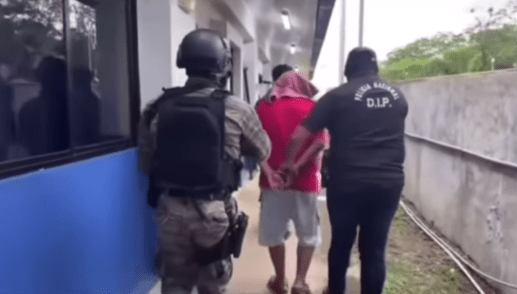
Toribio Garcia being arrested. Source: muycabreados
There have also been acts of repression in eastern Panama. Videos show police deploying large quantities of tear gas in the Indigenous community of Arimae in the Emberá-Wounaan Comarca, including within the grounds of a school. During one such clash, a traditional building burned down, but it is not known if the act was deliberate, or an accident resulting from the reckless deployment of munitions, which caused the thatched roof to ignite.
Indigenous and civil society groups have widely condemned Mulino’s treatment of Indigenous peoples, as reported by IC.
Across the world right now, Indigenous peoples are facing a renewed assault on their lands, rights, and ways of life.
From extractive industries pushing deeper into ancestral territories, to governments rolling back hard-won protections,
the threat is global—and it is growing.
What makes this moment especially dangerous is how little attention it receives.
Stories like this are disappearing in real time. Mainstream media
barely covers it and the coverage is fragmented. The public is left without the context
needed to understand what is truly at stake.
That is exactly why IC Magazine exists..
For more than 20 years, IC has reported on Indigenous struggles worldwide — consistently, independently, and without compromise.
We don’t follow news cycles; we trace patterns. We don’t sensationalize; we provide context.
And when the world looks away, we stay focused.
But this work is increasingly difficult to sustain.
We refuse to lock our reporting behind a paywall. We don’t sell access through subscriptions.
And we don’t answer to advertisers. IC Magazine survives solely because readers like you choose to
support independent Indigenous journalism.
Please donate today if you can. Every contribution helps us to continue this crucial work.
Thank you,
John Ahni Schertow
Founder and Editor in Chief