
Last Updated on October 9, 2025
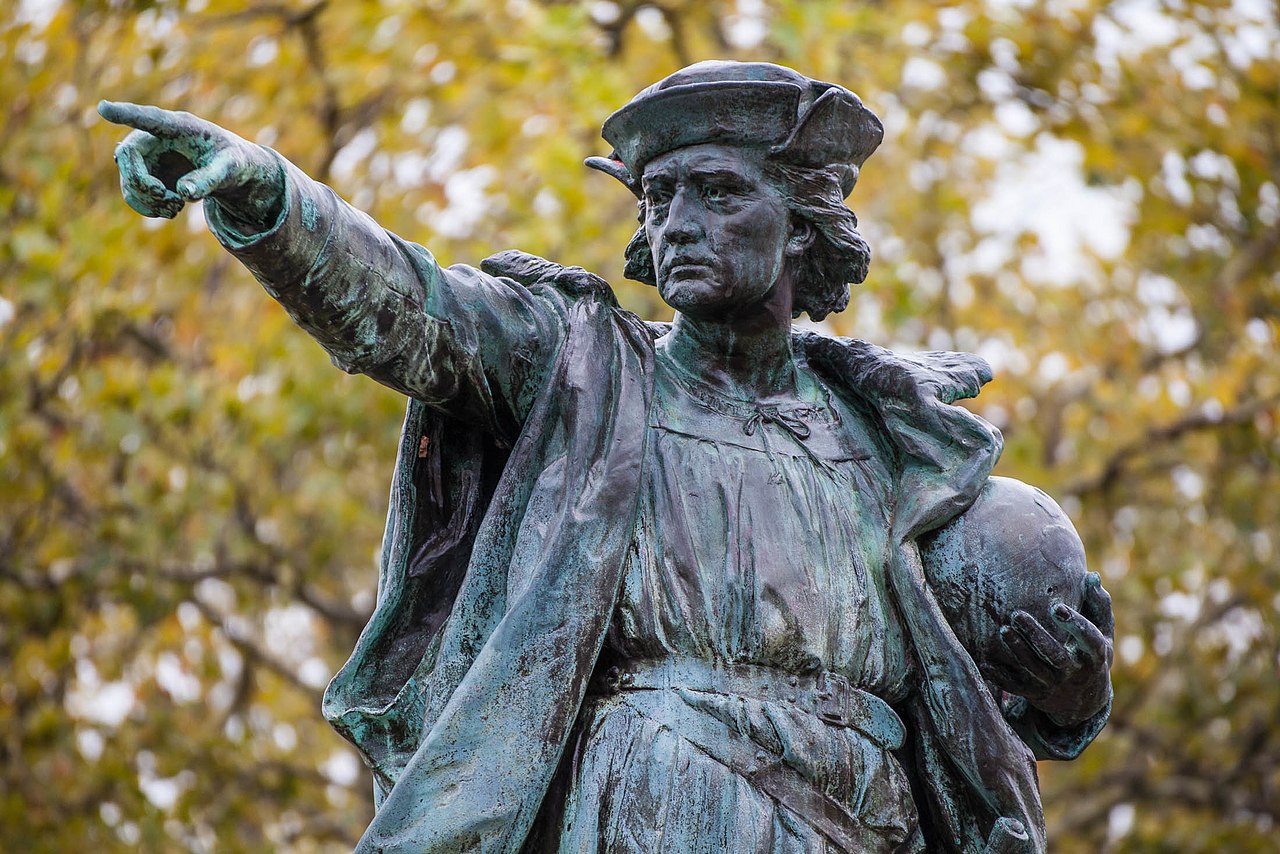
Early Thursday, President Donald Trump signed a proclamation praising Christopher Columbus as a “true American hero” and a “giant of Western civilization.” But Columbus was neither — and Trump’s glorification of him says more about power than history.
Columbus Day doesn’t just mark the anniversary of the Italian navigator’s arrival in the Americas. It marks the beginning of a centuries-long campaign of dispossession, enslavement, and erasure that included the near annihilation of the Taíno Peoples and the launch of the transatlantic slave trade.
But Columbus never “discovered” a new world. He set in motion a system of conquest that still shapes U.S. law, land policy, and global power to this day. We can see it clearly in the Trump administration’s recent moves against Indigenous rights and environmental protections.
The Trump administration’s environmental agenda reveals a clear pattern of aggression toward Indigenous rights and the environment.
We can see that with tribes that have expressed grave concern about rollbacks to water quality protections. Such rollbacks disproportionately damage Indigenous communities whose diets, spiritual practices, and cultural lifeways rely on local ecosystems.
Meanwhile, we have the reopening of oil and gas leasing on the Arctic National Wildlife Refuge and the approval of the long-debated Ambler Road project that threatens the lands of dozens of Indigenous Alaskan communities.
Sacred sites long stewarded or co-managed with tribal involvement also face renewed jeopardy, with precedent (and precedent-shredding) legal claims under Trump. This includes Bears Ears, the Chaco Canyon, Oak Flat, and hundreds of other culturally significant places.
Meanwhile, a sweeping executive order ending DEI programs across federal agencies (Executive Order 14151) also threatens environmental justice frameworks that have supported Indigenous claims to protection from environmental harm.
One of the most insidious tactics wielded by this administration is erasure. In a striking re-calibration of the U.S. Department of State’s annual Country Reports on Human Rights Practices, references to Indigenous peoples have been drastically reduced or deleted outright.
Mentions of land dispossession, environmental violence, and state-backed abuses — once standard in previous administrations — have been scrubbed from the record.
This political revisionism extends beyond the State Department. Across federal agencies, language referencing “sovereignty,” “consultation,” and “Indigenous rights” has been systematically softened or excised from public documents and websites.
At this point, the Bureau of Indian Affairs might as well be repurposed to fast-track resource extraction projects. A move that would make Columbus proud.
Among the most devastating examples is the decision to halt or defund federal initiatives aimed at documenting the history and legacy of Indian boarding schools.
More than US $1.6 million in support for research, archiving, and survivor testimony has been cut, effectively silencing projects that sought to uncover systemic abuse and intergenerational trauma. For survivors and families who have waited decades to see their experiences acknowledged, these cuts are not mere budgetary adjustments — they are a continuation of the same denial that allowed the atrocities to occur in the first place.
Just as Columbus viewed Indigenous Peoples as non-humans, the Trump administration is questioning the citizenship of everyone that predates the United States itself.
He is, in fact, challenging birthright citizenship under the Fourteenth Amendment — a rhetoric that places Indigenous peoples back under suspicion, as if their belonging were still a matter of permission rather than inherent right.
Citizenship for Indigenous peoples was never a gift; it was imposed through the 1924 Indian Citizenship Act as a tool of assimilation. To now reopen that debate is to revive a long history of conditional acceptance, where recognition is granted only when it serves colonial interests.
Consultation? Consent? These principles are being hollowed out. The administration’s approach to tribal entities, regulations, and executive action demonstrates a disdain for meaningful tribal sovereignty.
Optimistically, some early executive orders suggest clarifications around taxation, recognition, and visibility for tribal entities. But these gestures are dwarfed by broader trends like the dismantling of internal agency support for Indigenous programs, reductions in staff at Indian-serving federal offices, and the elimination of capacity-building investments.
Lastly, we have proposals to freeze federal grants that would slash approximately US $24.5 billion in funding crucial for health care, law enforcement, education, infrastructure, and other treaty‐based obligations to tribes.
Tribal leaders warn that such cuts would directly violate the legal and moral trust responsibility the United States has held for centuries.
These are not austerity measures — they translate immediately into fewer clinics, crumbling roads on reservations, staff layoffs, reduced educational supports, and limited capacity for self-governance. The National Center for American Indian Enterprise Development’s survey reveals that among tribal leaders, nearly every category of governance, infrastructure, and strategic planning is under strain.
This is not the past returning. It is the past refusing to leave. Columbus’s name lives on in the form of executive orders that dismantle protections, in development projects that carve through Indigenous lands, and in the bureaucratic precision with which erasure is managed. His spirit of domination has traded ships for spreadsheets and crosses for contracts — but the result is the same. It is dispossession masquerading as progress.
Each new policy wrapped in the rhetoric of “growth” or “national interest” is just another verse in the same old conquest song. It is a system that treats Indigenous resistance as an obstacle and Indigenous survival as an afterthought.
So while Columbus may be invoked as a symbol of courage, what his legacy really sanctifies is impunity — the idea that empire can take without consequence, rewrite without remorse, and still call itself civilization.
Across the world right now, Indigenous peoples are facing a renewed assault on their lands, rights, and ways of life.
From extractive industries pushing deeper into ancestral territories, to governments rolling back hard-won protections,
the threat is global—and it is growing.
What makes this moment especially dangerous is how little attention it receives.
Stories like this are disappearing in real time. Mainstream media
barely covers it and the coverage is fragmented. The public is left without the context
needed to understand what is truly at stake.
That is exactly why IC Magazine exists..
For more than 20 years, IC has reported on Indigenous struggles worldwide — consistently, independently, and without compromise.
We don’t follow news cycles; we trace patterns. We don’t sensationalize; we provide context.
And when the world looks away, we stay focused.
But this work is increasingly difficult to sustain.
We refuse to lock our reporting behind a paywall. We don’t sell access through subscriptions.
And we don’t answer to advertisers. IC Magazine survives solely because readers like you choose to
support independent Indigenous journalism.
Please donate today if you can. Every contribution helps us to continue this crucial work.
Thank you,
John Ahni Schertow
Founder and Editor in Chief