Last Updated on November 14, 2025
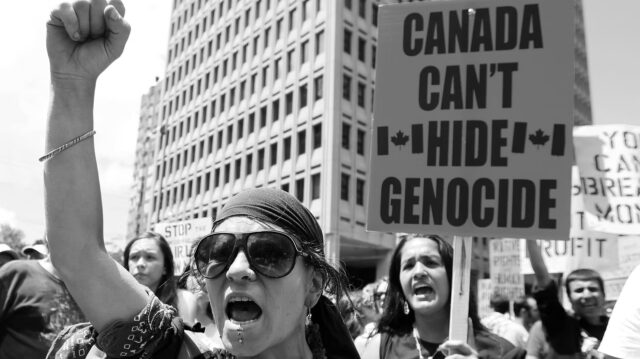
A proposed resolution before New Mexico’s state legislature would mark one of the first formal acknowledgments by a U.S. state of the decades‐long practice of coerced sterilization of Indigenous women — and carve out a path for investigation and truth-telling.
Introduced in the 2025 session of the New Mexico Legislature, the joint memorial would establish a statewide truth and reconciliation commission and a memorial to victims of forced sterilization, as well as an investigation into the history of sterilization practices that targeted Indigenous women in New Mexico.
New Mexico would become the first state in the nation to launch such a formal probe.
During a hearing before the New Mexico Legislative Indian Affairs Committee, Indigenous women’s reproductive rights advocates called on lawmakers to create mechanisms for official recognition and redress.
The resolution would:
State Sen. Linda Lopez (D-Bernalillo) agreed that the legislature needs to acknowledge the role New Mexico played in this history.
“It wasn’t us who are here in the Roundhouse at this point in time. And yes, it was maybe another governmental entity. But Madam Chair, I think those of us who are elected have a responsibility to say this should never have happened, this will not happen, and that we apologize,” she said.
Representative Michelle Paulene Abeyta (D-Bernalillo, McKinley, Valencia, San Juan, Socorro & Cibola) emphasized the need for better reproductive-health education targeting youth in Indigenous communities.
The proposed commission arrives against the backdrop of a long, often-hidden history of coerced sterilization targeting Indigenous women in the United States.
Beginning in the early 20th century, federal and state governments embraced eugenics policies that framed Native peoples — along with Black, Latina, disabled, and poor women — as “unfit” to reproduce. These ideas were codified in state sterilization laws and reinforced through federal Indian policy, shaping medical practices in reservation hospitals, boarding schools, and government-run health programs.
By the 1950s and 1960s, the Indian Health Service (IHS), then newly established, inherited a healthcare system shaped by those eugenic assumptions.
Many Native families reported that sterilizations were performed without full disclosure, under duress, or during other medical procedures. In 1976, the U.S. Government Accountability Office (GAO) documented 3,406 sterilizations of American Indian women in just four IHS regions between 1973 and 1976 — and noted that even these numbers likely underestimated the true scale because many records were incomplete or never kept.
Researchers and Indigenous advocates say the problem extended far beyond the GAO’s narrow review. Some estimates conclude that between 25% and 50% of Indigenous women of childbearing age were sterilized in the 1970s, often without proper consent.
Despite this history, many states — including New Mexico — have never enacted explicit bans on forced or coercive sterilization, nor have they created processes for public truth-telling or reparative justice.
Across the world right now, Indigenous peoples are facing a renewed assault on their lands, rights, and ways of life.
From extractive industries pushing deeper into ancestral territories, to governments rolling back hard-won protections,
the threat is global—and it is growing.
What makes this moment especially dangerous is how little attention it receives.
Stories like this are disappearing in real time. Mainstream media
barely covers it and the coverage is fragmented. The public is left without the context
needed to understand what is truly at stake.
That is exactly why IC Magazine exists..
For more than 20 years, IC has reported on Indigenous struggles worldwide — consistently, independently, and without compromise.
We don’t follow news cycles; we trace patterns. We don’t sensationalize; we provide context.
And when the world looks away, we stay focused.
But this work is increasingly difficult to sustain.
We refuse to lock our reporting behind a paywall. We don’t sell access through subscriptions.
And we don’t answer to advertisers. IC Magazine survives solely because readers like you choose to
support independent Indigenous journalism.
Please donate today if you can. Every contribution helps us to continue this crucial work.
Thank you,
John Ahni Schertow
Founder and Editor in Chief