Last Updated on March 13, 2026
Indigenous communities in eastern Mexico are urging President Claudia Sheinbaum to halt plans for hydraulic fracturing, warning that the controversial oil and gas extraction technique could damage the environment and disrupt the social fabric of the Huasteca region.
Representatives of Huastec (Tének) and Nahuatl communities in the Huasteca Potosina area of the state of San Luis Potosí issued a public statement rejecting any exploration or extraction projects that rely on hydraulic fracturing, commonly known as fracking.
Community leaders said such projects would threaten the territory’s ecosystems and livelihoods. They argue that large-scale extractive projects could profoundly alter the social and economic fabric of the region, which relies heavily on small-scale agriculture and access to local natural resources.
The Huasteca, a culturally diverse area spanning several Mexican states, is home to multiple Indigenous nations whose economies and identities remain closely tied to land and water. Nahuatl and Huastec peoples form a significant portion of the population and maintain longstanding agricultural traditions and community governance systems.
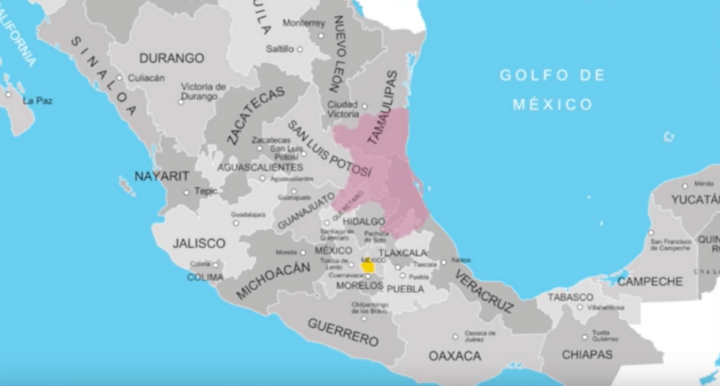
Huasteca location in Mexico. Credit: RAXERIOS on Wikimedia (CC)
In their statement, the communities raised concerns about the environmental risks associated with fracking. They warned that the technique can involve large volumes of water and generate toxic waste, while also posing risks such as methane leaks and induced seismic activity.
Water security was identified as a central concern. Community representatives said the Huasteca region contains at least 1,019 rivers, springs and aquifers that could be affected by drilling activities. They also warned that fracking operations could require millions of liters of water per well, potentially diverting resources from them.
The declaration also emphasized Indigenous rights under Mexican law and international agreements. The signatories said that any development without their consent would violate constitutional protections as well as the obligation to seek free, prior and informed consent established under International Labour Organization Convention 169.
According to the statement, as many as 3,268 localities—many predominantly Indigenous—could be directly affected by hydrocarbon development in the area.
The appeal comes amid a growing debate in Mexico over whether to expand fracking as part of a broader energy strategy. Supporters argue that increased domestic gas production could reduce the country’s dependence on imports, particularly from the United States.
Regardless of any benefits, the community representatives said they will not grant consent to projects that threaten their lands, culture or environment.
In their statement, the Huasteca communities urged the president to meet directly with Indigenous authorities and reconsider the development plans. They stressed that the region should not become a “sacrifice zone” for energy production, insisting that economic development must not come at the cost of Indigenous territories or ecological destruction.
Across the world right now, Indigenous peoples are facing a renewed assault on their lands, rights, and ways of life.
From extractive industries pushing deeper into ancestral territories, to governments rolling back hard-won protections,
the threat is global—and it is growing.
What makes this moment especially dangerous is how little attention it receives.
Stories like this are disappearing in real time. Mainstream media
barely covers it and the coverage is fragmented. The public is left without the context
needed to understand what is truly at stake.
That is exactly why IC Magazine exists..
For more than 20 years, IC has reported on Indigenous struggles worldwide — consistently, independently, and without compromise.
We don’t follow news cycles; we trace patterns. We don’t sensationalize; we provide context.
And when the world looks away, we stay focused.
But this work is increasingly difficult to sustain.
We refuse to lock our reporting behind a paywall. We don’t sell access through subscriptions.
And we don’t answer to advertisers. IC Magazine survives solely because readers like you choose to
support independent Indigenous journalism.
Please donate today if you can. Every contribution helps us to continue this crucial work.
Thank you,
John Ahni Schertow
Founder and Editor in Chief