Last Updated on August 14, 2026
A National, inclusive, non-discriminatory and peaceful effort, the “Mobilization to defend the Water” (Movilización Nacional para defender el Agua) officially began this morning in Ecuador, at 12:00am (0500 GMT).
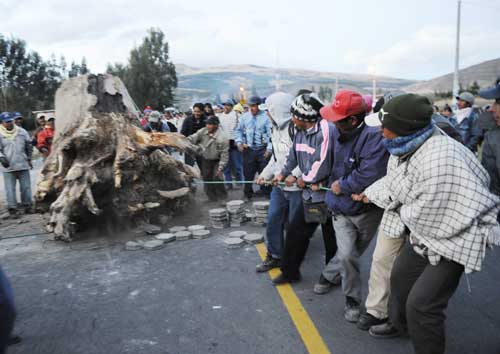
At this point, several roadblocks have reportedly been set up, involving rocks, trees and burning tires, on several sections along the Panamerican highway and at various other locations.
The mobilization was called on by CONAIE president Marlon Santi, two weeks ago, during the National Assembly to defend the Water. As noted in statements on ECUARUNARI‘s website, the country’s indigenous movement has been “exhausted by the process of dialogue” with the Correa government, and left with no choice but to mobilize to defend the water for themselves and all of Ecuador.
The mobilization, which will continue “indefinitely” according to CONAIE, is protesting the proposed, Water use and management Act, which can be approved by congress as soon as October 14.
The water act will give transnational mining companies free reign over water supplies throughout the country—threatening the health and well being of all Ecuadorians and especially Indigenous People, their cultures, their food supplies, and their most basic and fundamental rights.
Yesterday, the AFP reported that protests were being organized across seven of Ecuador’s 24 provinces. However, given last year’s Popular and Indigenous Minga in Colombia and the more recent Mobilization of Indigenous Peoples in Peru, there’s no telling how far it will grow.
Similarly, there’s no telling how long before police intervene. According to El Pais, more than 20,000 police have been deployed to challenge the mobilization, which so-called leftist President Correa has himself labeled a desperate campaign to destabilize his government with “lies.”
NOTE: ECUARUNARI has a live internet broadcast set up at http://www.livestream.com/ecuachaskitv. It is in Spanish, however it will provide coverage during the mobilization
Across the world right now, Indigenous peoples are facing a renewed assault on their lands, rights, and ways of life.
From extractive industries pushing deeper into ancestral territories, to governments rolling back hard-won protections,
the threat is global—and it is growing.
What makes this moment especially dangerous is how little attention it receives.
Stories like this are disappearing in real time. Mainstream media
barely covers it and the coverage is fragmented. The public is left without the context
needed to understand what is truly at stake.
That is exactly why IC Magazine exists..
For more than 20 years, IC has reported on Indigenous struggles worldwide — consistently, independently, and without compromise.
We don’t follow news cycles; we trace patterns. We don’t sensationalize; we provide context.
And when the world looks away, we stay focused.
But this work is increasingly difficult to sustain.
We refuse to lock our reporting behind a paywall. We don’t sell access through subscriptions.
And we don’t answer to advertisers. IC Magazine survives solely because readers like you choose to
support independent Indigenous journalism.
Please donate today if you can. Every contribution helps us to continue this crucial work.
Thank you,
John Ahni Schertow
Founder and Editor in Chief