Last Updated on May 18, 2026
The Saloya River is a living ancestor that is facing a death sentence from a harmful industrial development known as the San Jacinto Hydroelectric Project. This projected 49-megawatt hydroelectric dam threatens to choke this pristine river in the Ecuadorian cloud forest under the guise of green energy, while local communities who never consented to it battle for their survival. The Saloya River carries deep ancestral ties to the Yumbo peoples, and now local communities are fighting for their river, a living entity that is key for the future of our continent.
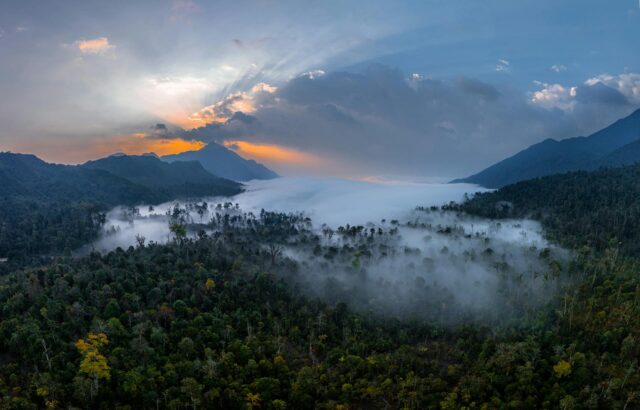
In the heart of the Andes, the Saloya River twists through the lush region of the Choco Andino. This waterway is an artery of the Choco Andino Biosphere Reserve, one of only seven biosphere reserves recognized by UNESCO. The reserve is a mist-draped biodiversity hotspot that contains an extreme range of altitude levels varying over 16,400 feet between Pacific lowlands and the tall Andean paramos. Such an extreme vertical diversity gives life to unique microclimates that allow endemic species found nowhere else in the world to thrive.
The Saloy region is home to the long-wattled umbrellabird, the Chocó’s most iconic endemic bird; the spectacled bear, the only bear across South America; and glass frogs with translucent skins that reveal internal organs and abound on pristine rivers.
Yet this irreplaceable jewel of life is now under siege. In November 2023, the Ecuadorian government granted a concession to the San Jacinto Hydroelectric Project. It did so without consultation or consent to Indigenous and local communities, overlooking a recent referendum that protected water sources in the province, and disrespecting constitutional guarantees.
Beneath a façade of renewable energy lies the deliberate murder of a living river. The dam’s extraction plan will erect a massive seven-meter wall, a free-flow spillway, and a two-chamber sand trap, all designed to divert roughly 10,000 liters of water per second away from the Saloya riverbed to generate electricity.
In response to this existential threat, local residents organized the Saloya Resiste Collective and filed an acción de protección (Constitutional Protection Action). They demand the immediate suspension of the dam project that was imposed without Free, Prior, and Informed Consultation of Indigenous communities or environmental consultation with locals, as required by law.
This hydro-project shows that it is urgent to recognize rivers as living beings with legal personhood. Local communities are fighting for their livelihoods while demanding fundamental rights for nature, asking the state to stop the murder of a priceless ecosystem that has sustained life for millennia for short-term corporate greed.
The San Jacinto Hydroelectric Project presents a horrifying blueprint for ecocide, a crime that is prosecuted by the International Criminal Court. Drastic alterations to the natural flow of the Saloya River from the dam would dry up riverbeds for most of the year, stranding fish in shallow pools, flooding reptile and bird nests, and aggravating erosion.
Dams use destructive methods such as hydropeaking, which releases blasts of water that wash away fish breeding grounds and destroy the nests of riverbank birds. More than 3,800 families who live in the Mindo and Saloya communities rely heavily on the river as a source of clean water and an attraction to ecotourism that fuels the regional economy. Without a functioning river, these communities would be devastated.
This project carries a high risk of “extinction debt,” a tragic pattern where habitat destruction leads to the slow, inescapable demise of endemic species. A top predator, the river otter which is already endangered, needs clean, flowing water and healthy fish to survive, and the iconic Mindo Glassfrog lays its eggs on leaves overhanging mountain streams, relying on the water below to hatch its tadpoles. If the Saloya River dries up, generations of these animals—or potentially, entire species—could be lost forever.
The fate of the Saloya River goes far beyond Ecuador’s borders; keeping this river alive and well as a global common matters deeply to the future of the world. The Choco-Andean region is an ancient climate refuge that never froze during the Ice Age, allowing ancient species to flourish and evolve uninterrupted while much of the globe was frozen solid. It carries unique genetic memory through millions of years of uninterrupted evolution.
Andean rivers are connected to the sky world. Although located on the western slopes of the Andes, the Saloya River is intimately connected to the Amazonian sky rivers in a large hydrological network that stabilizes the climate across South America. By disrupting the Saloya River, the San Jacinto dam will disrupt a key mechanism to regulate climate globally.
A dying river is a symptom of a dying planet. Granting the Saloya legal rights will create a beacon of restorative justice that shines through corrupt, profit-driven destruction.
In his book Is A River Alive, Robert Macfarlane dives into the transformative global movement on the rights of nature, pointing that humanity’s survival requires a profound “unlearning” of capitalist values that transformed rivers into “inanimate brute matter.” Macfarlane acknowledges the visionary Ecuadorian Constitution as a global turning point for the rights of nature, with its radical statement in Article 71 that nature “has the right to integral respect for its existence and for the maintenance and regeneration of its life cycles, structures, functions and evolutionary processes.”
Over the last decade, over twenty rivers from Colombia to Bangladesh were granted legal rights, recognized as living beings. One of the most iconic is perhaps the Whaganui River in Aotearoa (New Zealand), who was granted legal personhood in 2017 through the Te Awa Tupua (Whanganui River Claims Settlement) Act 2017 after more than 160 years of Māori resistance. The Magpie River in Canada was granted legal rights in 2021, to flow and to sue in court, by resolutions of the Innu Council of Ekuanitshit and the Minganie Regional County Municipality.
Granting rivers rights recognizes that a river’s health and humans’ health are inextricably linked.
As the Māori Whanganui proverb says, Ko au te awa, ko te awa ko au, “I am the river; the river is me.”
Protecting the Saloya is a critical step in addressing the global crises of climate change, pollution, and biodiversity loss. All of which the San Jacinto Project will only make worse by killing the Saloya River.
To fully understand what we stand to lose with the Saloya River, we must listen to the ancestral memory embedded in the landscape. Centuries before the arrival of concrete, bulldozers, and transmission lines, the Yumbo peoples lived by the Saloya River. The Yumbo carved a network of sunken trails through the cloud forest, living in a sustainable symbiotic relationship with the river. They left petroglyphs along the rivers and their ceremonial centers consisted of pools used for astronomical, religious, and political purposes.
Leanne Betasamosake Simpson approaches water as a living network that goes beyond narrow, human boundaries. In Theory of Water: Nishnaabe Maps for the Times Ahead, she sees water as the network to enable communication and relations among all life forms. Simpson notes that water “decentres itself: it leaks, moves, flows and reconnects, not as real estate… but as a living network.”
The scholar Ailton Krenak refers to rivers as living ancestors in his lectures, which are recorded in the Ancestral Futures book. He explains, “we are everywhere, because our ancestors, the rivers-mountains, are in everything.” Krenak warns us that the urban mindset that classifies rivers as energy potential can be devastating. For him, rivers are “our grandfather-river,” highlighting the familial bond that hydroelectric dams erase.
The Saloya is a relation among many life forms, past, present and future, one that propels a continuous global climate rebirth. To the Yumbo people and local communities of today, the river was never a resource that could be extracted. It was the fabric of life.
For the Yumbo centuries ago and for local communities today, the Saloya is the ancestor from which they came, and to which they will always return. Though the Yumbo may be gone from the Saloya banks, their cultural memory can be found in its waters. The Saloya is at once a living ancestor and grandchild.
By continuing to dam, divert, and desecrate living rivers for short-term industrial gain, we are engineering our own death. The local battle for the Saloya River is part of the global fight for climate justice and the survival of humanity. Mega-extractive projects are accelerating ecological collapse, creating more climate refugees with ever fewer places of refuge.
The San Jacinto Project represents an unlivable colonial mindset that reduces life to a commodity, placing environmental burdens on Indigenous and local communities everywhere.
Ecuador must honor the legal precedents it set for the world with cases like the Los Cedros Forest. It must apply the precautionary principle to stop projects from murdering the Saloya river. The courts must also formally recognize the Saloya River as a living subject of rights with the unalienable right to life.
Across the world right now, Indigenous peoples are facing a renewed assault on their lands, rights, and ways of life.
From extractive industries pushing deeper into ancestral territories, to governments rolling back hard-won protections,
the threat is global—and it is growing.
What makes this moment especially dangerous is how little attention it receives.
Stories like this are disappearing in real time. Mainstream media
barely covers it and the coverage is fragmented. The public is left without the context
needed to understand what is truly at stake.
That is exactly why IC Magazine exists..
For more than 20 years, IC has reported on Indigenous struggles worldwide — consistently, independently, and without compromise.
We don’t follow news cycles; we trace patterns. We don’t sensationalize; we provide context.
And when the world looks away, we stay focused.
But this work is increasingly difficult to sustain.
We refuse to lock our reporting behind a paywall. We don’t sell access through subscriptions.
And we don’t answer to advertisers. IC Magazine survives solely because readers like you choose to
support independent Indigenous journalism.
Please donate today if you can. Every contribution helps us to continue this crucial work.
Thank you,
John Ahni Schertow
Founder and Editor in Chief