Last Updated on June 25, 2026
Sea turtles always return to the beaches where they are born to nest. Hawksbill and Olive Ridley sea turtles have nested on the beaches of Manglaralto, Ecuador, for over 120 million years. Once born, they travel the Pacific ocean for about twenty years before returning to lay eggs when nesting season arrives.
They have repeated this cycle for more than two million generations. Maybe this is why turtles hold a special importance in origin stories of Turtle Island, helping Sky Woman to form the world on the back of a turtle shell.
Homo sapiens, in turn, are a biological newcomer who originated only 300 thousand years ago. Humans make up a mere 0.3 percent of the sea turtle’s longevity.
But humans are threatening to destroy the cycle of generations on the beaches of Manglaralto.
Since 2022, the local autonomous government of Santa Elena, known as GAD in Ecuador, has proposed the construction of a malecón, a concrete seawall along the coastline for tourist infrastructure. The town has just over 30 thousand people, making up a mere fraction of the global human population. Yet the concrete structure would sentence millenia-old turtle nesting sites to irreversible destruction, threatening the interspecies flow of all olive ridley and hawksbill sea turtles.
To fight this project, local community members mobilized to claim interspecies justice.
In an inspiring turn of events, nature defenders won over concrete. Left unchecked, the GAD would have carried out this project to fruition, lining their own pockets with profit in the process. Instead, local community members invoked constitutional rights of nature to file a case against the GAD requesting the total suspension of the malecón project. They mobilized allies, drew on key constitutional rights and international norms, and gathered scientific arguments from biology to urbanism.
Going a step further, they asked the courts to declare the legal personhood of the sea turtles who nest on the beaches of Manglaralto, a topic the court is still pondering. If their request is affirmed, it would be the first time Ecuadorian courts recognize turtles as subjects of rights. This would set an important legal precedent for the country and the world beyond.
The fishing village of Manglaralto on Ecuador’s Pacific coast is a sanctuary for all forms of nature. Located in the province of Santa Elena, it houses a mangrove ecosystem that serves as a nursery for life, where marine and riverine life unite.
Its beaches are nesting sites for sea turtles, primarily the Olive Ridley and Hawksbill species. During mass nesting events known as arribadas, hundreds to thousands of female turtles deposit their eggs in the sands of Manglaralto, cloaked under a cover of darkness. Eventually, their hatchlings use the natural light of the moon to find the ocean and set off to begin their brand-new lives.
These turtles are philopatric, meaning they will return to their birthplace to reproduce, guided by the innate ability to navigate home. This enduring cycle has sustained generations of life, binding the identity of the beach and the turtle in an inseparable relationship between land and sea.
Unfortunately, as touristic projects ravage untouched landscapes around the globe in unfulfilled promises of economic development, both the olive ridley and the hawksbill face a risk of extinction–a danger only accelerated by Santa Elena’s GAD.
Not only would construction on Manglaralto’s beaches directly pave over at least five active turtle nests within the planned zone, but it would threaten the reproductive cycles of all turtles who nest there. To successfully nest, turtles require the presence of native vegetation such as mangrove, an expanse of sand, and darkness. All of those conditions are still met within the natural beaches of Manglaralto yet they are threatened by the concrete malecón project. When a nesting turtle is met with an impermeable barrier such as concrete, she will be unable to dig. Exhausted and desperate, she drops her eggs into the ocean. This results in the death of her hatchlings and the destruction of a millenia-old generational cycle.
The malecón architect admitted that there is no technical plan for any sort of wastewater management system. This means that any sewage leak from the project poses a grave danger to the fragile mangrove ecosystem, inviting a joint public health and environmental catastrophe.
Because of its hazards, the project was initially met with local resistance. Residents planted a guerilla garden in peaceful protest in 2021, momentarily halting development. Yet the GAD revived the malecón project in January 2026, when Governor José Daniel Villao González secured a $3.3 million investment fund from the Development Bank of Ecuador (BDE). Aware of the damage this project would inflict, the GAD deliberately avoided completing two critical legal requirements–a formal environmental impact assessment and a mandatory environmental consultation with the community–as well as kept important project-related documents hidden from public view. Despite possessing no proper architectural plans, the GAD intended to begin malecón construction in April 2026, right in the middle of turtle nesting season.
Over 95% of the funding for the malecón came from loans issued by the Development Agency of France (DAF) to the BDE. With these loans came a contractual obligation to refrain from causing significant environmental damage, which the GAD has clearly disregarded. All throughout the malecón proposal process, the DAF remained officially unaware of the destruction their money would provoke.
Sea turtles are vital in managing the overall well-being of marine ecosystems by ensuring adequate levels of nutrients. Their unhatched eggs bring carbon, phosphorus, and nitrogen to beaches, promoting vegetation growth and the survival of other species. Sea turtles also maintain the health of coral reefs, which produce a large portion of the Earth’s oxygen through photosynthesis. When the survival of the olive ridley and hawksbill are threatened, so is that of every species within the biosphere.
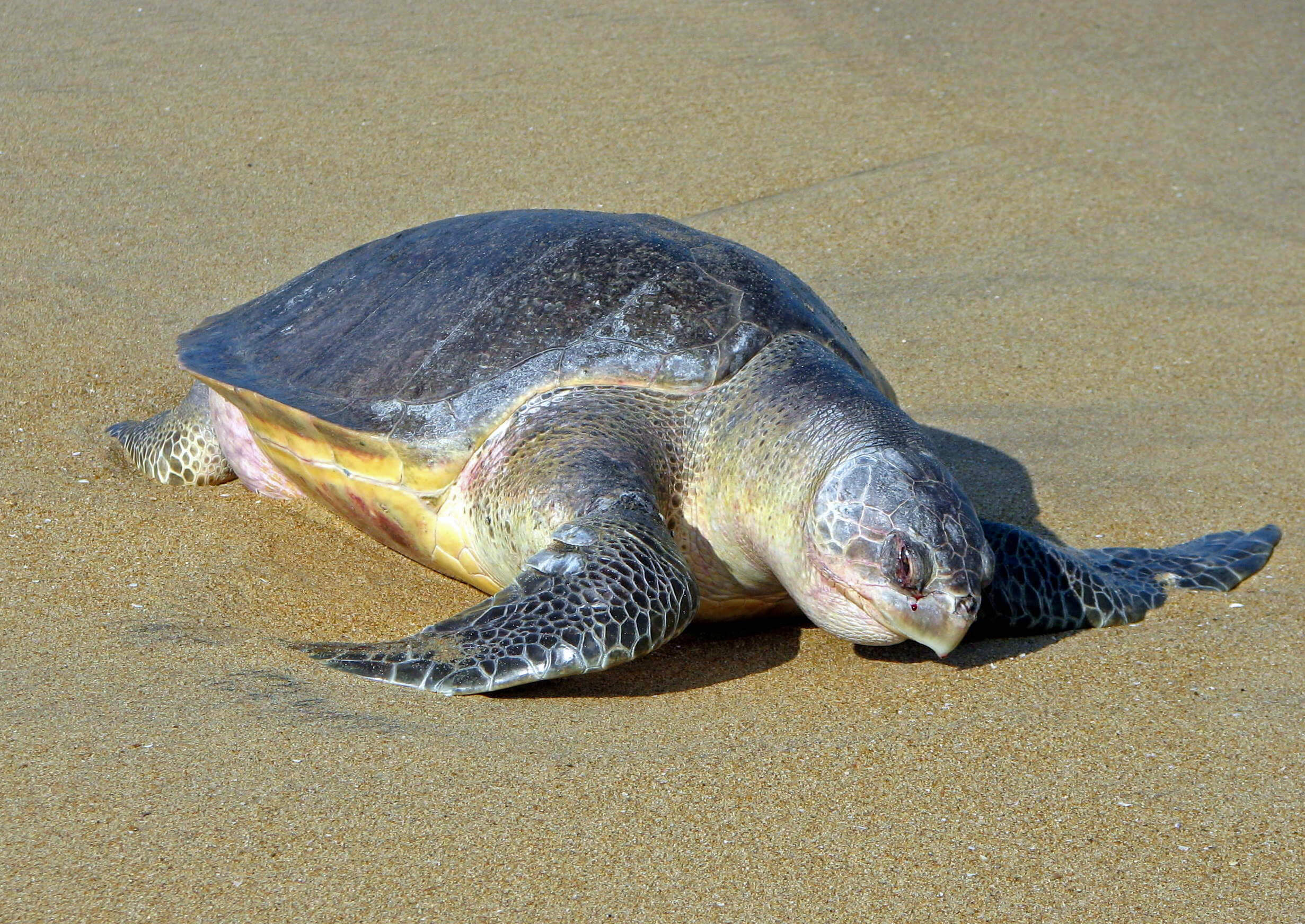
An olive ridley turtle. Credit: Wikimedia (CC)
Sea turtles are migratory species that exist beyond human conceptions of property and citizenship. Their home comprises the entire planet rather than any isolated subsection, as they must chart through numerous ecosystems to survive. The destruction of Manglaralto’s beaches would constitute more than a localized environmental disturbance; it would alter ecological relationships spanning oceanic and coastal systems.
Understanding the importance of the sea turtle and their widespread impacts, journalist Franklin Vega and lawyer Milton Castillo filed a lawsuit seeking precautionary measures against the GAD, the Ministry of the Environment, the BDE, and the Attorney General’s Office. They invoked the precautionary principle, citing the State’s obligation to prevent serious environmental damage in any situation that might pose a risk.
They relied on core standards of Ecuador’s 2008 Constitution as a foundation. The Constitution establishes nature as a subject of rights, recognizing its right to maintain life cycles and evolutionary processes, and guarantees the human right to live in an ecologically balanced environment. The malecón project would violate not only the constitutional rights of the sea turtle and the mangrove, but also those held by Manglaralto’s human residents.
In addition to the efforts of Vega and Castillo, numerous advocates within the community spoke up and filed amicus curiae, or “friend of the court,” legal briefs. From lawyers to anti-corruption activists to biologists, each perspective provided a unique piece of a larger puzzle to the court, developing a cohesive picture of the environmental destruction for a malecón project unlikely to bring any community benefit but rather accentuate existing corruption networks.
The nature defenders argued for the rights of sea turtles in the larger framework of legal precedents discussing the rights of the cloud forest, mangroves, and the mono estrella monkey. They invoked constitutional human rights as well as international and regional agreements obligating Ecuador to protect sea turtle nesting beaches.
Local organizing led the Ministry of the Environment to protect sea turtle nesting sites throughout the country. This new environmental measure de facto prohibits the construction of rigid infrastructure on any turtle nesting beach, and by extent in Manglaralto.
After a public hearing and a visit to the turtle nesting sites, the provincial court issued an acción de protección, ordering the immediate suspension of the Manglaralto malecón project.
As Manglaralto residents await the concluding sentence on the case, the judge is still considering extending an explicit form of legal personhood to the sea turtle, modeling legislation passed by Panama in 2023. This would enforce stricter protections within the province of Santa Elena.
The local defense of Manglaralto rippled across Ecuador, setting an important precedent in protecting beaches as liminal spaces for interspecies justice from the destruction of concrete.
Yet the GAD has already appealed the judge’s decision, unwilling to abandon the millions of cash flow attached to the project. The BDE still maintains free rein to allocate all remaining funds from the DAG as it wishes, likely financing future environmental catastrophes in the name of economic productivity.
Activists courageous enough to stand up against these abuses have faced the brutality of the Ecuadorian state. On June 8, anti-corruption activist Monika Silva Koniuszek was found murdered in her home. She had publicly denounced numerous environmental crimes, including the proposed malecón development in Manglaralto. Monika also exposed how politicians laundered financial interests under the guise of environmental privatization, a scheme in which Governor Villao was notably involved. Every environmental victory is backed by the bravery of activists like Monika, who risk their lives to protect their communities.
Within an extractive settler colonial state based on the appropriation of nature for profit, it is only a matter of time before a new threat arises. The mantra is profit over life.
The inevitable damage this concrete project would bring upon sea turtles cannot be understated, but nor can the hope of villagers resisting the ongoing destruction of developmental projects. The story of Manglaralto may seem irrelevant in the large scheme of things, yet it is in local practice with our feet in the sand that the fabric of life is sustained.
The human-turtle interspecies relations sustain life beyond the jurisdiction of Manglaralto, beyond Ecuador, beyond the continent of South America, and even beyond the present moment in time. The history of sea turtles blends the past with the future, playing a fundamental role in a marine balance ensuring the earth’s vitality.
There are ever more instances of environmental harm continually emerging across the globe every day. Living beings do not exist as solitary individuals, but as participants in interdependent systems. As mycologist Merlin Sheldrake describes in his book Entangled Life, threatening one element of biodiversity harms entire ecological networks.
Humanity relies on the turtle for survival just as much as the turtle depends on humanity; destroying one piece of nature’s worldwide web sentences the rest to destruction. When the turtle disappears, so do the coral reefs. When the coral reefs are destroyed, so are the oceans. Without the oceans, humanity will cease to exist.
Anishinaabe scholar Leanne Betasamosake Simpson discusses these sacred connections in Theory of Water: Nishnaabe Maps to the Times Ahead. The Anishinaabe know water as “Nibi,” whose meaning cannot be bound by the empirical world. Nibi is the force which sustains and nourishes, promoting a global rebirth of life. Nibi relates the intimate to the global.
Simpson begins her work with one simple precept: “Nibi is inside us, and it connects us to all forms of life on the planet. Nibi matters.”
The 300,000 year-old homo sapien and the 2 million year-old turtle are powered by the same life force, Nibi, each playing a crucial symbiotic role in its maintenance. One cannot survive without the other. The sooner humanity grasps this lesson, the more life will be created rather than destroyed.
Across the world right now, Indigenous peoples are facing a renewed assault on their lands, rights, and ways of life.
From extractive industries pushing deeper into ancestral territories, to governments rolling back hard-won protections,
the threat is global—and it is growing.
What makes this moment especially dangerous is how little attention it receives.
Stories like this are disappearing in real time. Mainstream media
barely covers it and the coverage is fragmented. The public is left without the context
needed to understand what is truly at stake.
That is exactly why IC Magazine exists..
For more than 20 years, IC has reported on Indigenous struggles worldwide — consistently, independently, and without compromise.
We don’t follow news cycles; we trace patterns. We don’t sensationalize; we provide context.
And when the world looks away, we stay focused.
But this work is increasingly difficult to sustain.
We refuse to lock our reporting behind a paywall. We don’t sell access through subscriptions.
And we don’t answer to advertisers. IC Magazine survives solely because readers like you choose to
support independent Indigenous journalism.
Please donate today if you can. Every contribution helps us to continue this crucial work.
Thank you,
John Ahni Schertow
Founder and Editor in Chief