

Last Updated on April 10, 2025
Indigenous and minority voices have long been suppressed in Canada’s media landscape. It’s an ironic fact given that Canada has been floating on a cloud of inclusivity since 1971, when the Canadian Government adopted multiculturalism as an official policy, “affirm[ing] the value and dignity of all Canadian citizens regardless of their racial or ethnic origins, their language, or their religious affiliation.”
“All Canadians are guaranteed equality before the law and equality of opportunity regardless of their origins”, reads the government’s website. “Canada’s laws and policies recognize Canada’s diversity by race, cultural heritage, ethnicity, religion, ancestry and place of origin and guarantee to all men and women complete freedom of conscience, of thought, belief, opinion, expression, association and peaceful assembly.” It sounds great doesn’t it? Unfortunately, it just doesn’t reflect the reality of Canada.
For the past 150 years, the Canadian State has been seeping in a brine of white nationalism that permeates Canadian lives so completely that they routinely commit acts of racism and don’t realize it.
Case in point: In the latest issue of Write, The Writers’ Union of Canada’s magazine, Hal Niedzviecki wrote an editorial announcing that he doesn’t believe in “cultural appropriation”, stating that, “Anyone, anywhere, should be encouraged to imagine other peoples, other cultures, other identities.” He then went on to say that, “There should even be an award for doing so — the Appropriation Prize for best book by an author who writes about people who aren’t even remotely like her or him.”
The asinine assertion quickly led to Niedzviecki’s resignation and an apology from the Writers’ Union of Canada.
The story should have ended there, albeit with a frank and open discussion about the actual meaning of cultural appropriation and its impact on Indigenous Peoples as well as the Canadian media’s tendency to marginalize, exploit and make a mockery of Indigenous Peoples with impunity.
Unfortunately, the situation took a hard right turn.
Ken Whyte, former editor-in-chief and publisher of Maclean’s, decided to tweet that he would donate $500 to fund an actual “appropriation prize.”
Whyte soon found support from The Walrus editor-in-chief Jonathan Kay, Maclean’s editor-in-chief Alison Uncles, and the National Post’s editor-in-chief Anne Marie Owens and about a dozen other members of Canadian media.
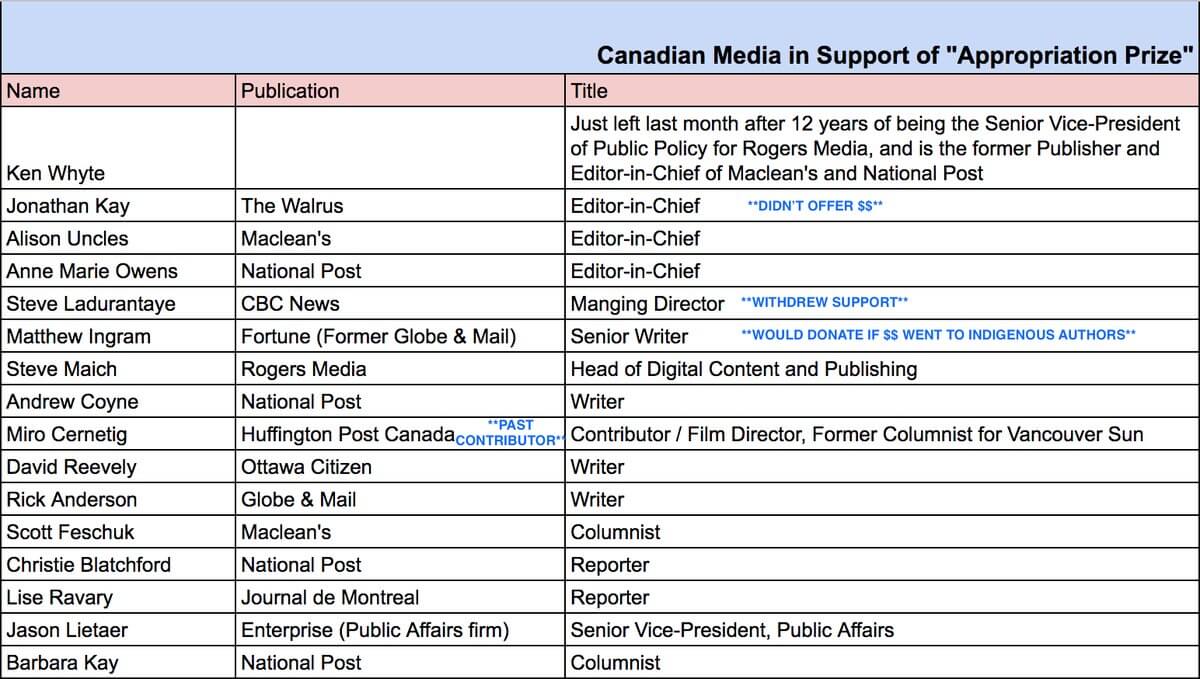
A list of the Canadian media orgs and journalists giving their own money to support a “Cultural Appropriation Prize”, edited to reflect those who’ve withdrawn support and/or written to clarify position. By @culturite
If nothing else, this is a razor sharp reminder of just how far Canadian media has to go before it can reconcile its own history of shirking responsibility toward Indigenous Peoples.
Make no mistake. This isn’t about white middle-class journalists having the courage or the right to tell stories about other peoples, other cultures, and other identities as Niedzviecki claimed in his editorial. The Canadian media landscape is already dominated by white middle-class journalists who are doing just that.
This is about white middle-class journalists, editors and publishers suppressing media diversity by appropriating opportunities for Indigenous and minority journalists. And it’s about ridiculing every Canadian’s right to access reporting that accurately and respectfully represents indigenous opinions, cultures, histories, needs and rights.
It’s also a symptom of a much deeper problem of racism in Canada that is being nurtured in no small part by the way the media continues to portray Indigenous Peoples.
For that reason, I can only hope that this preposterous call for an appropriation prize leads to something more than a few press releases and tweets.
We need more than words. We need a more inclusive and socially responsible standard in media.
We here at Intercontinental Cry are doing our part. For nearly 13 years we’ve been providing Indigenous Peoples with a platform to reach the international community. We’ve covered a lot of ground, both literally and figuratively. And now we’re stepping outside our comfort zone to launch the world’s first online indigenous journalism school, the Ka:nen School of Indigenous Journalism.
It’s going to take a lot more than a humble online school to change Canada’s media landscape, but we are going to move forward just the same. As an organization that was born out of the media’s failure to serve Indigenous Peoples, we really have no choice.
It’s time that we all start stepping forward now with innovative media projects of our own… for the sake of those who are cruelly unaware of their own racism; for those who are being strangled by silence; and yes, even those among us who desperately cling to decrepit white fences.
Across the world right now, Indigenous peoples are facing a renewed assault on their lands, rights, and ways of life.
From extractive industries pushing deeper into ancestral territories, to governments rolling back hard-won protections,
the threat is global—and it is growing.
What makes this moment especially dangerous is how little attention it receives.
Stories like this are disappearing in real time. Mainstream media
barely covers it and the coverage is fragmented. The public is left without the context
needed to understand what is truly at stake.
That is exactly why IC Magazine exists..
For more than 20 years, IC has reported on Indigenous struggles worldwide — consistently, independently, and without compromise.
We don’t follow news cycles; we trace patterns. We don’t sensationalize; we provide context.
And when the world looks away, we stay focused.
But this work is increasingly difficult to sustain.
We refuse to lock our reporting behind a paywall. We don’t sell access through subscriptions.
And we don’t answer to advertisers. IC Magazine survives solely because readers like you choose to
support independent Indigenous journalism.
Please donate today if you can. Every contribution helps us to continue this crucial work.
Thank you,
John Ahni Schertow
Founder and Editor in Chief


