
Last Updated on December 15, 2014
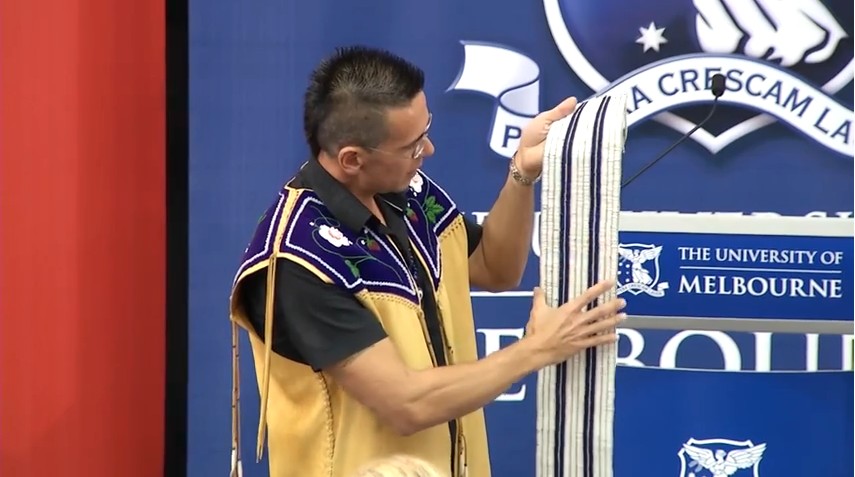
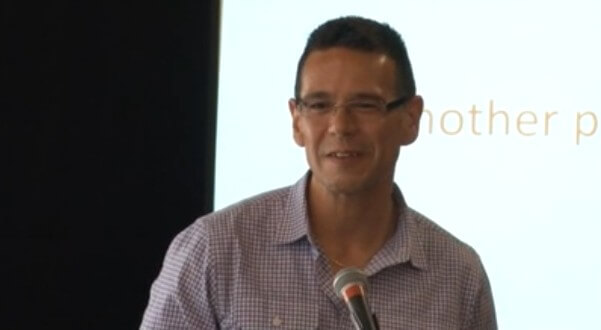
In this 90-minute lecture, Kanien’kehaka (Mohawk) professor Taiaiake Alfred examines the reality of Canada’s reconciliation framework and its failure to restore healthy relations between Onkwehonwe and Canadian society.
Lecture delivered as part of the academic conference on ‘Civic Freedom in an Age of Diversity : James Tully’s Public Philosophy’ at the University of Quebec in Montreal, April 24-26 2014.
A Professor in Indigenous Governance and in the Department of Political Science at the University of Victoria, Taiaiake Alfred is a specialist in studies of traditional governance, the restoration of land-based cultural practices, and decolonization strategies. An indigenous intellectual of international renown, he is the author of many scholarly publications and writings, including Wasáse (Broadview, 2005); Peace, Power, Righteousness (Oxford University Press, 1999/2009); and Heeding the Voices of Our Ancestors (Oxford University Press, 1995).
Across the world right now, Indigenous peoples are facing a renewed assault on their lands, rights, and ways of life.
From extractive industries pushing deeper into ancestral territories, to governments rolling back hard-won protections,
the threat is global—and it is growing.
What makes this moment especially dangerous is how little attention it receives.
Stories like this are disappearing in real time. Mainstream media
barely covers it and the coverage is fragmented. The public is left without the context
needed to understand what is truly at stake.
That is exactly why IC Magazine exists..
For more than 20 years, IC has reported on Indigenous struggles worldwide — consistently, independently, and without compromise.
We don’t follow news cycles; we trace patterns. We don’t sensationalize; we provide context.
And when the world looks away, we stay focused.
But this work is increasingly difficult to sustain.
We refuse to lock our reporting behind a paywall. We don’t sell access through subscriptions.
And we don’t answer to advertisers. IC Magazine survives solely because readers like you choose to
support independent Indigenous journalism.
Please donate today if you can. Every contribution helps us to continue this crucial work.
Thank you,
John Ahni Schertow
Founder and Editor in Chief