Last Updated on June 18, 2014
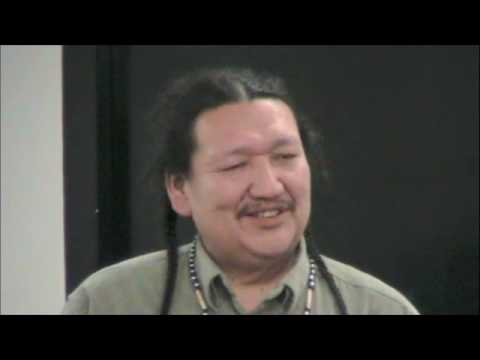
Kanien’kehaka Educator, Author and Activist Taiaiake Alfred talks about the realities and challenges of nativism, decolonization and indigeneity in this lecture, entitled, From Noble Savage to Righteous Warrior: Regenerating and Reinscribing Indigenous Presence.
An internationally recognized Kanien’kehaka (Mohwak) intellectual and political advisor, Taiaiake Alfred is well known for his incisive critiques and groundbreaking work in the fields of Indigenous governance and political philosophy.
In the past, Taiaiake has served as an advisor on land and governance and cultural restoration issues for many indigenous governments and organizations, and he has authored several important books including Wasáse: Indigenous Pathways of Action and Freedom and Peace, Power, Righteousness. Currently, Taiaiake serves as a Professor of Indigenous Governance at the University of Victoria.
On March 6, 2010, Taiaiake was in Vancouver to deliver this welcomed lecture as part of the Global Encounters Initiative Symposium at the University of British Columbia (UBC).
Speaking for a little under an hour, Taiaiake takes the time to explore a number of essential observations concerning the realities and consequences of nativism, the process of decolonization on a personal and collective level, and the heart of what it means to be “indigenous.”
A big thanks to UBC for fixing this video. To see more great lectures from the Global Encounters Initiative Symposium, please visit http://www.youtube.com/user/UBC
Across the world right now, Indigenous peoples are facing a renewed assault on their lands, rights, and ways of life.
From extractive industries pushing deeper into ancestral territories, to governments rolling back hard-won protections,
the threat is global—and it is growing.
What makes this moment especially dangerous is how little attention it receives.
Stories like this are disappearing in real time. Mainstream media
barely covers it and the coverage is fragmented. The public is left without the context
needed to understand what is truly at stake.
That is exactly why IC Magazine exists..
For more than 20 years, IC has reported on Indigenous struggles worldwide — consistently, independently, and without compromise.
We don’t follow news cycles; we trace patterns. We don’t sensationalize; we provide context.
And when the world looks away, we stay focused.
But this work is increasingly difficult to sustain.
We refuse to lock our reporting behind a paywall. We don’t sell access through subscriptions.
And we don’t answer to advertisers. IC Magazine survives solely because readers like you choose to
support independent Indigenous journalism.
Please donate today if you can. Every contribution helps us to continue this crucial work.
Thank you,
John Ahni Schertow
Founder and Editor in Chief