Last Updated on August 3, 2018

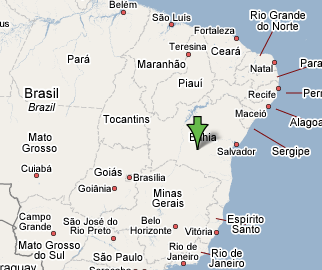
The Cimi-Assessoria de Imprensa, announced today that on August 28, the Brazilian government signed two decrees for the Tupinikim/Guarani, granting them title to 18,070 hectares of lands in the municipality of Aracruz, state of Espirito Santo, Brazil.
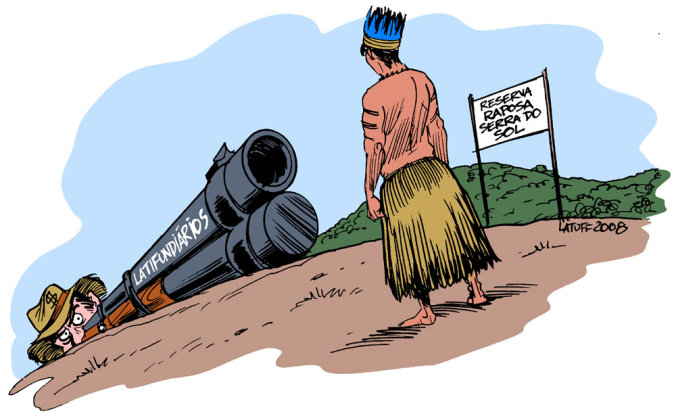
You may recall, late last month the Tupinikim/Guarani began a campaign to reclaim their lands. They set out exactly as they had announced, but just two weeks later, on August 11, they were once again evicted.
This recent decision, published in the Federal State Gazette and signed by the Minister of Justice Tarso Genro, is being celebrated by all the seven Tupinikim and Guarani villages.
Let’s just hope Aracruz Cellulose leaves it at that.
From Discovered and Conquered – Cimi-Assessoria de Imprensa, imprensa@cimi.org.br, announced today that the Brazilian government signed on August 28 demarcation decrees for the ownership of Tupinikim/Guarani lands
This historical decision was published in the Federal State Gazette by means of two ministeral decrees, no. 1463 and 1464, signed by the Minister of Justice Tarso Genro, declaring 18,070 hectares of lands in the municipality of Aracruz, state of Espirito Santo, Brazil, as indigenous lands, belonging to the Tupinikim and Guarani peoples. Before this decision, only 7,061 ha had been demarcated and another 11,009 ha had not, and continued being invaded by the eucalyptus and celulose producing company Aracruz Celulose. By means of this decision, the brazilian government fulfilled the brazilian constitution that says that it is the responsiblity of the government to demarcate lands, traditionally occupied by indigenous peoples and necessary for their physical and cultural survival.
The victory has been and continues being celebrated by all the seven Tupinikim and Guarani villages. Yesterday, the Chiefs declared that this victory is both a result from their union, their courage and determination to struggle for the lands they were evicted from in the past, guaranteeing the future of their children, but at the same time, this victory was also possible because of a strong network of support, both in Brazil as well as outside Brazil. (source)
for the ownership of Tupinikim/Guarani lands
Across the world right now, Indigenous peoples are facing a renewed assault on their lands, rights, and ways of life.
From extractive industries pushing deeper into ancestral territories, to governments rolling back hard-won protections,
the threat is global—and it is growing.
What makes this moment especially dangerous is how little attention it receives.
Stories like this are disappearing in real time. Mainstream media
barely covers it and the coverage is fragmented. The public is left without the context
needed to understand what is truly at stake.
That is exactly why IC Magazine exists..
For more than 20 years, IC has reported on Indigenous struggles worldwide — consistently, independently, and without compromise.
We don’t follow news cycles; we trace patterns. We don’t sensationalize; we provide context.
And when the world looks away, we stay focused.
But this work is increasingly difficult to sustain.
We refuse to lock our reporting behind a paywall. We don’t sell access through subscriptions.
And we don’t answer to advertisers. IC Magazine survives solely because readers like you choose to
support independent Indigenous journalism.
Please donate today if you can. Every contribution helps us to continue this crucial work.
Thank you,
John Ahni Schertow
Founder and Editor in Chief