Last Updated on November 29, 2013
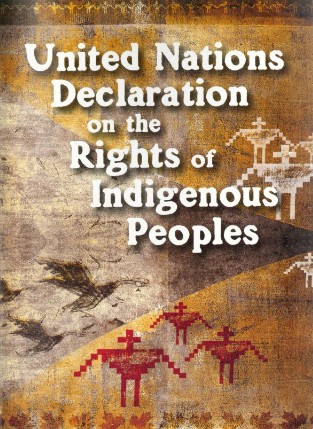
The Quinault Indian Nation hosted a UN Member States’ Reception on May 20, 2013 on the first day of the 12th Session of the UN Permanent Forum on Indigenous Issues (Now dubbed the UN Permanent Forum on Indigenous Rights). Quinault was joined by the Tlingit and [Haida], Navajo and the Wampanoag as co-hosts. That quiet affair upset the US government’s Department of State since the US government had not been invited. In an effort to win the upper hand over these nations’ efforts the US Mission to the UN proposed that the Department of State hold a listening session inviting all Indians interested to Washington, DC. The listening session was to take place on August 7th, but since the invitation was issued only a week or two before the proposed event and since it was not a meeting between Indian nations and the US government organized as a “government-to-government meeting” Indian governments rejected the proposal.
Representatives of the White House intervened in an effort to help set up an intergovernmental meeting and tribal leaders agreed to meet with the Department of State if the meeting was organized as an intergovernmental dialogue and it would take place in October. Ultimately the representative of the Department of State entered into exchanges of proposals with key tribal leaders, but after agreement was set on twelve of fifteen process and modality proposals the only points on which there would not be agreement were:
1. conducting the meeting as an intergovernmental dialogue where substantive exchanges of policy positions concerning implementation of the United Nations Declaration on the Rights of Indigenous Peoples could take place; and
2. establishing an understanding on the modalities for the World Conference on Indigenous Peoples to convene in New York City in September 2014.
The Department of State chose to cut off further letter exchanges and announced its listening session would go forward. After apparent consideration of the possibility that Indian governments would not participate unless their minimal terms were met, the listening session was called off.
While states’ governments like Sweden, Czech Republic, Lithuania, Belgium, Mexico and Germany have taken steps to engage indigenous governments directly to carry on a dialogue about implementation of the UN Declaration and modalities for the World Conference, the United States government has essentially failed to do so even when the most compromising proposals for such a dialogue have been presented.
The beginning of a global dialogue on Indigenous Rights has essentially begun and will continue through the World Conference on Indigenous Peoples and beyond. Indigenous governments have stepped up to the plate and are organizing to engage the international community in unprecedented fashion. The United States government had opposed the UN Declaration on the Rights of Indigenous Peoples all during its development in the 1980s right up to the UN General approval in 2007. Not until 2010 did the US government budge from its position of opposition to this important statement of principles and mandates among states’ governments. Yet, when all was said and done the Obama administration’s Department of State expressed doubts and rejected the principle of “free, prior and informed consent” (which would be required before state policies affecting the rights and interests of indigenous peoples could go ahead) even as it stated that the government “endorsed” the Declaration.
The Department of State’s behavior in response to a modest reception in New York for UN Missions was to call a listening session and then essentially reject indigenous government compromises and proposals for a fair and democratic dialogue on the implementation of the Declaration. After announcing the meeting the Department of State abruptly cancelled. This is the first post-UNDRIP endorsement “match” between indigenous governments and the United States government–and the US government lost. The US government needs to affirm its commitment to democratic dialogue and yet it failed the first test with indigenous nations.
Indigenous governments continue to move forward with their agenda to implement important parts of the UN Declaration and promote international dialogue.
Across the world right now, Indigenous peoples are facing a renewed assault on their lands, rights, and ways of life.
From extractive industries pushing deeper into ancestral territories, to governments rolling back hard-won protections,
the threat is global—and it is growing.
What makes this moment especially dangerous is how little attention it receives.
Stories like this are disappearing in real time. Mainstream media
barely covers it and the coverage is fragmented. The public is left without the context
needed to understand what is truly at stake.
That is exactly why IC Magazine exists..
For more than 20 years, IC has reported on Indigenous struggles worldwide — consistently, independently, and without compromise.
We don’t follow news cycles; we trace patterns. We don’t sensationalize; we provide context.
And when the world looks away, we stay focused.
But this work is increasingly difficult to sustain.
We refuse to lock our reporting behind a paywall. We don’t sell access through subscriptions.
And we don’t answer to advertisers. IC Magazine survives solely because readers like you choose to
support independent Indigenous journalism.
Please donate today if you can. Every contribution helps us to continue this crucial work.
Thank you,
John Ahni Schertow
Founder and Editor in Chief