Last Updated on September 7, 2025
The Wayuu Indigenous communities of Arroyo Guerrero in Colombia have formally denounced before international bodies a pattern of structural environmental racism and systematic violations of their human and environmental rights.
Three official letters have been sent to the Office of the United Nations High Commissioner for Human Rights (OHCHR), the Escazú Agreement Mechanism, and the Inter-American Commission on Human Rights (IACHR). The documents show that local authorities have promoted an urban development project that violates the Escazú Agreement, disregards rulings of the Constitutional Court, and threatens strategic ecosystems.
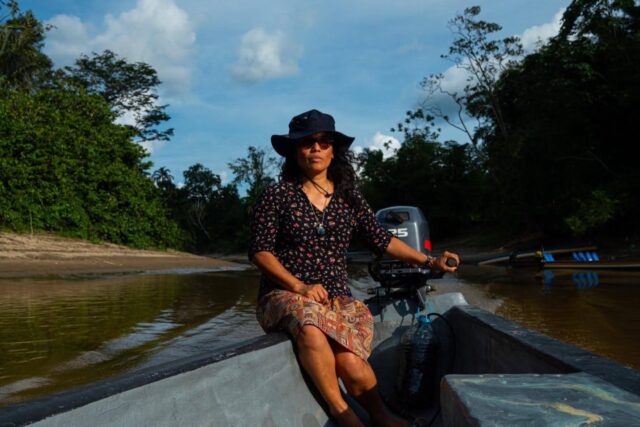
Death threats have been recorded against a Wayuu Indigenous woman leader for her defense of the territory against this mega infrastructure project, further aggravating the risk faced by environmental and human rights defenders in the region.
The conflict in Arroyo Guerrero mirrors what occurred in the Arroyo Bruno case, where the imposition of projects without prior consultation and a lack of transparency severely impacted Indigenous and Afro-descendant communities.
In this case, key rulings such as T-129/11 and, in particular, T-556/17—which safeguard ecosystems and guarantee the genuine participation of ethnic peoples—are being ignored. The Escazú Agreement is also being violated, which requires States to ensure access to information, public participation, environmental justice, and protection for environmental defenders.
Documented evidence points to the possible indirect involvement of a European-based company in activities related to this project, raising serious questions about its compliance with internationally recognized environmental and human rights standards.
One of the most striking pieces of evidence is a certificate of no impact issued by local authorities, stating that the project does not affect Indigenous communities.
However, cartographic images and demographic data included in the complaints clearly show that the project area overlaps with Wayuu territories and settlements.
“It is unacceptable for an official document to deny a reality backed by maps, censuses, testimonies, and our ancestral presence, attempting to erase our existence,” the communities stated.
Communities exercising their constitutional right to legal defense have been accused of “bad faith” by local authorities.
This accusation—lacking any factual or legal basis—constitutes an act of institutional harassment prohibited by the Escazú Agreement, Constitutional Court jurisprudence, and international standards set by the OHCHR and IACHR, which forbid reprisals against environmental defenders.
The Wayuu Indigenous communities affected by the PTAR in Arroyo Guerrero still do not know:
The absence of these responses prevents the communities and the public from assessing the true legality and viability of the project.
The communities call on national and international media to investigate and expose this situation, which threatens not only Arroyo Guerrero and its Indigenous population but also the coastal and marine ecosystems of La Guajira.
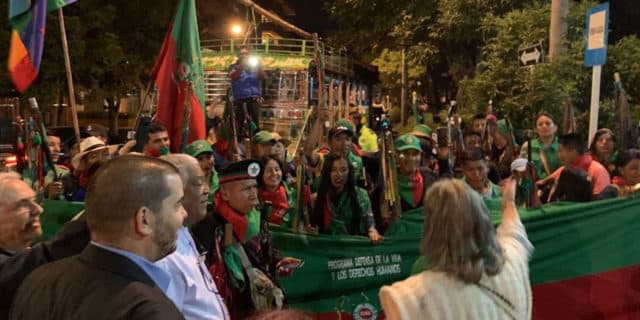
The communities of Arroyo Guerrero face an imminent risk of new threats for defending water, land, and life. Before tragedy strikes, we make this public call for journalists, organizations, and human rights defenders to amplify their voices and demand immediate protection.
From the word that protects and the water that gives life, we affirm that our struggle is not against people, but against injustice. We stand here, with dignity and memory, to defend what we are and what belongs to all, the land, the water, and the truth.
Water is spirit, the land is mother, and the word is life. To defend them is to live; to lose them is to die forever.
Press Contact:
Wayuu Indigenous Communities of Arroyo Guerrero
Municipality of Ríohacha, La Guajira, Colombia
Email: Mmapaa Ewainyusu PTAR mmapaaewainyusuptar@gmail.com
Across the world right now, Indigenous peoples are facing a renewed assault on their lands, rights, and ways of life.
From extractive industries pushing deeper into ancestral territories, to governments rolling back hard-won protections,
the threat is global—and it is growing.
What makes this moment especially dangerous is how little attention it receives.
Stories like this are disappearing in real time. Mainstream media
barely covers it and the coverage is fragmented. The public is left without the context
needed to understand what is truly at stake.
That is exactly why IC Magazine exists..
For more than 20 years, IC has reported on Indigenous struggles worldwide — consistently, independently, and without compromise.
We don’t follow news cycles; we trace patterns. We don’t sensationalize; we provide context.
And when the world looks away, we stay focused.
But this work is increasingly difficult to sustain.
We refuse to lock our reporting behind a paywall. We don’t sell access through subscriptions.
And we don’t answer to advertisers. IC Magazine survives solely because readers like you choose to
support independent Indigenous journalism.
Please donate today if you can. Every contribution helps us to continue this crucial work.
Thank you,
John Ahni Schertow
Founder and Editor in Chief