Last Updated on June 8, 2026
In 2017, residents living along Guatemala’s San Román River watched the water turn brown. Fish floated lifelessly to the surface, foul odors spread through nearby villages, and families reported contaminated drinking water. For the Q’eqchi’ Maya communities who depend on the San Roman River, the disaster was not simply environmental, it threatened an entire way of life.
The contamination was directly linked to the rapid expansion of industrial palm oil plantations in the region of Petén, part of a broader agribusiness industry that has destroyed forests and rivers, continuously encroaching on Indigenous territories across Latin America. Palm oil has become one of the world’s most profitable agricultural commodities, used in products ranging from cosmetics to processed foods. Yet behind the industry’s promises of “sustainable development” lies a brutal reality of violent dispossession and escalating environmental degradation.
The San Román River, located in Guatemala’s Petén region, forms part of the larger Usumacinta watershed, one of the most ecologically important freshwater systems in Central America. For centuries, Maya communities have cared for these waterways on which they depend for drinking water, fishing and farming, transportation, and spiritual practices.
Among many Q’eqchi’ Maya communities, water is not viewed as a resource to be extracted. Similarly to the Lakota who say MniWikoni, water is life for the Q’eqchi’ who consider rivers as living entities deserving of care and respect.
The San Roman River is one of their closest relatives. Q’eqchi’ Maya leader Saul Paau Maaz explains that the Maya concept of nawal reflects the spiritual interconnectedness between humans, animals, rivers, forests, and the broader natural world, emphasizing that people are only one part of a larger living system. “The Earth is not ours; we merely borrow it from our sons, daughters, and grandchildren,” he says.
Guatemala has constitutional protections for Indigenous rights and environmental health, yet palm oil agribusiness is expanding dangerously across Indigenous territories, exposing the widening gap between legal recognition and lived reality. Guatemala already faces a national water crisis, with the majority of rivers and freshwater systems now heavily polluted or overexploited.
The struggle to protect the San Román River is not an isolated environmental conflict, but part of a broader global crisis in which so-called “development” justifies the dispossession of Indigenous peoples, the destruction of ecosystems, and the erosion of relational ways of life between human and more than human life.
These conflicts raise urgent questions. What happens when states and corporations prioritize extractive profit over the survival of human and more-than-human communities? Why are legal and political frameworks defending indigenous peoples and nature repeatedly incapable of preventing harm?
The answer lies in the persisting structures, rather than the events.
Palm oil monoculture is the latest chapter in a long history of dispossession, extraction, and abusive power. For centuries, Indigenous Maya communities have faced land seizures, forced displacement, genocidal violence, and exclusion from political power, dating back to the Spanish Conquistadors in the 16th century. During Guatemala’s civil war from 1960 to 1996, Indigenous communities were disproportionately targeted in acts later recognized as genocide.
Today, many activists and scholars argue that modern extractive industries continue these patterns through environmental destruction and corporate control of Indigenous lands. As Juan Castro and Manuela Picq put it, “colonialism did not end with independence; its logic shifted to settler colonialism shaped by the capitalist imperative of extraction and dispossession.”
In The Fourth Invasion, Giovanni Batz explains that Maya communities understand contemporary extractive projects as a continuation of earlier waves of colonial violence, as demonstrated by plantation economies that fuel land dispossession, and most atrociously, genocidal violence through armed conflict.
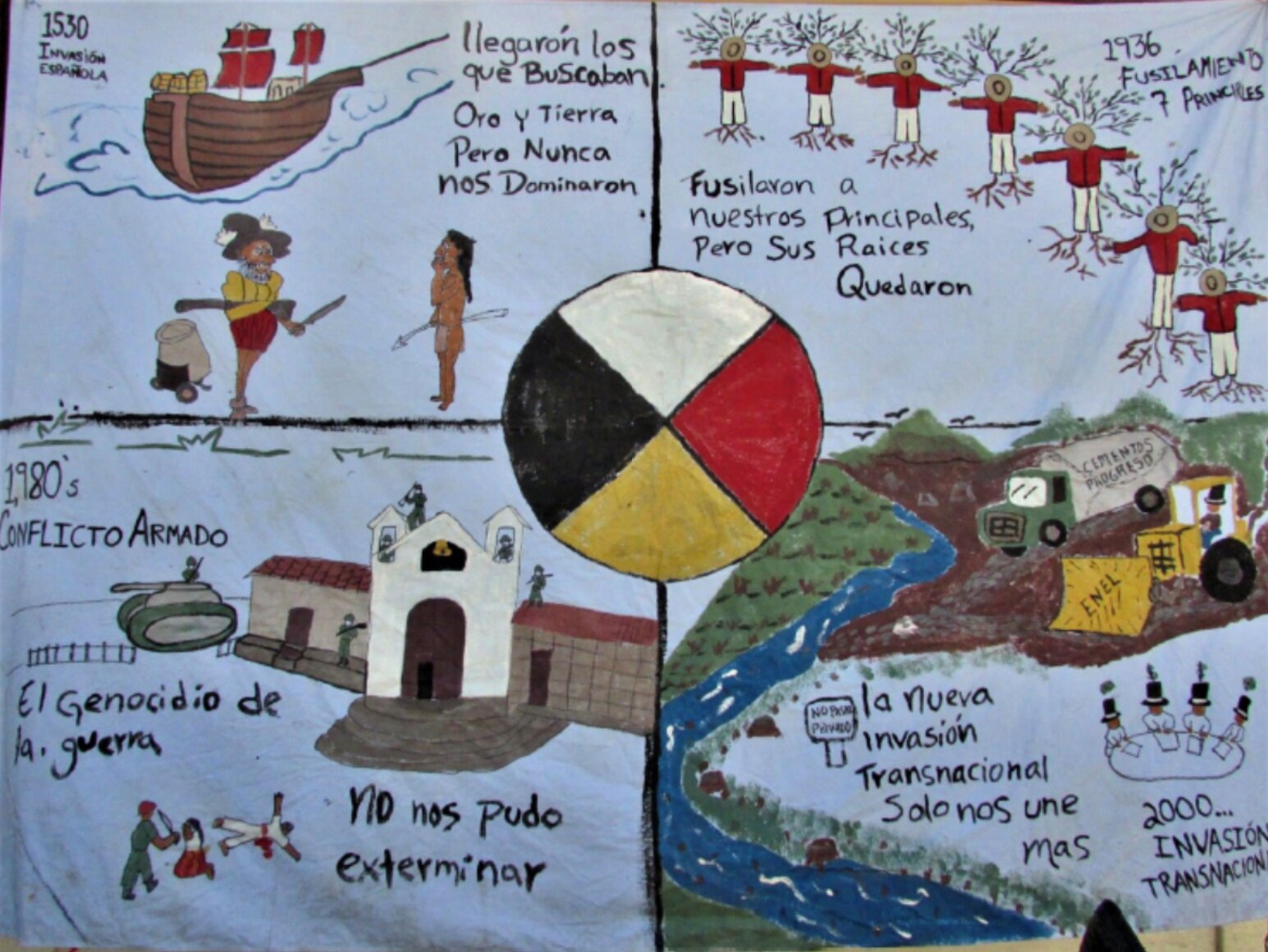
Image from The Fourth Invasion, a drawing created by a young child that documents the ongoing dispossession of Maya communities in Guatemala through extractive industries and territorial expansion. The piece situates the contemporary expansion of oil palm cultivation within a broader historical pattern of colonialism, land appropriation, environmental destruction, and violence against Indigenous peoples, as current agro-industrial extraction reproduces historical structures of dispossession that impact Maya territories. (Source)
The “fourth invasion” refers to the modern expansion of extractive industries, including mining, hydroelectric projects, and agribusiness. It reveals ongoing patterns of displacement, destruction, and erasure under the language of modernization. Palm oil monocultures reproduce the same structures of domination and extraction that Indigenous communities in Guatemala have resisted and suffered from for centuries.
Petén is one of the most biodiverse areas in Central America, home to lush tropical forests and wetlands that shelter endangered wildlife including jaguars. Petén is also deeply intertwined with the history and continuity of Maya civilization. There are several ancient Maya cities nearby, including Tikal, one of the most powerful political, economic, and military centers of the ancient Mesoamerican world in the eighth century AD. These landscapes are not only environmentally significant, but culturally and spiritually embedded within Indigenous memories, governance, and relations to land.
Yet biodiverse ecosystems that hold millennia of history are increasingly being destroyed to make space for industrial monocultures. Dense rainforests that sustain interconnected species are transformed into symmetrical rows of identical palm trees cultivated for export markets. Maya lifeways are erased for profit on global markets.
Although corporations frequently market palm oil as “sustainable agroforestry,” scientists have repeatedly debunked the myth of green agribusiness, proving why monoculture plantations are not forests. They drastically reduce biodiversity, fragment wildlife habitat, and depend heavily on chemical fertilizers and pesticides. Research has shown that palm oil expansion contributes to freshwater contamination, soil degradation, and biodiversity loss across tropical regions. Most recently, palm oil plantations have increasingly jeopardized the nesting and mating patterns of the famously recognized Scarlet Macaw bird.
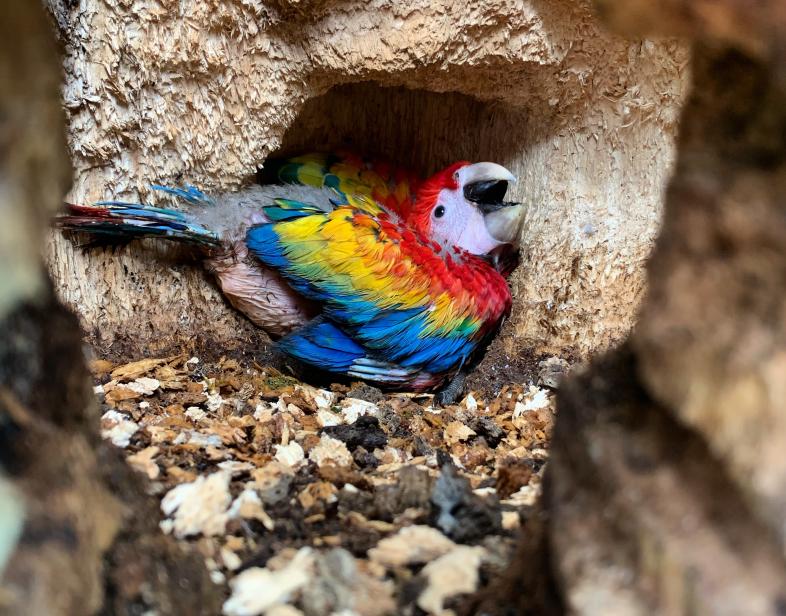
The most pressing threat to Macaw populations is the loss of nesting habitat, which has increased exponentially in Mexico and Guatemala, where many Macaw populations inhabit. Agroforestry is a main cause of this loss of habitat, forcing them to lose their nests and become more vulnerable, as depicted in the picture above. (Source)
But for Maya communities, the harm is not merely ecological. It is a disruption of their entire lifestyle.
In addition to destroying the ancestral homelands, agribusiness is murdering their non-human relatives. Rivers hold spiritual and cultural significance deeply tied to collective memory. Maya understandings of water emphasize reciprocity and stewardship, recognizing rivers as living beings. What many see as environmental destruction may be read as murder of extended family in Maya worldviews.
In Is a River Alive?, Macfarlane argues that the capitalist logic is ultimately self-defeating because in seeking to maximize what rivers can provide economically, extractive industries simultaneously diminish the rivers’ ability to continue providing clean water, biodiversity, ecological balance, and life itself.
Palm oil agribusiness is water-grabbing. Studies conducted in Guatemala’s northern lowlands indicate that rivers near palm oil plantations show murkier water, higher temperatures, and dramatically lower aquatic biodiversity. Fertilizer runoff contributes to eutrophication, a process where excess nutrients trigger algal blooms that deplete oxygen in waterways and suffocate aquatic life.
For communities living along the San Román River, these impacts are deeply personal. Water contamination affects drinking supplies, subsistence farming, and fishing practices that families have relied on for generations. Women often bear disproportionate burdens, traveling farther to collect clean water while caring for relatives suffering from water-related illnesses. Exposure to chemically contaminated and polluted water has been linked to serious health risks including gastrointestinal disease, neurological damage, reproductive disorders, endocrine disruption, and increased rates of cancer, particularly in communities experiencing long term exposure to industrial and agricultural runoff.
Nature defenders who challenge extractive industries face intimidation, criminalization and violence. Human rights organizations have documented killings, disappearances, death threats, arbitrary arrests, and harassment directed at activists, community leaders, journalists, and Indigenous land defenders who oppose projects linked to palm oil, mining, hydroelectric development. In many cases, communities confronting extractive destruction are met with militarization, surveillance, and the use of state institutions to suppress dissent and protect corporate interests. Not meaningful legal protection.
In fact, palm oil monocultures in Peten depend on the marginalization of Indigenous communities whose relationships to land and water directly challenge dominant models of development. Environmental destruction and human rights abuses become inseparable, producing not only ecological collapse, but ongoing social crises marked by forced displacement, cultural erasure, and the systematic undermining of self-determination.
Scholars refer to this process as “water grabbing,” a form of resource appropriation in which powerful states and corporations seize control over water systems through extraction, diversion, privatization, or contamination in ways that undermine local communities’ survival. Unequal power structures allow private interests to monopolize rivers, aquifers, and watersheds while externalizing the environmental and social costs onto Indigenous and rural communities. Communities are left with water scarcity, pollution, and the disruption of traditional relations to territory as corporations accumulate profit.
The defense of the San Román River is not only against contamination, it is against another invasion that erases and replaces Maya lifeways. It is about ongoing colonial power that grabs land, water, and the future of Indigenous peoples in their human and more than human forms.
What makes the situation of the San Roman River particularly alarming is that many of these harms persist despite existing legal protections. Guatemala’s constitution recognizes Indigenous cultural rights, environmental protection, and the right to health. International agreements, including the United Nations Declaration on the Rights of Indigenous Peoples and ILO Convention 169, affirm Indigenous peoples’ rights to maintain control over ancestral territories and require meaningful consultation before development projects proceed. Yet Indigenous communities report exclusion from decision-making processes while the state overlooks environmental regulations.
The struggle to defend the San Román River ultimately reveals the limitations of legal and political systems that continue to prioritize extraction over relational forms of life. While Indigenous rights and environmental protections may exist on paper, they remain insufficient when states and corporations continue to profit from pollution.
Addressing these harms requires moving beyond superficial recognition of Indigenous rights toward genuine practices of self-determination grounded in territorial autonomy, meaningful consent, and respect for Indigenous epistemology. For Q’eqchi’ Maya communities, rivers, forests, and ecosystems are living relatives embedded within collective memory, spirituality, and reciprocal obligations. Recognizing these relationships challenges dominant extractive models that separate humans from the natural world.
Around the world, growing movements for the rights of nature are challenging legal systems that continue to treat rivers, forests, and ecosystems as property available for exploitation. As long as rivers like the San Román remain codified as objects for extraction in the eyes of the law, they will continue to be subordinated to corporate and state interests.
Recognizing rights of nature offers an alternative approach by acknowledging rivers as living entities with intrinsic value and enforceable rights to exist, regenerate, and be protected from harm. For the Q’eqchi’ Maya communities defending the San Román River, such recognition would not only strengthen environmental protection, but also affirm more than human relationality.
In the face of accelerating climate collapse and biodiversity loss, recognizing the rights of nature is no longer a progressive choice. It is becoming a matter of life-or-death if we want humanity to survive centuries of deadly extractive systems.
Across the world right now, Indigenous peoples are facing a renewed assault on their lands, rights, and ways of life.
From extractive industries pushing deeper into ancestral territories, to governments rolling back hard-won protections,
the threat is global—and it is growing.
What makes this moment especially dangerous is how little attention it receives.
Stories like this are disappearing in real time. Mainstream media
barely covers it and the coverage is fragmented. The public is left without the context
needed to understand what is truly at stake.
That is exactly why IC Magazine exists..
For more than 20 years, IC has reported on Indigenous struggles worldwide — consistently, independently, and without compromise.
We don’t follow news cycles; we trace patterns. We don’t sensationalize; we provide context.
And when the world looks away, we stay focused.
But this work is increasingly difficult to sustain.
We refuse to lock our reporting behind a paywall. We don’t sell access through subscriptions.
And we don’t answer to advertisers. IC Magazine survives solely because readers like you choose to
support independent Indigenous journalism.
Please donate today if you can. Every contribution helps us to continue this crucial work.
Thank you,
John Ahni Schertow
Founder and Editor in Chief