
Last Updated on April 10, 2025
Canada and Ecuador’s new free-trade agreement is threatening the rights of Indigenous peoples and their territories, and increasing social and environmental conflicts across the country. These are just some of the concerns being brought forward by the National Confederation of Indigenous Peoples in Ecuador and other civil rights organizations in the country.
The free-trade agreement signed on Feb. 4 is being heralded by Global Affairs Canada for promoting trade, business and investment. Once ratified, the agreement will eliminate tariffs and other barriers to open access to foods, services and investment between the two countries. The agreement is a crucial part of Canada’s larger global trade diversification strategy.
But Indigenous communities across Ecuador reject the agreement entirely. Mining Watch Canada, a non-governmental watchdog of Canada’s mining industry, also argues the deal has come without proper consent. In a letter written to Justin Trudeau while he was still prime minister, they said the agreement will have implications for human rights and the environment in Ecuador.
Canada is one of Ecuador’s biggest foreign investors. Around C$1.8 billion of this investment is in Ecuador’s mining industry. At least 15 Canadian mining companies currently operate in Ecuador.
Opponents of the free-trade agreement argue the open market will only further encourage Canadian mining development in the country. This development will disproportionately affect Indigenous people and their territories. It will also likely lead to an increase in human rights abuses and environmental exploitation in the region.
Canadian mining companies have a long history of human rights abuses and environmental destruction in Latin America. According to a 2023 report by the non-profit Amazon Watch, of the 37 Canadian mining projects that happened that year, 24 had violated Indigenous peoples’ rights to territory and self-determination.
Mining Watch Canada also presented a report to the House of Commons in 2023 on the global harm perpetrated by Canadian mining companies abroad. These harms included widespread violence, targeted deaths and the criminalization of anti-mining protesters. Sexual assaults by mining security, forced labour, evictions and environmental harm all received a blind eye abroad in place of economic diplomacy.
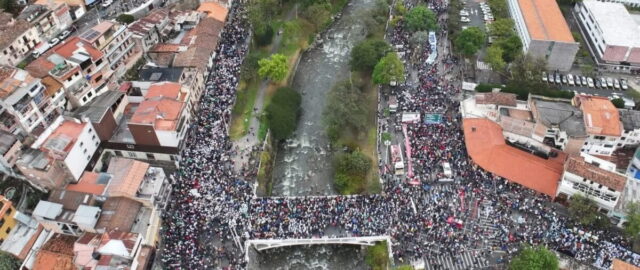
Over the last year, anti-mining protests in Ecuador have been led by Indigenous communities against numerous Canadian mining projects. Activists have been fighting to protect their rights and stop the illegal expansion of mining projects in Indigenous territories.
Activists who have rejected projects on their lands have been threatened, experienced violence and been criminalized as a result. Some protesters have even been labelled “terrorists” and charged when protesting for their rights and the rights of nature.
Foreign companies operating in Ecuador aren’t being held accountable for violating the United Nations Declaration on the Rights of Indigenous Peoples. Nor are companies adhering to the country’s constitution — though legally they’re required to.
The UN’s Declaration on the Rights of Indigenous Peoples recognizes the spiritual, cultural, environmental and social interconnection of land or territories with Indigenous people. It acknowledges that the cultural practices, livelihoods and health practices that people carry out within these territories are deeply connected to their ancestral lands.
According to the declaration, Indigenous peoples must be consulted regarding any changes in or within their lands. They reserve the right to determine the use and development of their lands. They also have the right to determine any readdress needed to mitigate adverse environmental, economic, social, cultural or spiritual impacts.
The UN’s declaration was ratified by Ecuador in 2007. In 2021, Canada affirmed the declaration as a human rights instrument to interpret and apply within Canadian law. Indigenous rights are also embedded into Ecuador’s constitution.
But Indigenous rights are being disregarded in Ecuador in place of economic gain.
The free-trade agreement was negotiated by Ecuadorian President Daniel Noboa’s administration. His administration has consistently encouraged and invited Canadian foreign mining investment onto Indigenous territory with little to no regard for their legal obligation to consult with Indigenous peoples in the region.
This means that under the new free-trade agreement, Canadian companies will continue to operate as if shielded from prosecution for any environmental damage and community destruction they cause.
Leaders of the Indigenous rights movement in Ecuador believe this free-trade agreement was negotiated to help expand mining operations in the region. Their concerns about the agreement have also been echoed by Canadian unions. The expansion of mining operations would also pose devastating impacts to Ecuador’s critical, biologically diverse flora and fauna — as well as to the livelihoods that rely on it.
Mining projects cause environmental destruction such as deforestation, air and water pollution, carbon emissions and biodiversity loss. Expanding mining projects in Ecuador would increase the risks of contamination to already fragile waterways. Damage and pollution from the mining industry risks further destruction of the Amazon rain forest, which plays a critical role in protecting against climate change.
Many of Earth’s remaining flourishing ecosystems and biological hotspots are stewarded by Indigenous Peoples. But what was once a progressive state praised for its support of its Indigenous nations and for embedding the rights of nature into its constitution, Ecuador is now a state that seems to have lost its way.
This free-trade agreement does hold great potential in boosting economic trade, relationships and investment between Ecuador and Canada countries. However, it’s important this new agreement prioritizes the protection of healthy ecosystems and the sovereignty of the Indigenous peoples that call the region home.
Mining companies must also be held to account for their actions and the human rights abuses and environmental destruction they have caused.
Martina Jakubchik-Paloheimo, PhD Candidate, Department of Geography and Planning, Queen’s University, Ontario
This article is republished from The Conversation under a Creative Commons license. Read the original article.
Across the world right now, Indigenous peoples are facing a renewed assault on their lands, rights, and ways of life.
From extractive industries pushing deeper into ancestral territories, to governments rolling back hard-won protections,
the threat is global—and it is growing.
What makes this moment especially dangerous is how little attention it receives.
Stories like this are disappearing in real time. Mainstream media
barely covers it and the coverage is fragmented. The public is left without the context
needed to understand what is truly at stake.
That is exactly why IC Magazine exists..
For more than 20 years, IC has reported on Indigenous struggles worldwide — consistently, independently, and without compromise.
We don’t follow news cycles; we trace patterns. We don’t sensationalize; we provide context.
And when the world looks away, we stay focused.
But this work is increasingly difficult to sustain.
We refuse to lock our reporting behind a paywall. We don’t sell access through subscriptions.
And we don’t answer to advertisers. IC Magazine survives solely because readers like you choose to
support independent Indigenous journalism.
Please donate today if you can. Every contribution helps us to continue this crucial work.
Thank you,
John Ahni Schertow
Founder and Editor in Chief