
Last Updated on August 8, 2025
2025 has been a landmark year for Indigenous rights, marked by major victories won through courage, persistence, and collective power. Yet, alongside these hard-earned gains, we’ve witnessed a troubling pattern of setbacks—particularly where state governments continue to prioritize economic growth over land protection, cultural survival, and consent. It’s disheartening, especially when countries like Canada and Brazil tout their commitments to Indigenous peoples while simultaneously advancing policies that erode those very rights.
For this International Day of the World’s Indigenous Peoples, we turn our attention to nine of the most damaging attacks on Indigenous rights we’ve seen so far in 2025—examples that remind us just how far we still have to go.
First we head to an emerging crisis in South Papua, where a government-backed plan aims to convert over 2 million hectares of lands into industrial-scale plantations for sugar and rice. This project would have a direct impact on 40,000 Indigenous peoples in the region; however, many more could be indirectly affected.
Meanwhile, Indonesia’s security forces in West Papua’s densely forested Central Highlands have allegedly killed and injured dozens of civilians, and displaced thousands of Indigenous Papuans, in response to an attack on a group of alleged miners. Further military operations have reportedly resulted in burning down villages and attacks on churches. Witnesses also say that Indonesian forces have been using drones and helicopter gunships to drop bombs.
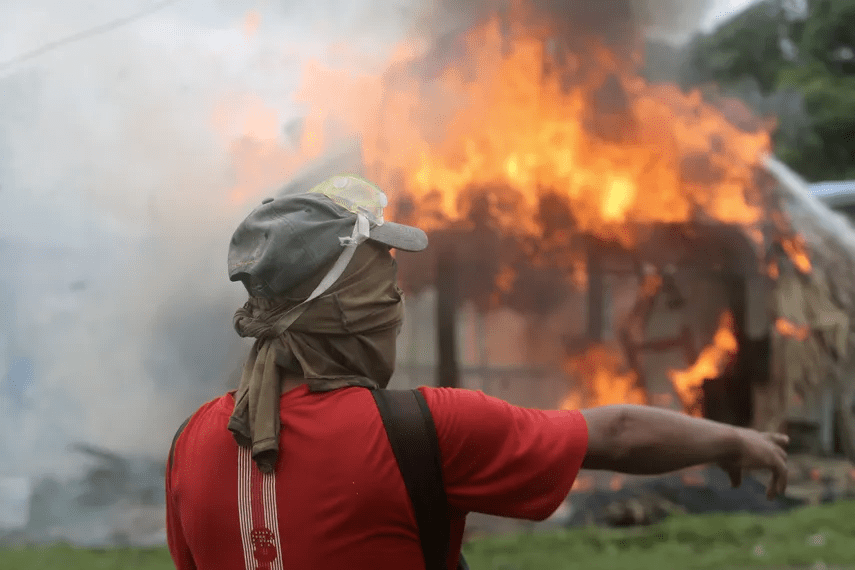
IC documented numerous cases of repression with Panamanian police forces detaining, threatening and even killing Indigenous protesters for standing up to the government of President Raúl Mulino. An Indigenous Ngäbe child also died in June as a result of exposure to tear gas that was fired by riot police.
Indigenous Peoples joined forces with teachers, doctors, trade unions, and students in a broad-based alliance that united around several key demands. Chief among them was the repeal of Law 462. Protesters also called on the government to abandon plans to reopen the controversial Cobre Panamá copper mine in Donoso and to reject proposals to dam the Río Indio as a solution to declining water levels in the Panama Canal.
Donald Trump’s return to power has led to a significant rollback of Native American rights across multiple domains, from education to sovereignty. Most recently, we saw sweeping actions to weaken protections for burial grounds, prayer sites, and ancestral landscapes across the U.S. We also saw the closure of 25 Bureau of Indian Affairs offices directly undermining treaty obligations and tribal self-governance.
Meanwhile, the fight continues to ensure Indigenous Peoples have access to clean water. As Native News Online recently reported, a whopping 50% of households on Native American Reservations still lack access to reliable water sources, clean drinking water, or adequate sanitation.
A new report details how drug traffickers are increasingly invading Indigenous territories, bringing violence, corruption, and environmental destruction in Peru’s Amazon region.
According to the report, cartels are going so far as to build illegal airstrips, bribe local officials, and threaten Indigenous leaders who defend their lands. Entire communities are being displaced or forced into silence. And the state government is doing next to nothing to stop it. The report goes on to highlight that these illegal activities have placed more than 270 Indigenous communities at risk.
A new bill is moving through Ecuador’s National Assembly that would allow private and foreign companies to run so-called “protected” areas — which means Indigenous communities could see ancestral territories sold off to the highest bidder without their free, prior, and informed consent.
Indigenous leaders are calling the bill unconstitutional — and they’re absolutely right. Protected lands stewarded by Indigenous peoples have always been more biodiverse than any national park run from a corporate boardroom. Privatization is just a new mask for the same old dispossession.
Brazil’s Congress has passed a sweeping environmental deregulation, widely dubbed the “Devastation Bill,” which dismantles decades of licensing safeguards by allowing mining, infrastructure, and agribusiness projects to bypass environmental impact assessments through self-declared online applications. Critics warn it threatens about 90% of licensing procedures in Brazil, puts 18 million hectares of forest at risk, and jeopardizes more than 3,000 protected areas. The bill also excludes untitled Indigenous and quilombola lands from impact review, stripping communities of vital rights and protections.
As Brazil prepares to host the UN’s COP30 climate summit in Belém this November, the bill’s passage has caused alarm both domestically and internationally, casting doubt on the country’s environmental leadership and climate commitments.
With the likes of Ontario’s Bill 5 and Canada’s Bill C‑5, the situation up north isn’t fairing much better. In response to these two controversial bills, First Nations have launched a growing campaign of resistance that has included protests, public walkouts, media campaigns, and grassroots organizing from communities determined to stop what many are calling a new wave of colonial development.
Nine Ontario First Nations are also taking the federal and provincial governments to court over the new laws that, they say, threaten their lands, ways of life, and fundamental rights. The nations argue that both laws effectively allow governments to approve massive undertakings such as mining in the ecologically sensitive Ring of Fire region—without meaningful environmental assessments, cultural heritage protections, or consent from First Nations.
Under President Javier Milei’s administration, Argentina has rolled back key protections for Indigenous communities, opening the doors to extractive industry expansion and widespread dispossession. In December 2024, Milei issued Decree 1083/2024, repealing the Territorial Emergency Law that recognized Indigenous peoples’ ancestral land rights and shielded them from eviction.
The repeal enabled provinces to resume enforcement of evictions and enabled large-scale investment projects, while dismantling the National Registry of Indigenous Communities and other institutions that granted formal legal recognition to Indigenous communities. Provinces like Chubut and Río Negro have seen escalating evictions, while Mapuche communities report violence, stigmatization, and labeling as “terrorists” amid state crackdowns.
Suriname’s proposed land rights bill was supposed to recognize the territorial claims of Indigenous and tribal communities. Instead, it sparked strong resistance for threatening to strip communities of meaningful control, replacing the internationally recognized principle of Free, Prior, and Informed Consent (FPIC) with a superficial consultation procedure. Under the bill, the state could override community interests by deeming projects in ancestral lands as being in the “public interest.” Communities would also be required to register as corporate entities, subjecting them to an approval processes that may judge whether they “qualify” for collective rights.
This discord follows persistent delays since 2007, when the Inter-American Court of Human Rights ruled that Suriname must respect Indigenous land rights in logging and mining concession areas. Despite this ruling, successive bills have stalled, and amendments introduced in February 2025 have intensified mistrust. Indigenous leaders warn these legislative changes may ultimately consolidate governmental power while undermining their already tenuous relationship with the state.
The stories outlined here are not isolated tragedies. They are part of a sweeping, global pattern of systemic injustice that is cloaked in the language of development, nationalism, and economic growth. From legislative rollbacks to militarized crackdowns and environmental deregulation, these actions expose a hard truth that Indigenous rights are still seen as expendable.
But these are not simply stories of suffering; they are opportunities to amplify Indigenous leadership, invest in grassroots movements, and hold governments and corporations accountable for the harms they commit.
On this International Day of the World’s Indigenous Peoples, let us all do our part to support all indigenous frontlines that organize and resist these attacks on Indigenous rights and the ecosystems they protect.
Across the world right now, Indigenous peoples are facing a renewed assault on their lands, rights, and ways of life.
From extractive industries pushing deeper into ancestral territories, to governments rolling back hard-won protections,
the threat is global—and it is growing.
What makes this moment especially dangerous is how little attention it receives.
Stories like this are disappearing in real time. Mainstream media
barely covers it and the coverage is fragmented. The public is left without the context
needed to understand what is truly at stake.
That is exactly why IC Magazine exists..
For more than 20 years, IC has reported on Indigenous struggles worldwide — consistently, independently, and without compromise.
We don’t follow news cycles; we trace patterns. We don’t sensationalize; we provide context.
And when the world looks away, we stay focused.
But this work is increasingly difficult to sustain.
We refuse to lock our reporting behind a paywall. We don’t sell access through subscriptions.
And we don’t answer to advertisers. IC Magazine survives solely because readers like you choose to
support independent Indigenous journalism.
Please donate today if you can. Every contribution helps us to continue this crucial work.
Thank you,
John Ahni Schertow
Founder and Editor in Chief