Last Updated on November 12, 2025
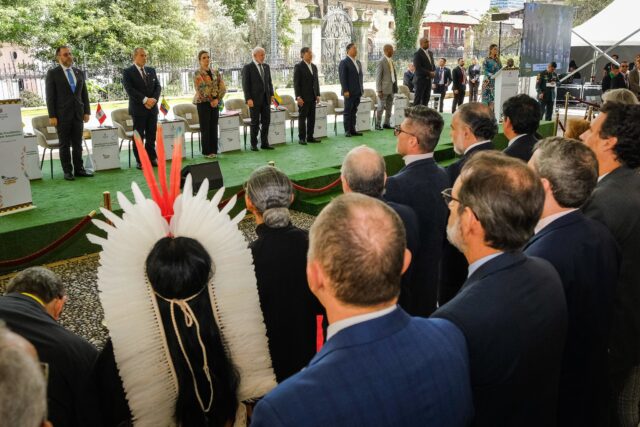
The governments of nine tropical countries recently made a joint pledge to recognize 160 million hectares, or 395 million acres, of Indigenous and other traditional lands by 2030, according to a Nov. 7 announcement at the World Leaders Summit, an event hosted ahead of the U.N. Climate Change Conference in Belém, Brazil.
The Intergovernmental Land Tenure Commitment (ILTC) marks the first time countries have come together to expand recognition for land tenure for Indigenous and other traditional land stewards.
So far, Brazil, Colombia, Costa Rica, Ecuador, Fiji, Indonesia and the Democratic Republic of Congo have signed the commitment. A breakdown of specific commitments by country has not yet been made publicly available but is expected to be announced on Nov. 17, according to the ILTC press office.
Sonia Guajajara, Brazil’s minister of Indigenous peoples, said in a press release that at least 59 million hectares (146 million acres), more than one-third of the pledge’s total commitment, would come from Brazil, the conference’s host country.
According to a 2023 report by the global advocacy group Rights and Resources Initiative, more than 1.3 billion hectares (3.2 billion acres) of land is protected by Indigenous, Afro-descendant and other traditional communities, but only 11% is formally recognized as theirs in the 73 countries analyzed.
The announcement of the ILTC was made on the same day that Norway, Germany, the U.K., the Netherlands and 35 philanthropies and donors renewed a pledge to donate $1.8 billion over four years toward land tenure.
Over the last four years, the Forest and Land Tenure Funders Group behind the pledge donated an annual average of $485 million, increasing every year. In 2024, the donors reached $527 million in donations, but only an estimated 7.6% of this was considered direct funding. In the pledge’s renewal, the donors said they would increase this percentage from 2026 onward.
“We will continue efforts to increase the share of direct, long-term, and flexible financing, ensuring communities have genuine decision-making power and influence over how funds are used,” the group’s signatories wrote in their announcement.
Referring to the new commitment, the renewed funding pledge and the launch of a new financial market fund called the Tropical Forests Forever Facility, Wanjira Mathai, managing director for Africa and global partnerships at the World Resources Institute (WRI), wrote in a statement: “Together these initiatives demonstrate a massive and welcome shift in recognizing the central role that Indigenous Peoples, Afro-descendants, and local communities play in protecting the forests that sustain us all.” WRI receives funds from at least one of the pledge’s donors.
“These pledges represent both a matter of justice for these communities, survival for our forests, and necessity for our climate goals,” Mathai added.
This article was originally published by Mongabay. It has been re-published at IC under a Creative Commons License.
Across the world right now, Indigenous peoples are facing a renewed assault on their lands, rights, and ways of life.
From extractive industries pushing deeper into ancestral territories, to governments rolling back hard-won protections,
the threat is global—and it is growing.
What makes this moment especially dangerous is how little attention it receives.
Stories like this are disappearing in real time. Mainstream media
barely covers it and the coverage is fragmented. The public is left without the context
needed to understand what is truly at stake.
That is exactly why IC Magazine exists..
For more than 20 years, IC has reported on Indigenous struggles worldwide — consistently, independently, and without compromise.
We don’t follow news cycles; we trace patterns. We don’t sensationalize; we provide context.
And when the world looks away, we stay focused.
But this work is increasingly difficult to sustain.
We refuse to lock our reporting behind a paywall. We don’t sell access through subscriptions.
And we don’t answer to advertisers. IC Magazine survives solely because readers like you choose to
support independent Indigenous journalism.
Please donate today if you can. Every contribution helps us to continue this crucial work.
Thank you,
John Ahni Schertow
Founder and Editor in Chief