
Last Updated on October 1, 2025
On August 18, 2025, tension erupted in the Andean highlands of Ecuador. Three intelligence agents of the Ecuadorian National Police were detained by The Union of Peasant Organizations of the North of Cotopaxi (Unocanc).
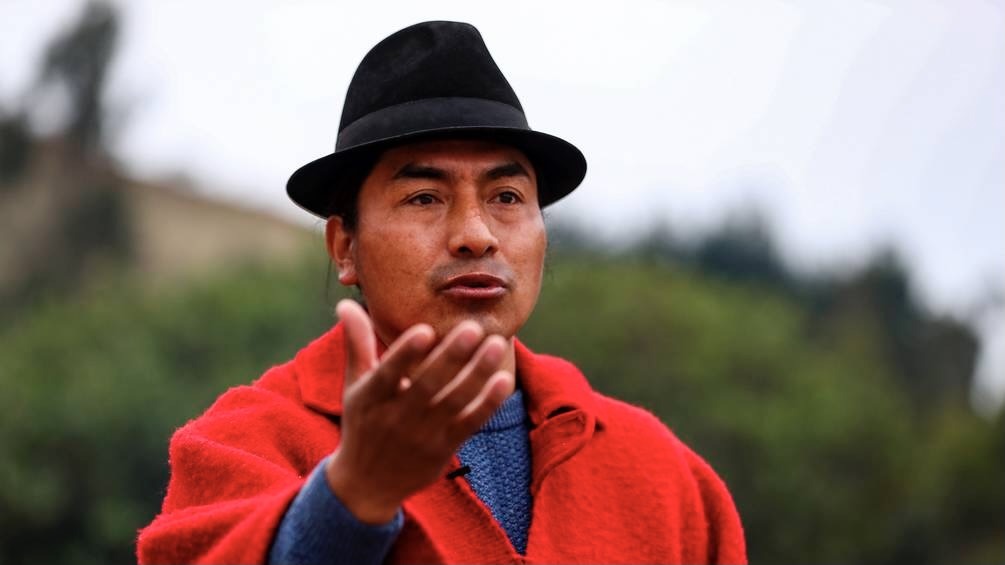
The officers were accused of carrying out “intimidating actions” while conducting surveillance near the home of the Leonidas Iza, former presidential candidate and ex-leader of the Confederation of Indigenous Nationalities of Ecuador (CONAIE).
The prominent Kichwa-Panzaleo activist said the agents entered his community without permission and photographed him near his residence. Speaking at a press conference, Iza also accused two of the agents of trying to have him killed, stating, “I stepped into the street to stop the vehicle. It accelerated toward me, and the driver halted, but the officers shouted at him to run me over,” he said.
The Indigenous and Peasant Movement of Cotopaxi (MICC), which brings together 33 organizations and 510 communities, described the surveillance as part of an “alleged assassination attempt.” The officers denied the accusation.
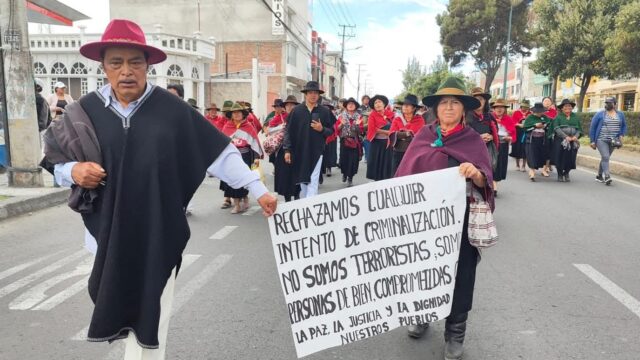
Following the incident, a traditional communal hearing was convened by the MICC in line with Ecuador’s constitutional recognition of Indigenous legal traditions.
Unlike a typical judicial proceeding, the process unfolded in a customary way, with the nawinchina (spiritual purification), allichina (presentation of charges), and finally pakatachina and kunak (the reading and approval of a communal sentence).
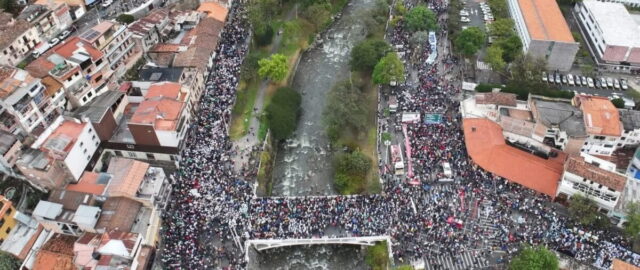
Invitations were extended to more than 500 communities, transforming the hearing into a collective affirmation of Indigenous sovereignty.
On August 21, the community sentenced the officers to deliver a public apology and barred them from returning to the community for ten years, emphasizing restoration of communal honor and safety, rather than physical harm. The agents were then released.
The state’s institutions offered mixed responses. The Attorney General’s Office (Fiscalía) acknowledged the agents were working in a “collaborative capacity” on an ongoing investigation but refused to disclose details. The police admitted they had no judicial authorization for the surveillance but insisted they were only verifying whether Iza lived at the location.
The Fiscalía also said it “respects and recognizes” Indigenous norms and called for dialogue to improve coordination between state and Indigenous justice systems.
While questions remain about the officers’ true intentions, the outcome in Cotopaxi reflects more than a local dispute. It underscores the growing role of Indigenous justice in Ecuador’s democratic landscape.
The case also made it clear that any attempt at surveillance or intrusion will be met with a firm assertion of self-governance.
Across the world right now, Indigenous peoples are facing a renewed assault on their lands, rights, and ways of life.
From extractive industries pushing deeper into ancestral territories, to governments rolling back hard-won protections,
the threat is global—and it is growing.
What makes this moment especially dangerous is how little attention it receives.
Stories like this are disappearing in real time. Mainstream media
barely covers it and the coverage is fragmented. The public is left without the context
needed to understand what is truly at stake.
That is exactly why IC Magazine exists..
For more than 20 years, IC has reported on Indigenous struggles worldwide — consistently, independently, and without compromise.
We don’t follow news cycles; we trace patterns. We don’t sensationalize; we provide context.
And when the world looks away, we stay focused.
But this work is increasingly difficult to sustain.
We refuse to lock our reporting behind a paywall. We don’t sell access through subscriptions.
And we don’t answer to advertisers. IC Magazine survives solely because readers like you choose to
support independent Indigenous journalism.
Please donate today if you can. Every contribution helps us to continue this crucial work.
Thank you,
John Ahni Schertow
Founder and Editor in Chief